



Who would have guessed it, today Google is celebrating the first demonstration of the Mechanical Televisor, which happened more than 90 years ago in 1925. The “Mechanical Televisor” are directly linked to modern day Television systems, although the technology is very different from modern day television it lead to one of the most entertaining inventions of all time.

Imagine the only way to see things was to go and see it for yourself, no full motion recordings or broadcasts. Imagine a life without Sports being broadcast over live television, or your favorite movie could not have been recorded and broadcast. No Comedy movies, no Cooking or Reality shows, and no News broadcasts. It is hard to imagine it, but before 1925 the only way to see full motion was to be a live witness to it.
Television and the invention of the Mechanical Televisor changed the world forever. On my personal rating of all time most awesome inventions the Television and Mechanical Televisor ranks high in the top 10.
What is almost even more amazing about the technology is that it was already invented in the early 1900’s. During this time there were several people and scientists exploring with ways to create motion pictures. Some of the earliest Television sets used the technology between 1920 and 1930.
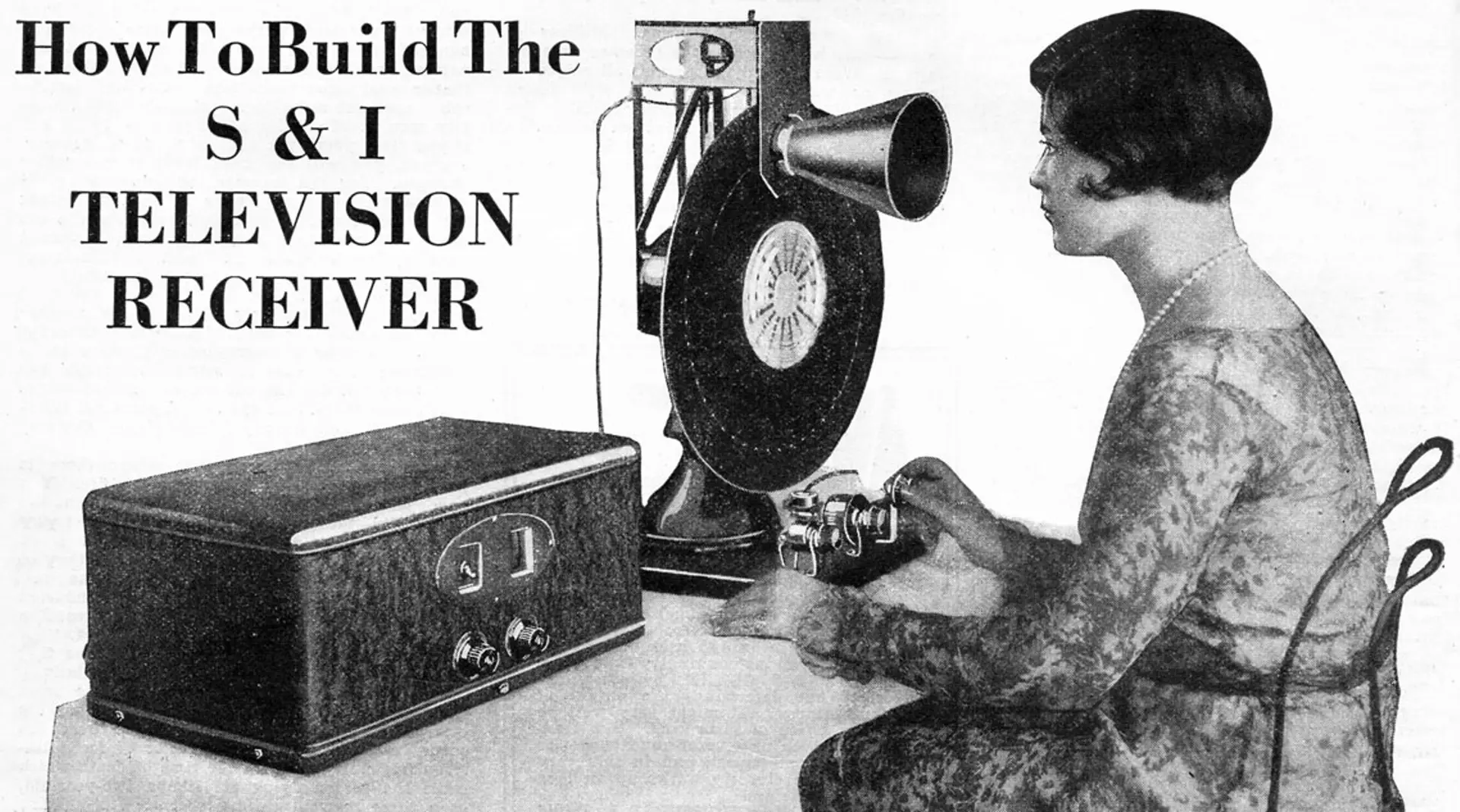
Watching a homemade mechanical-scan television receiver in 1928. The “televisor” which produces the picture uses a spinning metal disk with a series of holes in it, called a Nipkow disk, in front of a neon lamp.
Each hole in the disk passing in front of the lamp produces a scan line which makes up the image. The video signal from the television receiver unit is applied to the neon lamp, causing its brightness to vary with the brightness of the image at each point. This system produced a dim orange image about 1 1/2 inches square. Allowing one to see Motion Pictures.
Invention of the television was work of many people in the 19th century and early 20th century.
Facsimile transmission systems for still photographs pioneered methods of mechanical scanning of images in early 19th century. Alexander Bain introduced the facsimile machine in 1843 to 1846. Frederick Bakewell demonstrated a working laboratory version in 1851.
Willoughby Smith discovered the photoconductivity of the element selenium in 1873, laying the groundwork for the selenium cell phototube which was used as a pickup in most mechanical scan systems.
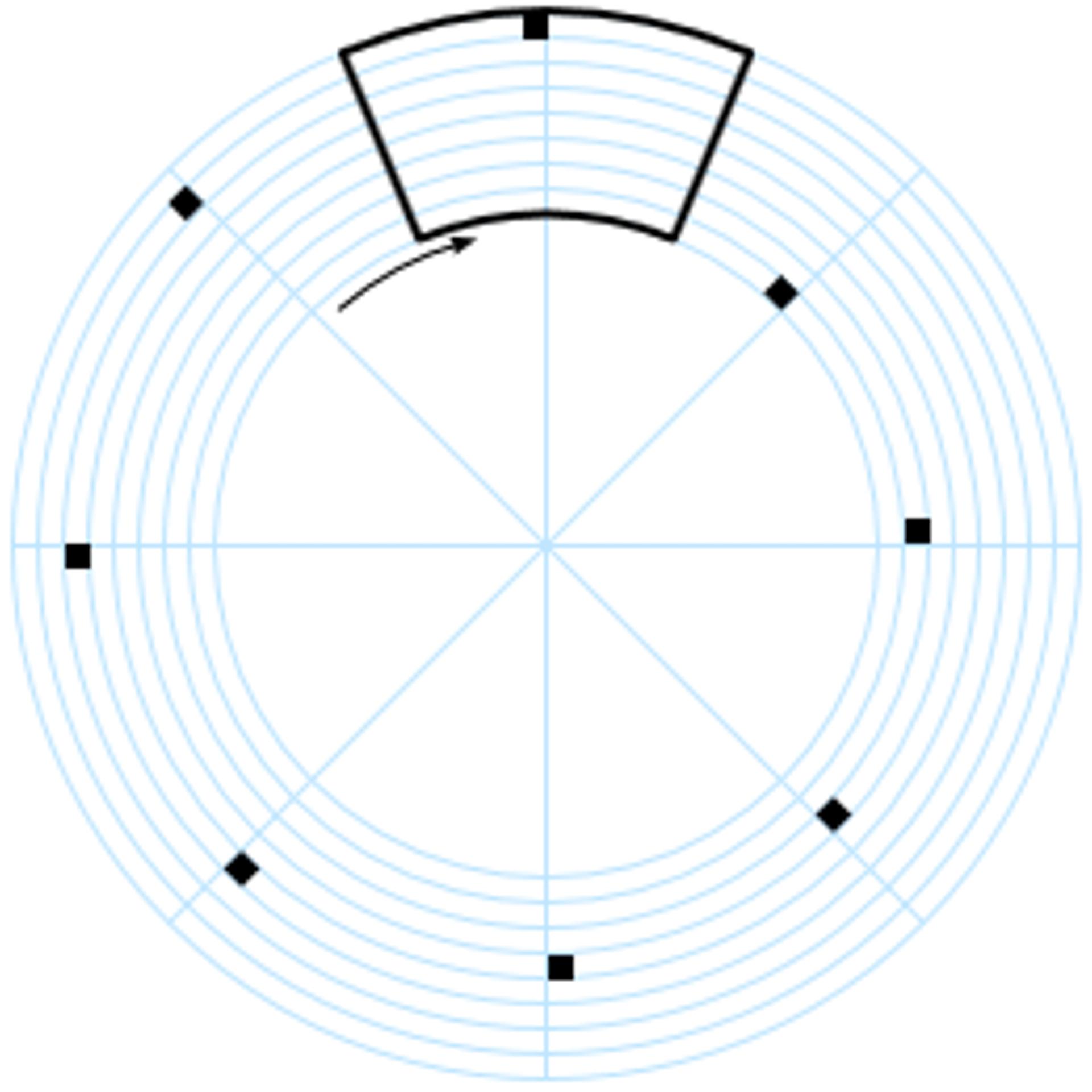
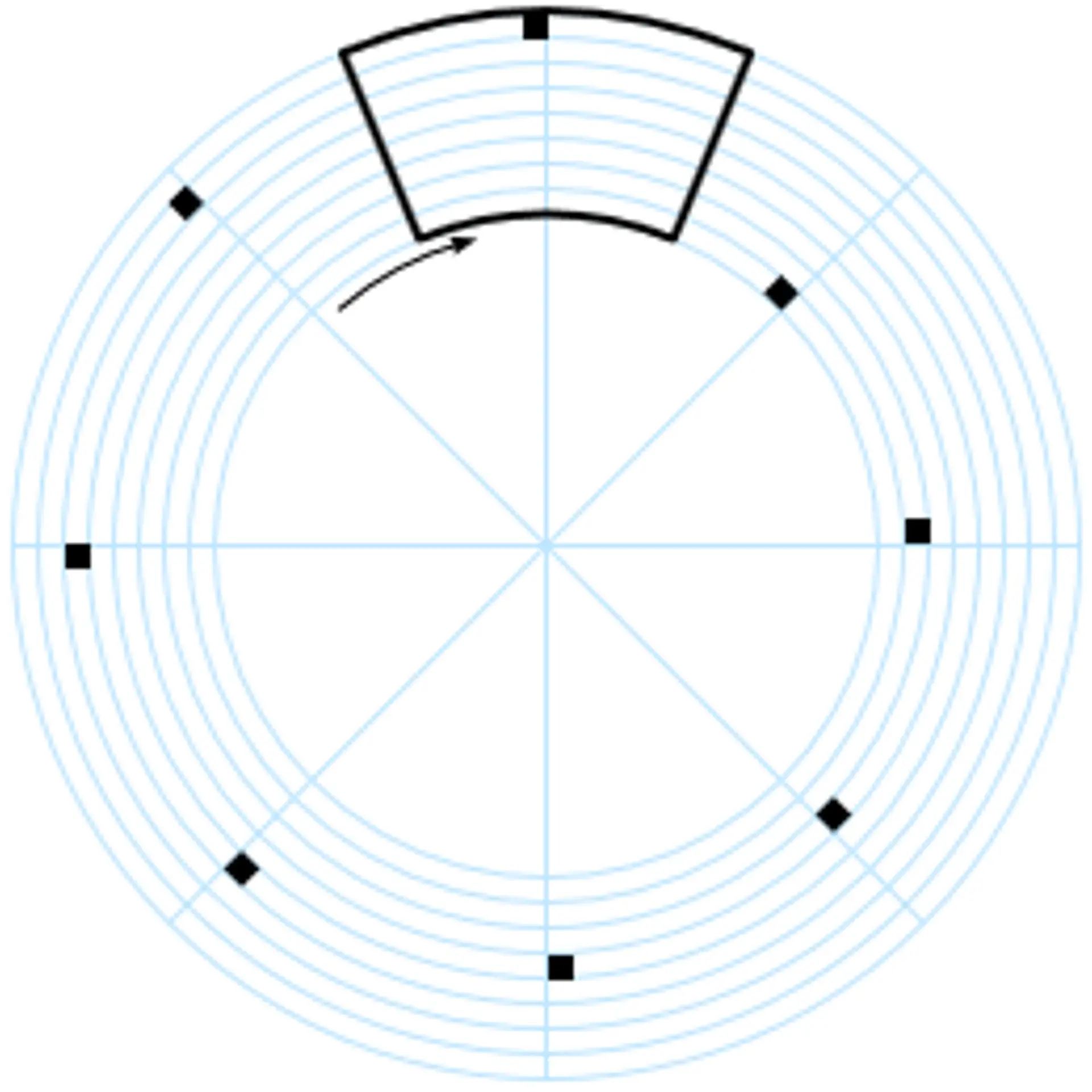
The Nipkow disk. This schematic shows the circular paths traced by the holes, that may also be square for greater precision. The area of the disk outlined in black shows the region scanned.
As a 23-year-old German university student, Paul Julius Gottlieb Nipkow proposed and patented the Nipkow disk in 1884. This was a spinning disk with a spiral pattern of holes in it, so each hole scanned a line of the image. Although he never built a working model of the system, Nipkow’s spinning-disk “image rasterizer” was the key mechanism used in most mechanical scan systems, in both the transmitter and receiver.
Constantin Perskyi had coined the word television in a paper read to the International Electricity Congress at the International World Fair in Paris on August 25, 1900. Perskyi’s paper reviewed the existing electromechanical technologies, mentioning the work of Nipkow and others.
However, it was not until 1907 that developments in amplification tube technology, by Lee de Forest and Arthur Korn among others, made the design practical.
The first demonstration of the instantaneous transmission of images was by Georges Rignoux and A. Fournier in Paris in 1909. A matrix of 64 selenium cells, individually wired to a mechanical commutator, served as an electronic retina. In the receiver, a type of Kerr cell modulated the light and a series of variously angled mirrors attached to the edge of a rotating disc scanned the modulated beam onto the display screen. A separate circuit regulated synchronization. The 8×8 pixel resolution in this proof-of-concept demonstration was just sufficient to clearly transmit individual letters of the alphabet. An updated image was transmitted “several times” each second.
In 1911, Boris Rosing and his student Vladimir Zworykin created a system that used a mechanical mirror-drum scanner to transmit, in Zworykin’s words, “very crude images” over wires to the “Braun tube” (cathode ray tube or “CRT”) in the receiver. Moving images were not possible because, in the scanner, “the sensitivity was not enough and the selenium cell was very laggy”.
First Demonstration of the Mechanical Televisor
By the 1920s when amplification made television practical, Baird employed the Nipkow disk in his prototype video systems.
On March 25, 1925, Scottish inventor John Logie Baird gave the first public demonstration of televised silhouette images in motion, at Selfridge’s Department Store in London.
Since human faces had inadequate contrast to show up on his primitive system, he televised a ventriloquist’s dummy named “Stooky Bill” talking and moving, whose painted face had higher contrast. By January 26, 1926 he demonstrated the transmission of image of a face in motion by radio.
This is widely regarded as first television demonstration. Baird’s system used the Nipkow disk for both scanning the image and displaying it. A bright light shining through a spinning Nipkow disk set with lenses projected a bright spot of light which swept across the subject.
Selenium photoelectric tube detected the light reflected from the subject and converted it into a proportional electrical signal.
This was transmitted by AM radio waves to a receiver unit, where the video signal was applied to a neon light behind a second Nipkow disk rotating synchronized with the first. The brightness of the neon lamp was varied in proportion to the brightness of each spot on the image. As each hole in the disk passed by, one scan line of the image was reproduced.
Baird’s disk had 30 holes, producing an image with only 30 scan lines, just enough to recognize a human face. In 1927, Baird transmitted a signal over 438 miles (705 km) of telephone line between London and Glasgow. In 1928, Baird’s company (Baird Television Development Company/Cinema Television) broadcast the first transatlantic television signal, between London and New York, and the first shore-to-ship transmission.
In 1929, he became involved in the first experimental mechanical television service in Germany. In November of the same year, Baird and Bernard Natan of Pathé established France’s first television company, Télévision-Baird-Natan. In 1931, he made the first outdoor remote broadcast, of the Epsom Derby In 1932, he demonstrated ultra-short wave television. Baird’s mechanical system reached a peak of 240-lines of resolution on BBC television broadcasts in 1936 though the mechanical system did not scan the televised scene directly. Instead a 17.5mm film was shot, rapidly developed and then scanned while the film was still wet.
Awesome Invention that lead to the Modern Day Television
I really loved the Google Doodle today March 25, 2015 about the invention of the Mechanical Televisor, I always thought that Television was invented as “Television” and while doing the research for this article it was interesting to discover that “Television” was a result of the discovery of the Mechanical Televisor!


