



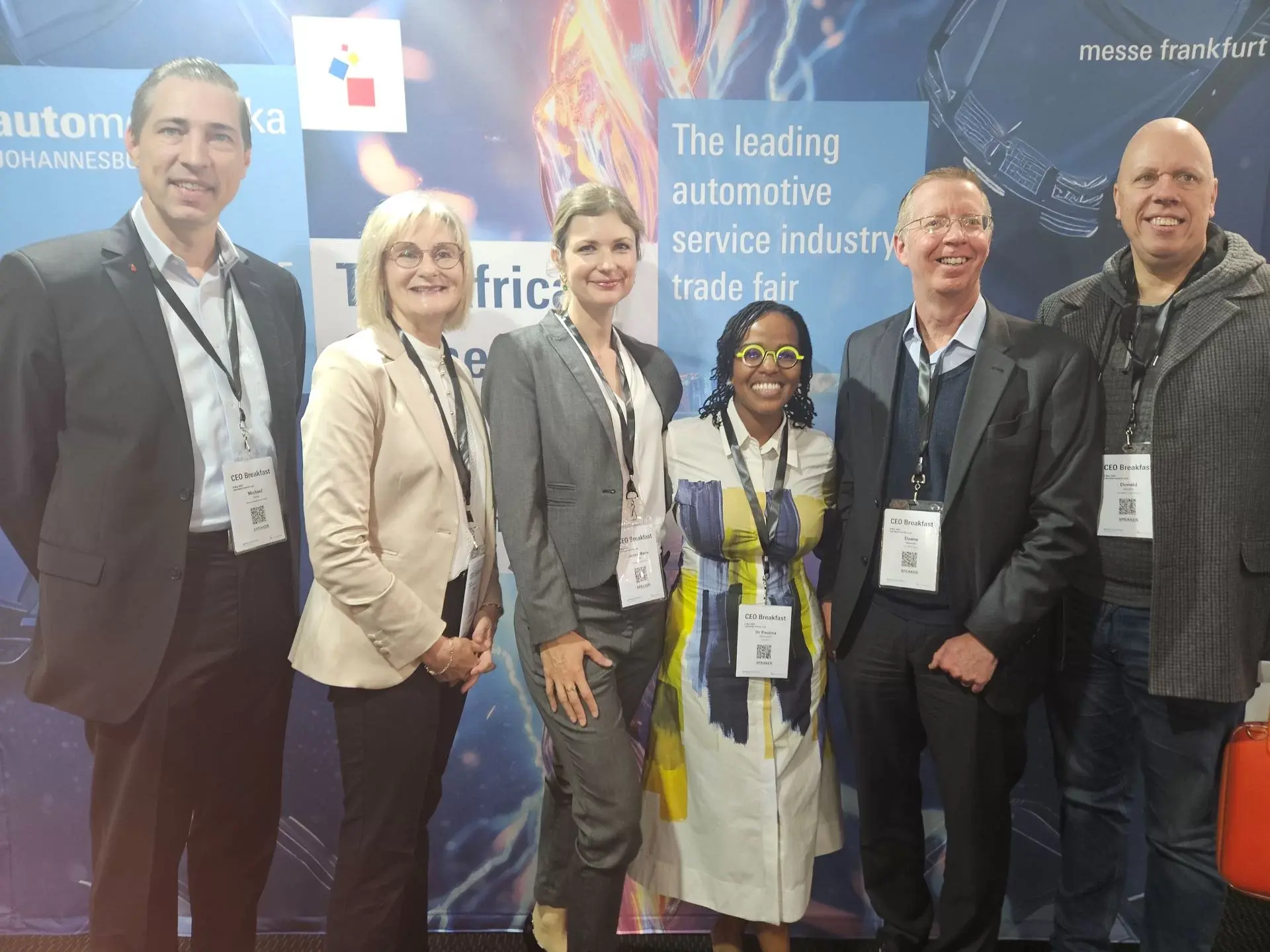
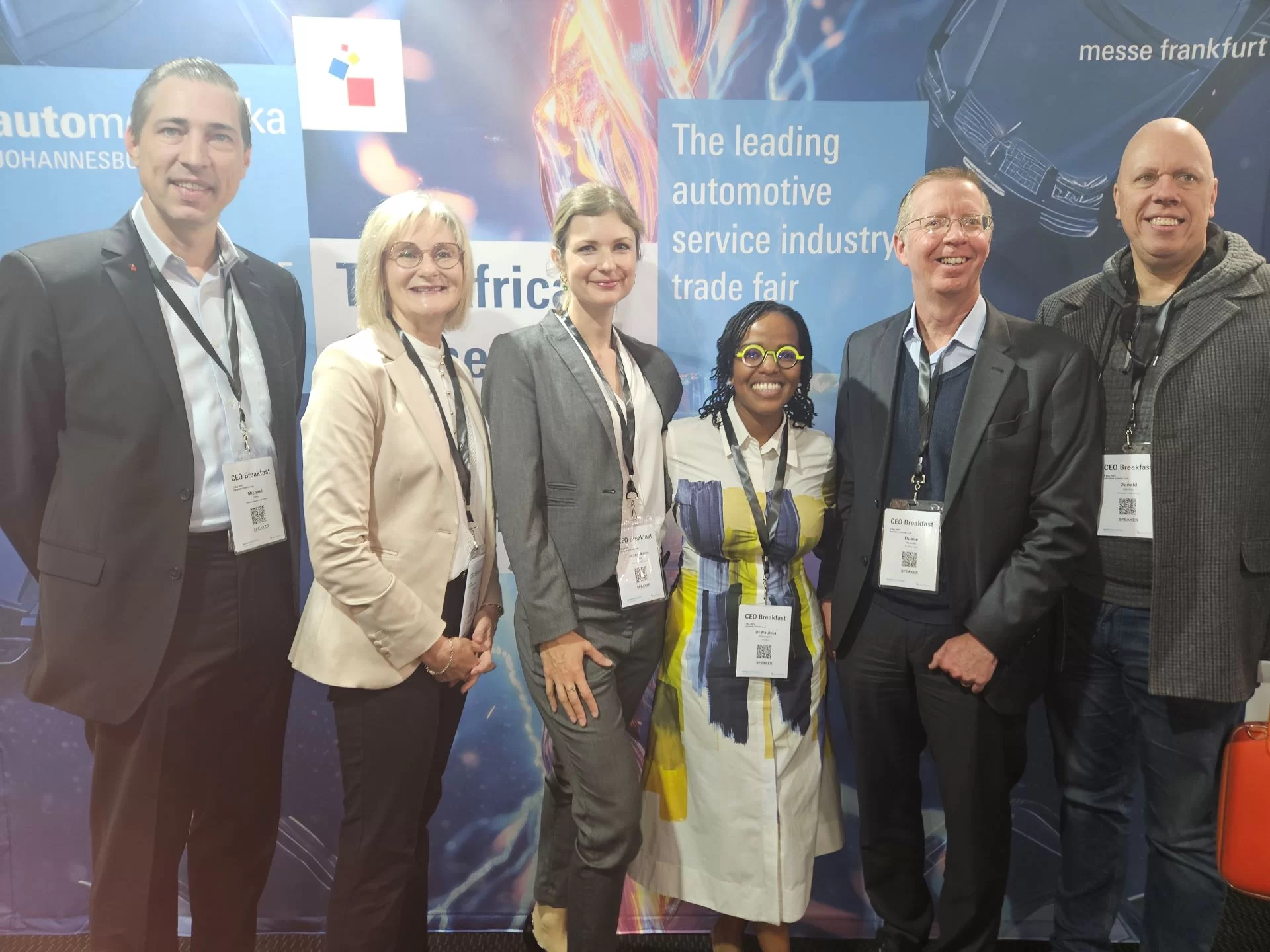
On Thursday, 8 May, the Centurion Country Club became the focal point for high-level dialogue on the future of South Africa’s automotive industry. Hosted by Messe Frankfurt South Africa, the latest Automechanika CEO Breakfast carried the timely theme “The African Connection”, uniting industry leaders and policy experts in a candid exploration of shifting trade dynamics and regional opportunities.
Charting New Routes Amid Shifting Trade Tides
“With trade agreements, tariffs and geopolitical alliances in flux, South African automotive companies are actively seeking new avenues for growth,” remarked Michael Dehn, Managing Director at Messe Frankfurt South Africa, during his opening address.
As Dehn explained, the rapidly changing global order—marked by the African Continental Free Trade Area (AfCFTA), AGOA renegotiations, and the evolving role of BRICS—demands not only adaptability but also proactive repositioning by industry players.
And the stakes are high.
Recent tariff hikes by the United States—25% on vehicles and components and a new 10% baseline on all imports—have disrupted long-standing trade flows. Until recently, 99% of South African automotive exports entered the US duty-free under AGOA. That lifeline has been abruptly curtailed, prompting the industry to reevaluate its export strategies.
Uneven Ground: US Relations and Export Rebalancing
Dr. Paulina Mamogobo, Chief Economist at NAAMSA, noted a dramatic shift in export trends. “Exports to the US fell from 6% in 2024 to just 2% in Q1 of 2025, even before full enforcement of the tariffs,” she stated, highlighting how the threat alone has reshaped trade behaviour.
Yet, this drop has not spelled disaster—at least not yet. “We’ve seen a reallocation of export destinations,” Mamogobo continued, hinting at a strategic pivot toward other regions, including intra-African trade. The full scope of these shifts will be detailed in NAAMSA’s upcoming Automotive Trade Manual, set for release on 15 May.
Mamogobo sees the AfCFTA as South Africa’s most promising countermeasure—a $3.4 trillion opportunity designed to eliminate tariffs and strengthen continental trade. But infrastructure gaps remain a major hurdle to realising its full potential.
Competing in an Overcrowded Global Market
While South Africa reconfigures its export strategy, the global automotive chessboard grows ever more complex.
Ronel Oberholzer, Head of Sub-Saharan Africa Economics at S&P Global Market Intelligence, warned of intensified competition as China’s surplus of electric vehicles—propelled by state incentives—begins to flood African markets. India’s cost leadership further adds pressure. “BRICS is not so much a market for South African exports as it is a launchpad for investment into Africa,” she said.
This sentiment was echoed by Jenny Tala, Director for Southern Africa at Germany Trade & Invest. “The new US tariffs effectively erase the benefits South Africa once enjoyed under AGOA,” she said. Her advice: diversify. “We must expand regional and international trade ties to safeguard our automotive competitiveness.”
Silver Linings in a Stormy Climate?
Not all perspectives were bleak. Duane Newman, Partner at EY South Africa, sees opportunity amid the turmoil. The Trump administration’s protectionist stance, paired with a reduced focus on New Energy Vehicles (NEVs), could open doors for South African ICE (internal combustion engine) vehicle manufacturers.
“There’s a strategic advantage here,” Newman noted. “As global manufacturers look to decentralise production away from Mexico and China, South Africa can attract investment and become a reliable node in diversified supply chains.”
Infrastructure: The Elephant on the Road
But tapping into this potential requires more than smart strategy—it demands solid infrastructure.
Donald MacKay, CEO at XA Global Trade Advisors, pointed to the prohibitively high costs of road freight and underutilisation of rail. “Rail transport is half the cost of road but still five times more expensive than sea freight. That speaks volumes about our logistical inefficiencies,” he cautioned. For the AfCFTA to succeed, Africa needs infrastructure investment as robust as its trade ambitions.
The Power of Connection
Despite the challenges, the event closed on an optimistic note. “Exhibitions like Automechanika Johannesburg remain critical platforms where these essential connections are made,” Dehn concluded. “Even in a volatile global market, these forums offer clarity, collaboration and forward motion.”
As the road ahead bends and shifts with geopolitical winds, South Africa’s automotive industry is clearly not sitting idle. It is steering toward a reimagined future—one trade deal, infrastructure project, and business alliance at a time.


