



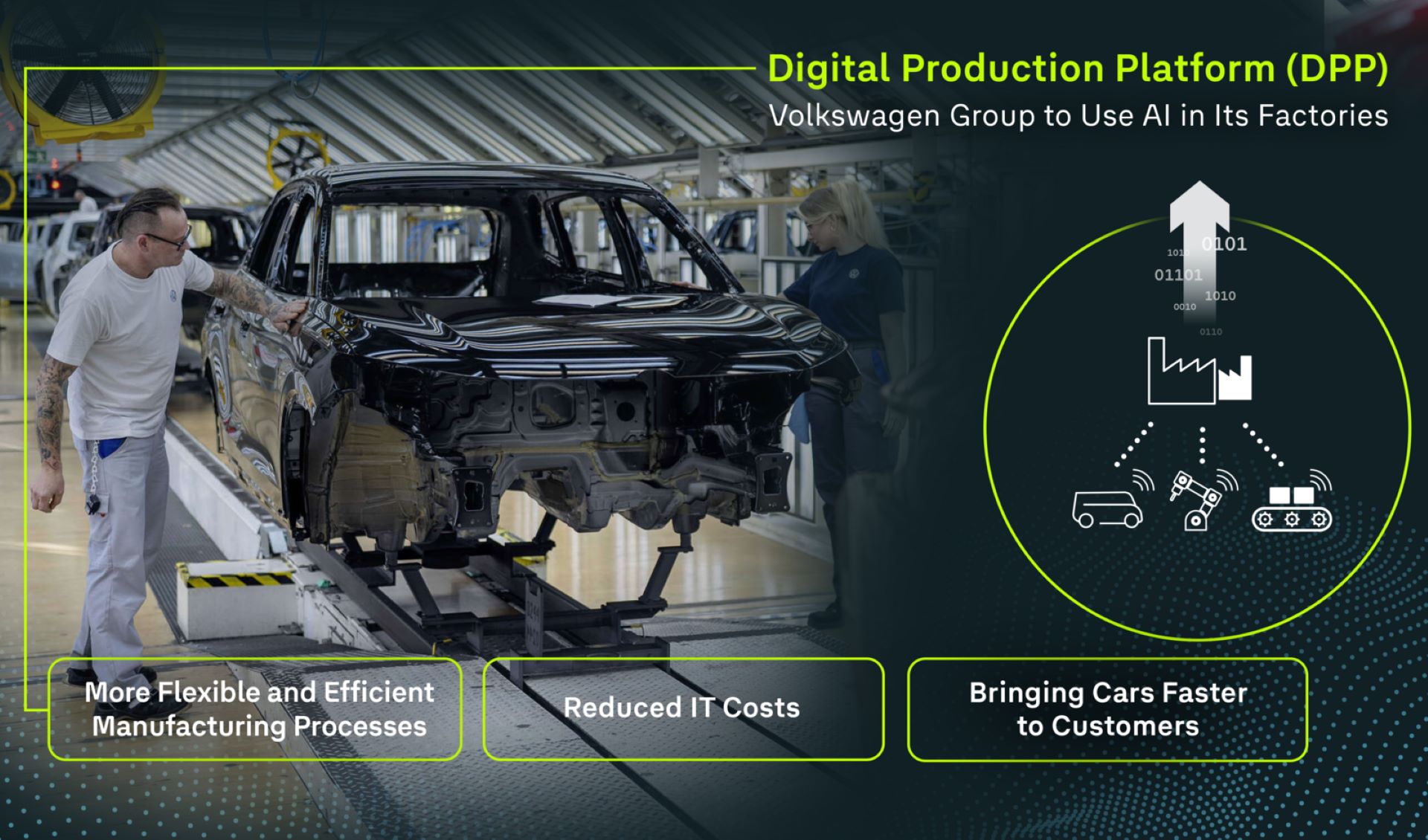
Volkswagen Group is accelerating the digital transformation of its vehicle production, harnessing artificial intelligence (AI) and advanced IT systems across its global operations. The company has extended its partnership with Amazon Web Services, Inc. (AWS) for another five years to advance the Digital Production Platform (DPP) – Volkswagen’s “factory cloud” – which now connects 43 production sites worldwide.
Originally conceived as an industrial partner network, the DPP has evolved into a central digital hub linking order intake, logistics, and manufacturing. This seamless data integration enables standardized deployment of IT systems across factories, supports AI-driven workflows, and accelerates new model launches. Ultimately, it forms the backbone for Volkswagen’s future of software-defined vehicles (SDVs).
“Our goal is to be the global leader in automotive technology. By digitalizing and connecting all aspects of our operations, we can bring products and innovations to our customers faster than ever,” said Hauke Stars, Board Member for IT at Volkswagen Group. “The DPP acts as the digital nervous system of our factories, enabling AI-powered production at scale.”
Efficiency, Cost Savings, and Standardization
Volkswagen is now able to deploy key IT solutions, such as the “Guided Vehicle Completion” system, uniformly across plants, optimizing complex assembly processes. The cloud-based infrastructure provided by AWS ensures high system availability and reduces the risk of production interruptions. Standardized systems have already generated savings in the double-digit million range while creating a unified data foundation for technologies like AI.
AI applications under the DPP now exceed 1,200 across Volkswagen Group operations, enhancing quality control, energy efficiency, and sustainability. At the Poznań plant in Poland, AI-driven optimization of electricity consumption has cut energy costs by 12% and reduced CO₂ emissions. Predictive maintenance, remote quality monitoring, and real-time image analysis at sites such as Wolfsburg and Ingolstadt are improving production accuracy and efficiency.
Resilience and Flexibility
Continuous access to production data allows Volkswagen to respond swiftly to supply chain disruptions, enhancing operational resilience. Centralized standards also strengthen cybersecurity and system reliability, ensuring production remains agile under varying conditions.
“Our high-performance production capabilities are a cornerstone of Volkswagen Group’s success,” said Christian Vollmer, Board Member for Production and Logistics. “By integrating development and manufacturing through a shared, AI-ready data structure, we can deliver vehicles to customers faster and more efficiently.”
Preparing for Software-Defined Vehicles
Looking ahead, the DPP will underpin Volkswagen’s transition to software-defined vehicles, where core functionalities are managed and updated through software. AI solutions like KI4UPS will be adapted to the next-generation electronics architecture developed in partnership with Rivian Automotive, enabling rapid deployment of software updates during production.
“Volkswagen is setting new standards for smart manufacturing,” said Kathrin Renz, Vice President of AWS Industries. “Our extended collaboration leverages AWS cloud, IoT, and machine learning services alongside Volkswagen’s manufacturing expertise to fast-track AI-driven innovations throughout production.”
By combining cloud-based infrastructure, AI, and standardized systems, the DPP is establishing Volkswagen’s factories as global benchmarks for efficiency, resilience, and future-ready vehicle production, while aligning with industry standards like Catena-X.