



A Market That Refuses to Slow Down
South Africa’s used car market may have taken a slight breather in September 2025, but it remains one of the most resilient and revealing indicators of the country’s automotive sentiment. Despite a minor month-on-month dip, the sector continues to surge ahead year-on-year — proving that the local appetite for reliable, affordable mobility has never been stronger.
According to the latest AutoTrader data, 33,907 used vehicles changed hands during September 2025. While this marks a modest -3.2% decline from August, it represents an impressive +16.4% increase compared to the same month last year. The figures tell a clear story: even as economic headwinds persist, South Africans are not shying away from the pre-owned market. They are simply buying smarter.
From Status to Substance
The shift in consumer behaviour is unmistakable. The allure of prestige badges is dimming, replaced by a focus on practicality, dependability, and long-term value. As George Mienie, CEO of AutoTrader South Africa, notes, “The ongoing strength in entry-level hatch and bakkie sales reflects a pragmatic shift among local buyers. They’re prioritising value, reliability, and practicality over brand prestige.”
This sentiment is reflected across the sales charts. Toyota, Volkswagen, and Ford continue to dominate, collectively accounting for more than a third of all used car transactions. Yet, it’s not the luxury lines or performance models drawing attention — it’s the everyday workhorses and wallet-friendly hatchbacks that are moving off forecourts fastest.
The Usual Suspects — and Some Rising Stars
Toyota once again tops the used car brand leaderboard, recording 5,638 units sold in September 2025. Volkswagen follows with 4,743 units, while Ford rounds out the top three at 3,423. Hyundai and Suzuki remain steady in fourth and fifth, while BMW and Mercedes-Benz — the only premium marques in the top 10 — continue to slip down the rankings.
Interestingly, BMW was the only brand among the top performers to show month-on-month growth (+2%), while Kia and Renault experienced the sharpest declines (-7%). On a year-on-year basis, however, the overall picture brightens considerably. Hyundai and Kia both recorded exceptional growth of +61%, outpacing the steady double-digit increases from the top three brands. Renault also impressed with +17% growth, while Nissan and Mercedes-Benz saw minor contractions.
This dynamic reveals two important truths: buyers remain loyal to trusted brands, but they’re increasingly chasing affordability over aspiration.
Hatchbacks and Bakkies: The Backbone of the Market
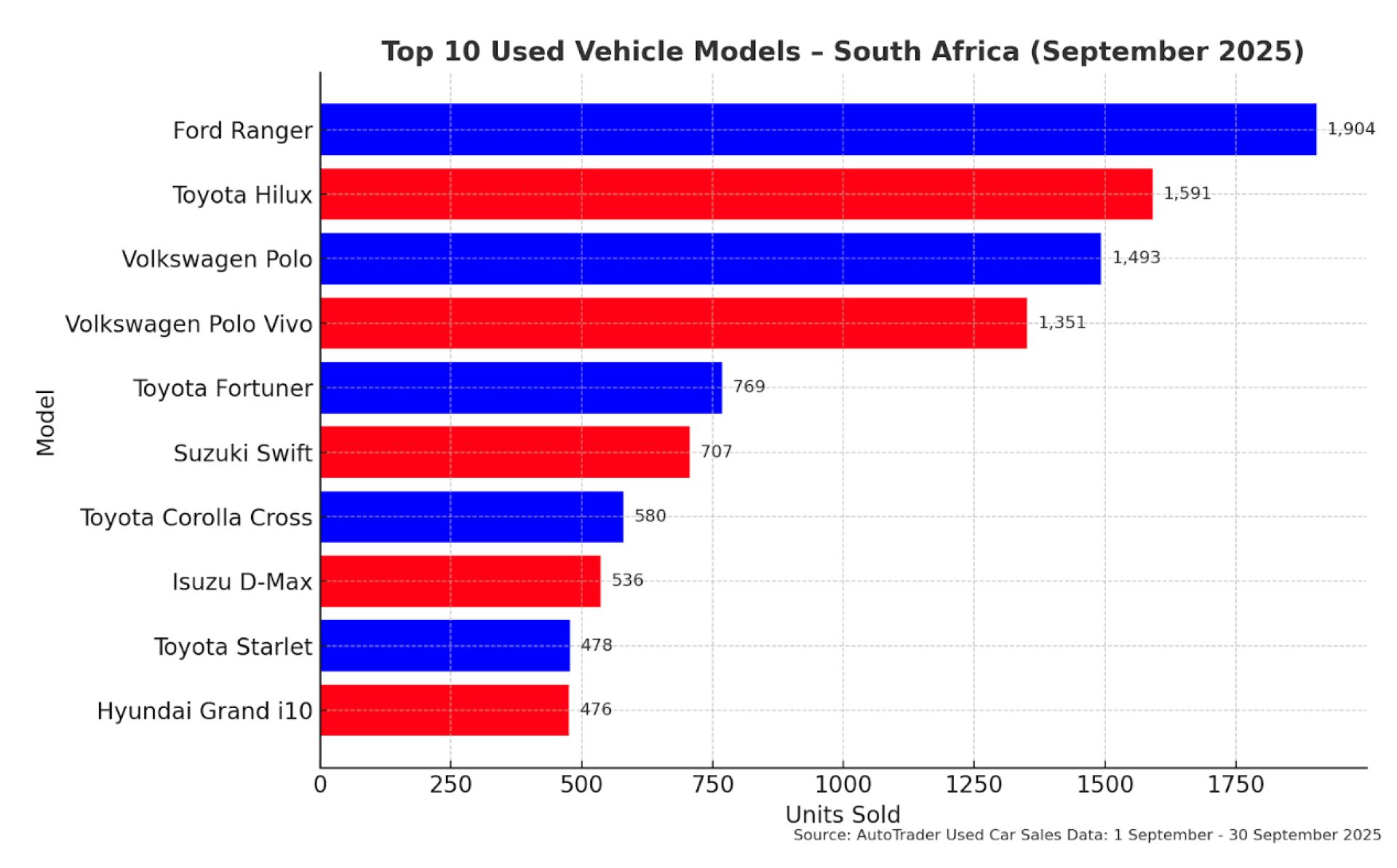
On the model front, the Ford Ranger continues to be South Africa’s undisputed favourite, with 1,904 used units sold in September. Close behind, the Toyota Hilux racked up 1,591 units — a rivalry as fierce on the used market as it is in the new. The Volkswagen Polo and Polo Vivo occupy the next two spots, their enduring appeal rooted in fuel efficiency, low maintenance costs, and accessible pricing. The Toyota Fortuner, a perennial family favourite, rounds out the top five.
Notably, the resurgence of compact hatchbacks is reshaping the lower end of the market. Models like the Toyota Starlet (478 units) and Hyundai Grand i10 (476 units) are climbing fast, while the Suzuki Swift (707 units) and Toyota Corolla Cross (580 units) demonstrate that small cars with strong reputations for reliability are the new status symbols.
These models aren’t just selling well — they’re surging year-on-year. The Grand i10 has more than doubled its performance, with sales up by a remarkable +121.4%. The Corolla Cross saw a +67.1% increase, and the Swift gained +47%. It’s a clear reflection of consumer priorities: practicality, economy, and peace of mind now outrank flashier alternatives.
The Numbers Behind the Narrative
The cumulative value of used car transactions in September 2025 reached R13.83 billion, a slight -3.8% decrease from August’s R14.38 billion but a robust +19.4% jump from the R11.59 billion recorded in September 2024.
The average used car sold for R416,302 — a small dip from August’s figure but still higher than last year’s R405,154. Meanwhile, average mileage edged up slightly to 73,447 km, though vehicles remain newer and lower-mileage compared to 2024, when the average stood at 75,585 km.
These figures point to a steady stream of high-quality stock and a consumer base confident enough to buy, but discerning enough to demand value.
Brand Breakdown: Familiar Names, Evolving Roles
Volkswagen’s Polo Vivo 1.4 remains South Africa’s most popular used vehicle variant, with 1,063 units sold last month. It’s followed by the Polo 1.0 TSI (971 units), reinforcing VW’s grasp on the small-car segment. The Hilux 2.8 GD-6 (690 units) and Ranger XL (628 units) dominate the utility category, while the Hilux 2.4 GD-6 (558 units) underscores Toyota’s wide-reaching versatility.
In the broader market rankings:
- Ford Ranger: 1,904 units | Avg. Price: R480,031 | Avg. Mileage: 84,416 km | Avg. Age: 4 years
- Toyota Hilux: 1,591 units | Avg. Price: R465,006 | Avg. Mileage: 109,549 km | Avg. Age: 5 years
- VW Polo: 1,493 units | Avg. Price: R271,809 | Avg. Mileage: 69,927 km | Avg. Age: 5 years
- VW Polo Vivo: 1,351 units | Avg. Price: R202,098 | Avg. Mileage: 53,714 km | Avg. Age: 4 years
- Toyota Fortuner: 769 units | Avg. Price: R482,910 | Avg. Mileage: 108,167 km | Avg. Age: 6 years
This mix of durable bakkies and compact hatchbacks reveals a consumer base increasingly motivated by practical needs — commuters, families, and entrepreneurs who see vehicles as long-term assets rather than luxury statements.
A Confident Market in Transition
Although September’s dip may suggest a plateau in growth, the broader trajectory of South Africa’s used car sector remains upward. The market is buoyed by strong consumer confidence, accessible finance options, and a stable supply of well-maintained stock — all underpinned by a growing recognition that value and reliability are the new badges of honour.
Where luxury once dictated aspiration, longevity and efficiency now define it. The modern South African car buyer isn’t buying for applause; they’re buying for assurance. And in a market where every rand counts, the vehicles that promise the most — and deliver on it — are the ones steering the country forward.


