




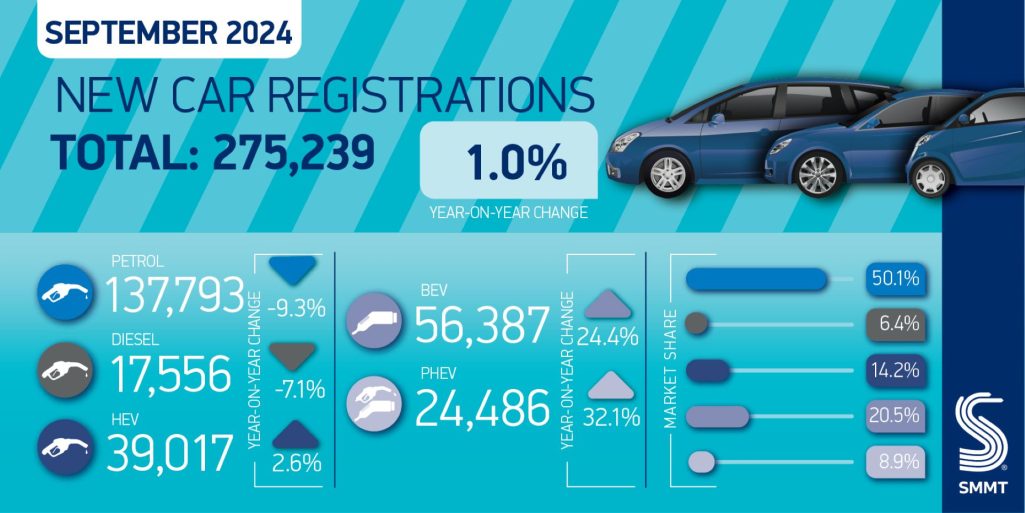
The UK’s new car market saw a modest rise of 1.0% in September 2024, as EV discounting from manufacturers propped up demand during the key ‘74’ plate change month. The Society of Motor Manufacturers and Traders (SMMT) reported 275,239 new vehicle registrations for the month, making it the strongest September performance since 2020, but still 19.8% below pre-pandemic levels from 2019.
Despite the slight market growth, the underlying dynamics reveal significant challenges, especially concerning the adoption of electric vehicles (EVs). September witnessed a record-breaking 56,387 battery electric vehicle (BEV) registrations, largely driven by aggressive manufacturer discounting. This pushed the year-to-date BEV market share to 17.8%, with expectations of it reaching 18.5% by year-end. However, this growth remains insufficient to meet the government’s zero-emission vehicle mandate.
Fleet Demand Outpaces Private Consumers
A breakdown of September’s figures highlights a dichotomy between fleet and private consumer demand. Fleet purchases increased by 3.7%, accounting for 54.2% of the market, while private consumer registrations dropped by 1.8%. The business sector faced the sharpest decline, with volumes falling by 8.4%. These shifts suggest that while corporate entities continue to invest in new vehicle fleets, individual buyers are more hesitant, likely due to the high upfront costs of BEVs and persistent concerns about charging infrastructure.
BEV registrations soared by 24.4% compared to the same period last year, achieving a market share of 20.5% in September, up from 16.6% in 2023. However, much of this growth was driven by fleet demand, with 75.9% of BEV registrations attributed to corporate buyers. In contrast, private demand rose by a mere 3.6%, resulting in only 410 additional BEV purchases despite unprecedented discounting. Diesel-powered vehicles saw a faster rate of growth among private consumers, with demand rising 17.1% in September, underscoring the continued reliance on traditional fuel types.
Plug-in Hybrids Show Rapid Growth
One of the month’s standout performers was the plug-in hybrid electric vehicle (PHEV) segment, which grew by an impressive 32.1%, capturing 8.9% of the market. Hybrid electric vehicles (HEVs) also saw modest growth, with registrations up by 2.6%, contributing to a 14.2% market share. By contrast, both petrol and diesel registrations continued their downward trend, declining by 9.3% and 7.1% respectively. However, despite this reduction, internal combustion engine vehicles still accounted for 56.4% of the total market, proving their enduring appeal amid the EV transition.
The Challenge of BEV Adoption
While September’s BEV figures might suggest that the electric revolution is gathering pace, a closer look reveals significant obstacles to mass-market adoption. Year-to-date private BEV demand remains down 6.3%, with high upfront costs and concerns about the UK’s charging infrastructure hampering consumer confidence. Despite recent investments, the pace of infrastructure development has not kept up with demand, leaving many potential buyers wary of making the switch to electric.
The situation has prompted the SMMT and major vehicle manufacturers to call on the government for urgent support. In a letter to the Chancellor, the SMMT outlined several measures to accelerate the EV transition. These include halving VAT on new EV purchases, scrapping the VED ‘expensive car’ tax supplement for zero-emission vehicles (ZEVs), equalising VAT on public charging, and maintaining business incentives like the Benefit in Kind scheme and the Plug-in Van Grant.
According to Mike Hawes, SMMT Chief Executive, while the record EV performance in September is promising, the current market trajectory threatens the industry’s environmental ambitions. “Despite manufacturers spending billions on both product and market support, the market is not growing quickly enough to meet mandated targets. The Chancellor must use the forthcoming Budget to introduce bold measures on consumer support and infrastructure to get the transition back on track.”
The Path Forward
As the UK approaches a critical juncture in its journey toward zero-emission mobility, it’s clear that more robust government intervention is required. Manufacturers cannot continue to bear the financial burden of deep discounting indefinitely. Without more substantial consumer incentives and a reliable, expansive charging infrastructure, the transition to electric vehicles risks stalling, putting both environmental goals and the automotive industry’s future viability at risk.
The coming months will be crucial in determining whether the UK can overcome these hurdles and maintain its position as a leader in the global shift to sustainable transportation. With the SMMT and major manufacturers pushing for urgent government action, all eyes will be on the Chancellor’s upcoming Budget to see whether these calls for support will be answered.


