



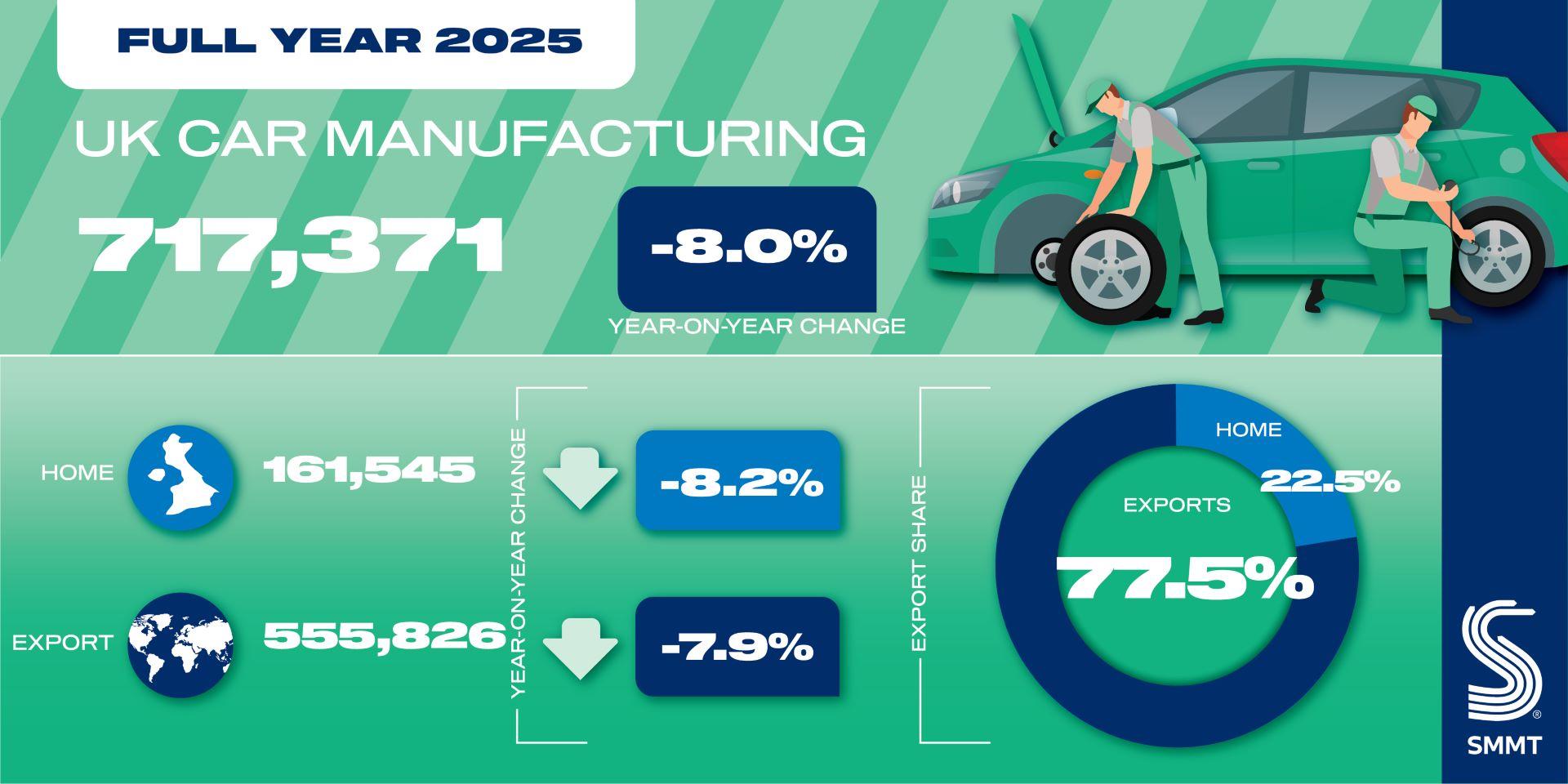
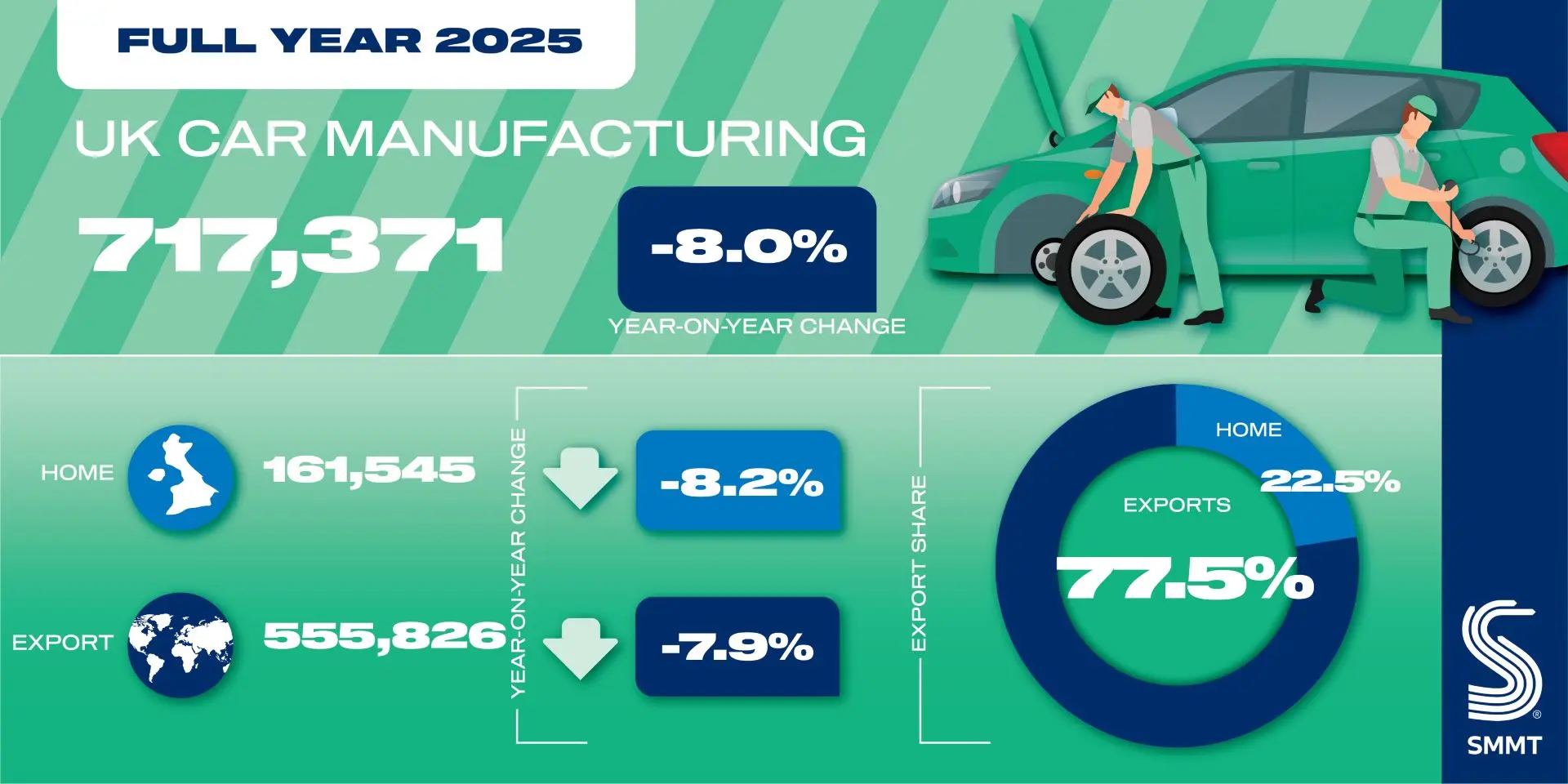
UK vehicle manufacturing endured a difficult 2025, with output falling sharply as the industry navigated structural change, trade uncertainty and operational disruption. According to figures released today by the Society of Motor Manufacturers and Traders (SMMT), total car and commercial vehicle production declined by 15.5% last year to 764,715 units, underlining what the sector has described as its toughest year in a generation.
Factories produced 717,371 cars and 47,344 commercial vehicles during the year. While car output fell by a comparatively modest 8.0%, commercial vehicle volumes collapsed by 62.3%, reflecting the consolidation of production sites, ongoing restructuring and weaker demand. Production was further constrained by a cyber incident that halted output at the UK’s largest automotive employer, alongside new tariffs affecting transatlantic trade and the broader transition towards decarbonised manufacturing.
There were, however, tentative signs of recovery as the year drew to a close. December car production rose by 17.7% to 53,003 units, ending four consecutive months of decline and offering a note of optimism for 2026. Commercial vehicle production continued to struggle, with van, truck, bus and coach volumes down 67.7% in the month to just 2,281 units, marking the ninth consecutive monthly decline.
Over the full year, car production for the UK market fell by 8.2% to 161,545 units, while exports declined by 7.9% to 555,826 units. Exports remained the backbone of UK car manufacturing, accounting for 77.5% of total output. Europe continued to dominate as the largest export destination, receiving 56.7% of shipments, followed by the United States at 15.0% and China at 6.3%. Exports to all three major markets fell, with shipments to the US down 18.3% amid tariff uncertainty earlier in the year. Turkey and Japan completed the top five export markets, ahead of Canada, Australia, South Korea, Switzerland and the UAE.
Electrified vehicle production stood out as a relative bright spot. Output of battery electric, plug-in hybrid and hybrid cars rose by 8.3% to a record 298,813 units, representing 41.7% of total car production. Momentum is expected to build further in 2026 with the start of next-generation volume EV production in Sunderland and the planned launch of seven new electric models across UK factories.
Looking ahead, the outlook for the sector is cautiously positive. Independent forecasts suggest UK car production will return to growth in 2026, rising by more than 10% to around 790,000 units. Total light vehicle output is expected to reach approximately 824,000 units, with the potential to climb to one million vehicles by 2027 if new model programmes remain on schedule and the right operating conditions are put in place.
Significant public and private investment has already been committed to support this transition, including the government’s £4 billion DRIVE35 programme under its Modern Industrial Strategy. However, the SMMT has stressed that achieving the ambition of more than 1.3 million vehicles produced annually by 2035 will depend on effective delivery of the strategy’s commitments. Key priorities include reducing the UK’s high energy costs, ensuring full sector eligibility for the British Industrial Competitiveness Scheme, strengthening the domestic supply chain and stimulating a sustainable home market for new vehicles.
Trade policy remains equally critical for an industry that is fundamentally export-led. With Europe still the UK’s largest automotive trading partner, tariff-free access and clarity around forthcoming Rules of Origin changes are essential, particularly against a backdrop of increasingly protectionist proposals within the EU. At the same time, manufacturers are urging the government to avoid further uncertainty in US trade relations and to fully realise the benefits of new agreements with markets such as South Korea and India.
Commenting on the figures, SMMT chief executive Mike Hawes said 2025 had been “the toughest year in a generation for UK vehicle manufacturing”, but emphasised that the outlook for 2026 was one of recovery. He pointed to the launch of new, increasingly electrified models and improving economic conditions in key markets as reasons for confidence, while stressing that long-term growth would depend on competitive energy costs, stable trade relationships and a healthy domestic market. For the sector, he said, 2026 must be the year in which government strategy translates into tangible delivery.


