



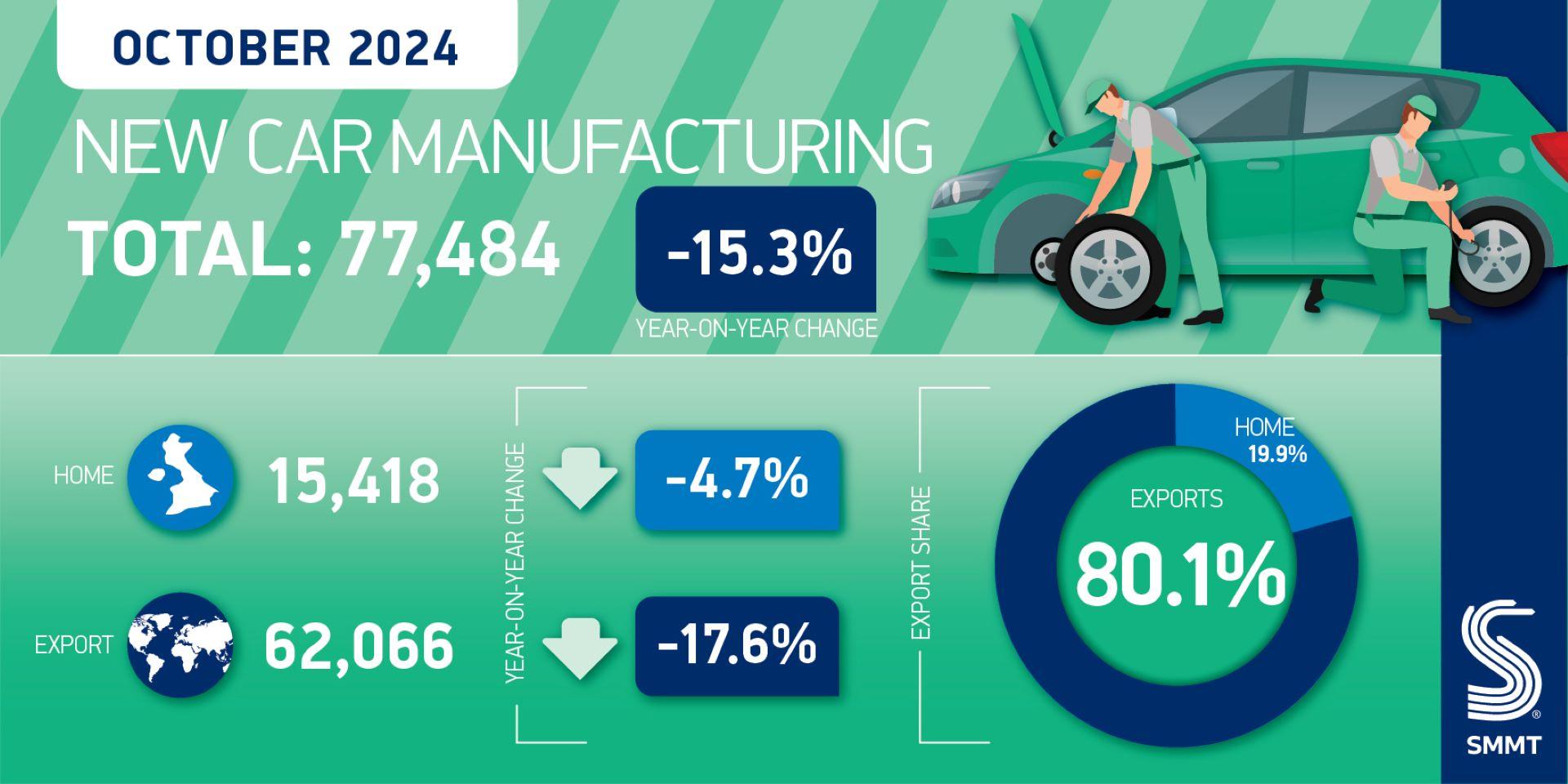
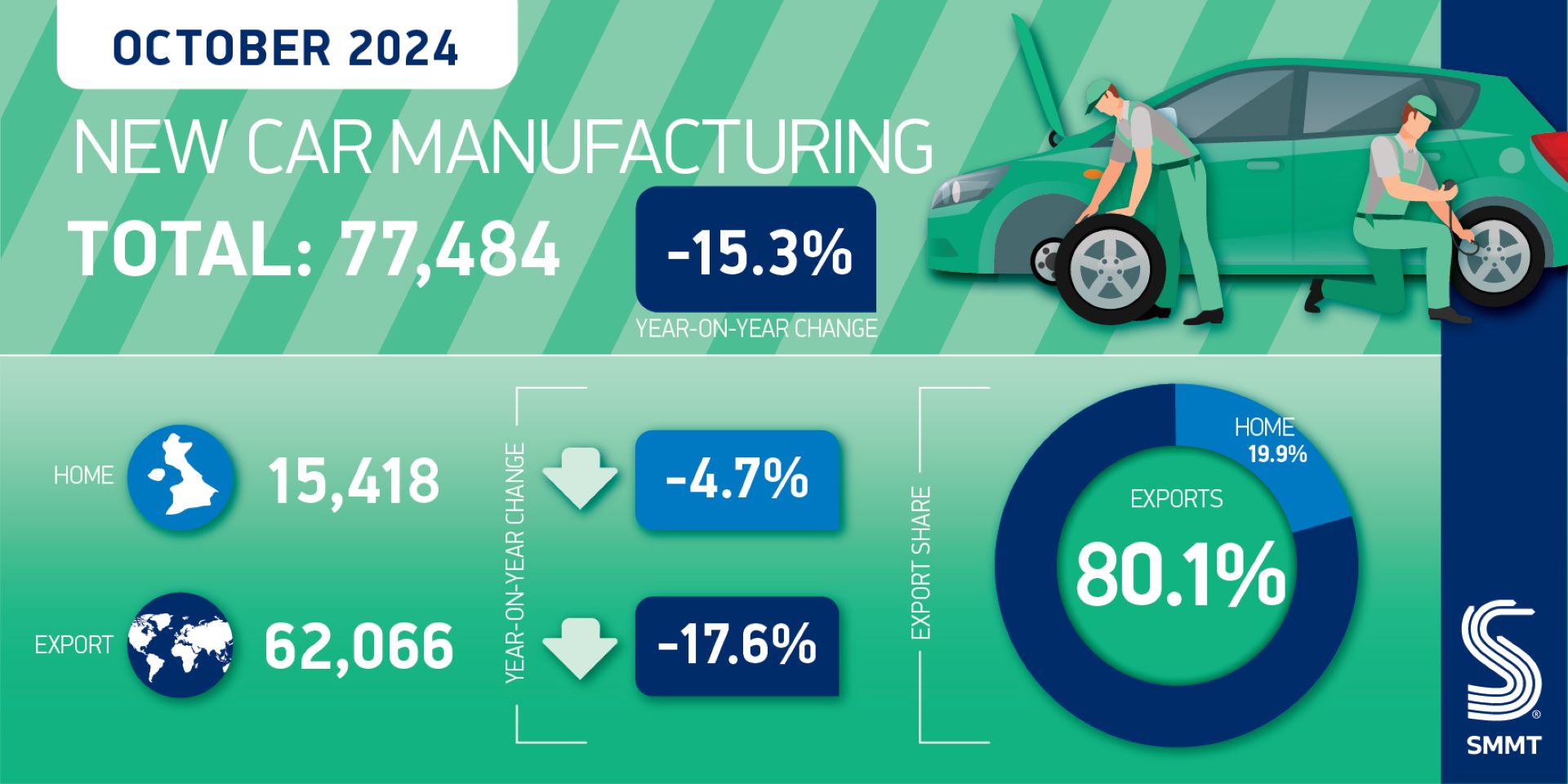
Thursday, 28 November 2024 — The UK automotive industry is grappling with an alarming downturn, with car production falling by 15.3% in October, as new figures released by the Society of Motor Manufacturers and Traders (SMMT) reveal an eighth consecutive month of decline. A total of 77,484 vehicles were produced, a stark 14,037 units fewer than the same time last year. The situation is exacerbated by a broader global slowdown in car markets, with both domestic and export sales struggling to maintain momentum.
Export Challenges and a Shifting Landscape
October’s production slump is mirrored in the performance of export markets, which plummeted by 17.6% in comparison to the previous year. This highlights the fragility of the UK’s global standing in the automotive sector, with the EU remaining the largest market, though even exports there fell by 34.6%. However, a notable exception has been the United States, where exports surged 96.2%, driven by increasing demand for the UK’s premium and luxury models.
While the demand from the US offers a glimmer of hope, overall, the export decline has significantly contributed to a 10.8% fall in year-to-date production, with a sharp 14.8% drop in exports. At the same time, domestic production has seen a modest increase of 5.3%, with 159,125 cars being manufactured for the UK market.
The Strain of the Electric Vehicle (EV) Transition
Despite the UK’s ongoing efforts to transition to zero-emission vehicles, the production of battery electric, plug-in hybrid, and hybrid electric vehicles fell by 32.6% in October, highlighting the challenges facing the shift to EVs. Although 24,719 electrified vehicles were produced, these made up only 31.9% of the overall output. The figures underscore the industry’s struggle to balance the transition to cleaner technologies with an environment of declining consumer demand.
Manufacturers had previously committed over £20 billion in investments to support this green transition, a significant sum signaling their commitment to achieving net-zero emissions. However, these investments are under increasing pressure, as weak demand in both domestic and European markets leaves little room for growth. The UK is finding itself in a particularly precarious position, with ambitious zero-emission targets and timelines, but without the necessary consumer incentives to stimulate demand.
The Outlook for the UK Automotive Industry
The latest independent forecasts paint a grim picture for the immediate future of UK car production. The latest projections suggest production will total around 911,000 vehicles in 2024, and a further decline to 839,000 units in 2025. This would represent a drop of over a third from the pre-pandemic levels of nearly 1.4 million vehicles produced in 2019.
While there is potential for some recovery, with zero-emission model launches planned for the coming years, the outlook remains uncertain. If consumer demand increases and planned product launches go ahead as expected, UK car production could reach above one million vehicles by 2028. However, if the market stagnates further, the industry could see output remain below this threshold until 2030, with a worst-case scenario that could see production fall to less than 750,000 units — a devastating outcome for the sector, jobs, and the wider UK economy.
The Call for Immediate Government Action
The situation facing the UK automotive sector is increasingly urgent. Industry leaders are calling for a comprehensive industrial strategy that supports both consumers and manufacturers. Without regulatory reforms and an environment that fosters demand, the sector risks further decline, especially in the face of unsustainable business costs and weak EV demand.
Mike Hawes, Chief Executive of SMMT, emphasized the gravity of the situation: “These are deeply concerning times for the automotive industry, with massive investments in plants and new zero-emission products under intense pressure. Slowdowns in the global market — especially for EVs — are impacting production output, with the situation in the UK particularly acute given we have arguably the toughest targets and most accelerated timeline but without the consumer incentives necessary to drive demand. The cost of stimulating that demand and complying with those targets is huge and, as we are seeing, unsustainable. Urgent action is therefore needed and we will work with government on its rapid review of the regulation and the development of an ambitious and comprehensive Industrial Strategy to assure our competitiveness.”
A Critical Crossroads for UK Car Manufacturing
As the UK automotive industry confronts these challenging conditions, the need for a robust partnership between the government and the sector has never been clearer. Measures to address high energy costs, improve consumer incentives, and promote free and fair trade are essential to ensure that UK manufacturing remains globally competitive. With the future of thousands of jobs and the wider economy at stake, a clear and decisive strategy is needed now to steer the industry back on track.


