



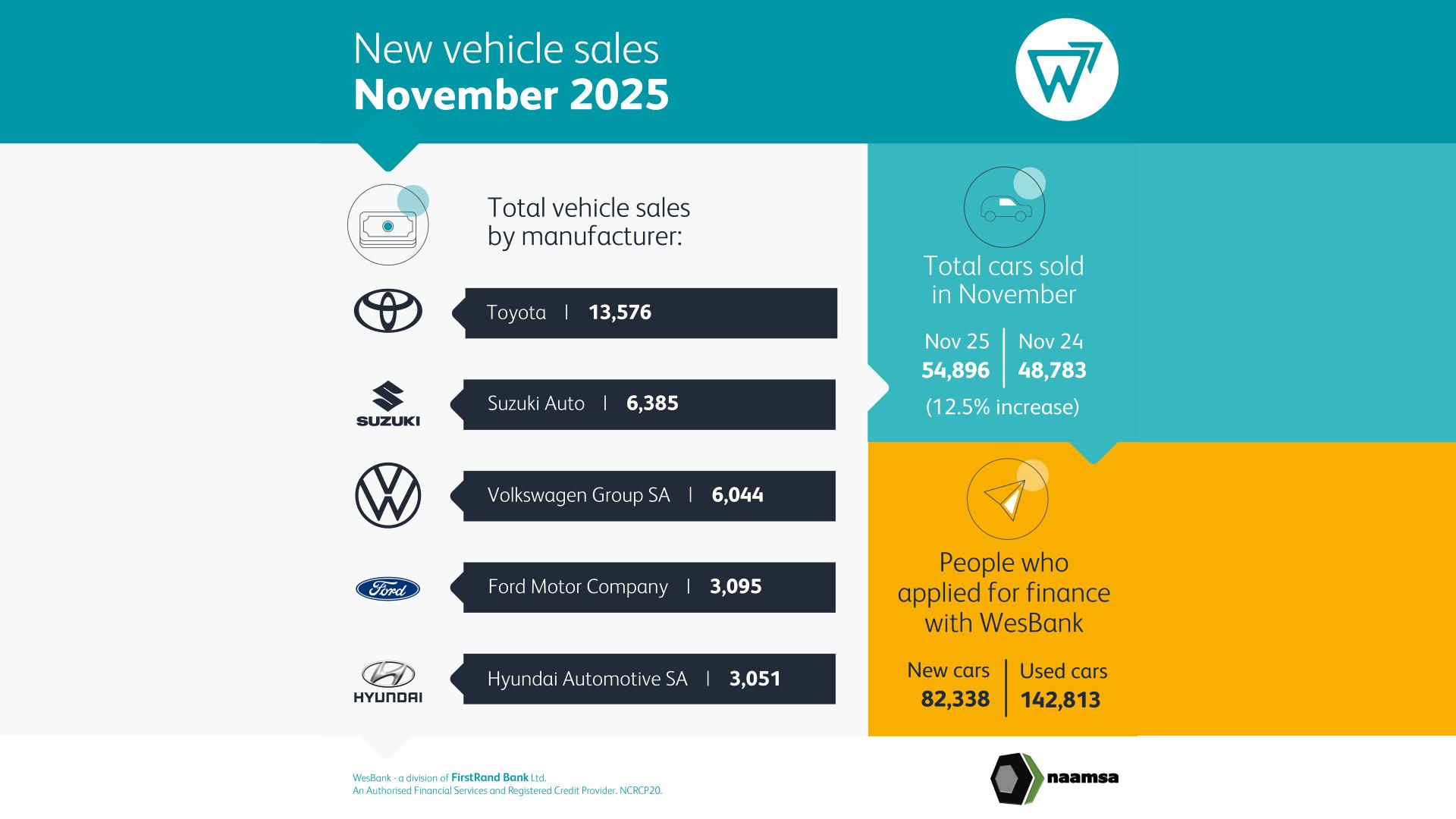
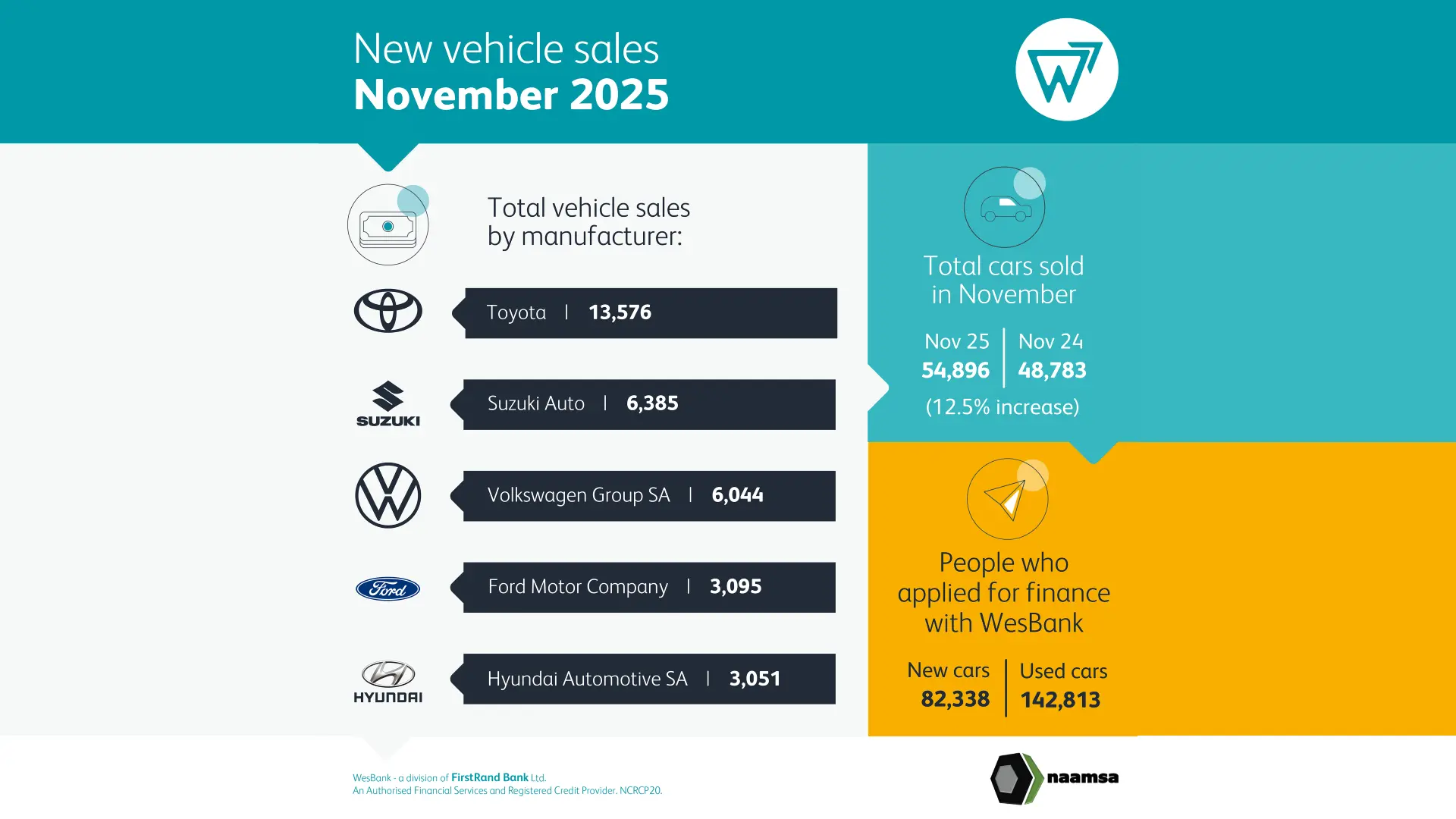
Johannesburg, 01 December 2025 – South Africa’s new vehicle market is heading into the festive season with strong momentum, posting robust growth in November. According to naamsa | the Automotive Business Council, new vehicle sales climbed 12,5% year-on-year, reaching 54,896 units. This result caps a year of steady recovery, with year-to-date sales now 15,4% ahead of 2024.
“November’s performance reflects a market responding to a more supportive economic environment. Lower inflation, relief at the fuel pump, and the first interest rate cut under the revised 3% target have helped restore predictability in household budgets. This stability is starting to show in mobility decisions,” says Lebo Gaoaketse, Head of Marketing and Communication at WesBank.
The contrast with November 2024 is notable. Last year’s 48,585 units marked the best month of that year but were driven primarily by rental fleet deals amid declining consumer demand. In contrast, this November’s growth was broader, reflecting real improvements in the economy and stronger consumer confidence.
Of the total November sales, dealer sales accounted for 43,702 units (79,6%), while the rental industry absorbed 16,3%, government 2,4%, and industry corporate fleets 1,7%. Medium and heavy commercial vehicle sales were relatively stable, with medium trucks at 698 units (-0,6%) and heavy trucks at 1,992 units (+1,3%).
“The recovery in the light commercial segment is an encouraging signal for small businesses and fleet operators. Reinvestment in workhorse vehicles usually points to firmer business confidence and expectations of better trading conditions ahead,” Gaoaketse adds.
Recent macroeconomic developments have reinforced cautious optimism. Fuel prices fell significantly in November, dropping 51 cents per litre for petrol and 21 cents for diesel, while the rand strengthened following South Africa’s first sovereign credit rating upgrade in nearly two decades. Additionally, the repo rate cut to 6.75% has improved medium-term affordability without encouraging overextension among buyers.
Encouragingly, the market’s growth appears to be driven by disciplined consumer behaviour rather than exuberance. “Affordability remains a clear priority. Even with improving economic indicators, households are aware of their limits. Buyers are approaching dealerships with well-prepared budgets, strong views on total cost of ownership, and a preference for predictable finance structures,” explains Gaoaketse.
However, caution remains warranted. Export volumes declined 3,9% year-on-year to 35,848 units due to softer global demand and renewed geopolitical tensions. The potential fallout from international developments, including the G20 Summit and possible AGOA exclusion, could weigh on the sector in the future.
With December still ahead, WesBank expects the market to maintain its momentum. “The fundamentals are much healthier than they were a year ago,” Gaoaketse concludes. “The market we see today is built on informed choices and realistic budgets. This discipline supports long-term stability for both consumers and the industry, and is an encouraging sign of things to come.”


