


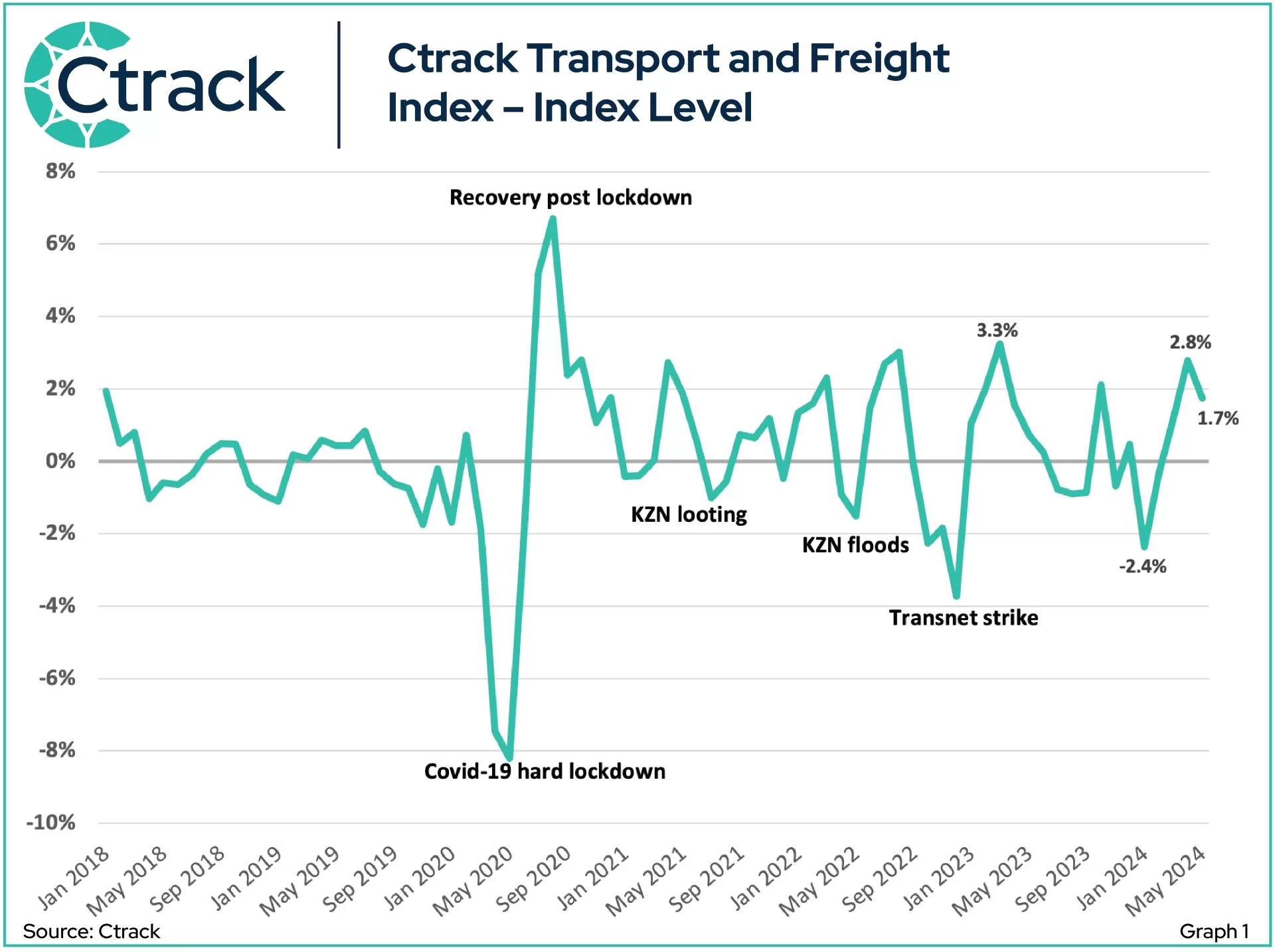
The Ctrack Transport and Freight Index (Ctrack TFI) experienced a notable increase in May, reaching an index level of 125.6. This represents a 1.7% rise compared to April and a 2.5% improvement over the same period last year. This marks the third consecutive monthly increase in the index, suggesting that the transport sector’s contribution to overall GDP could enter positive territory in Q2 2024. The diverse sub-sectors of the index highlight the interconnected nature of the logistics sector, and May was no exception. On a monthly basis, three subsectors saw growth in May 2024, with air freight leading the way (+5.5% m/m) and the heavily weighted road freight subsector following suit (+2.7% m/m). Compared to a year earlier, five of the six sub-sectors improved during May, while only the pipeline transport sub-sector declined.
Air Freight has been a standout performer among the sub-sectors since early 2024. Comparing May’s index level to December 2023 reveals a significant 15.4% increase in air freight activity. The sub-sector rose by 5.5% in May, marking the fourth consecutive monthly increase and reaching the highest index level on record. On a quarterly basis, the sector is up by an impressive 18.0%, significantly contributing to the overall recovery of the logistics sector. Most underlying components saw increases in May, with only cargo load on planes declining slightly but remaining at high levels. Despite a slight reduction in cargo load on planes in April and May, it remained 51.0% higher than in January 2024. Additionally, the International Air Transport Association (IATA) continued to report strong global air cargo demand, with double-digit annual growth in cargo tonne-kilometres (CTK) for the fifth consecutive month. International CTKs expanded by 11.4% YoY globally, driven by carriers from the Middle East, Africa, and Asia. Although Africa only accounts for 2% of the global market, a 10.6% annual growth rate in CTKs to Africa is noteworthy.
Sea Freight, which faced significant challenges in April, rebounded in May. Across all South African ports, the number of containers landed increased by 14.5% m/m in May (vs -17.9% in April), and the number of containers shipped surged by 45.5% m/m after a 32.5% drop in April. Other cargo handled (excluding vehicles) also rose by 12.4% in May, following an 11.6% decline in April. Year-to-date sea freight is still up by 5.4% compared to the same period in 2023. Sea freight remains a focal point of South Africa’s structural reform efforts. Recently, Grindrod, a JSE-listed logistics group, was selected by Transnet Ports Authority (TNPA) to develop and operate the first container terminal at the Port of Richards Bay. This development is expected to increase the port’s container handling capacity from 50,000 twenty-foot equivalent units (TEUs) to 200,000 TEUs per annum, in line with the TNPA KZN ports master plan. Given the historical under-performance of the sea freight sector, this development is a welcome sign of progress towards structural reforms that will promote much-needed growth for the South African economy.
The Road Freight sub-sector, which has grown significantly in recent years and currently accounts for 83.6% of all freight payload in South Africa, continued its recovery in May. This marks the third consecutive month of positive growth following an almost year-long downward trend. Road freight increased by 2.7% m/m in May compared to 4.5% in April, and it is up by 8.6% on a quarterly basis. Heavy vehicle traffic on the N3 toll route (class 3 & 4 trucks) increased by 6.6% in May, while a double-digit decline was recorded on the N4 route. Heavy vehicle traffic on the N4 toll route spiked in March and April due to restrictions on the R36 Bambi-Mashishing route and renewed issues at South African ports, which led to additional traffic towards the Port of Maputo. With the resumption of normal port operations in May, particularly at the Durban port, this additional demand decreased.
The Rail Freight sub-sector saw a slight decline in May but continues its gradual overall recovery. For the first five months of 2024, rail freight increased by 11.0% compared to the same period in 2023. Despite many ongoing challenges, progress has been made under Operation Vulindlela, aimed at providing additional capacity to Transnet and reversing the trend of moving goods from rail to road. The first phase of this initiative concluded with the end of the government’s 5-year term and received praise for maintaining private sector interest and mobilizing government efforts. The second phase, currently being scoped, will likely continue focusing on the logistics sector while expanding to new areas of reform.
The Storage and Handling sub-sector of the Ctrack Transport and Freight Index declined by 1.1% m/m in May, remaining just 1.6% above year-ago levels. Inventory indicators fell, while total transshipments (landed and shipped containers) increased by 4.3% after a significant drop in April. Lastly, the transport of liquid fuels via Transnet Pipelines (TPL) increased by 0.2% m/m in May but declined by 0.3% and 2.0% on a quarterly and annual basis, respectively, reflecting the economy’s sluggishness.
The Ctrack TFI suggests that the transport sector could positively contribute to Q2 2024 GDP. With two months of data on the Ctrack TFI now available, a quarterly increase in the index is likely, indicating a potential positive contribution to overall economic growth in Q2. Historically, the transport & communication sector has often outperformed other economic sectors, such as in 2023 when it grew by 3.5% compared to overall GDP growth of just 0.7%. However, in Q1 2024, the transport & communication sector underperformed, contracting by 0.5% q/q seasonally adjusted compared to a 0.1% contraction in overall GDP. Despite a slow start to the year, Q2 looks promising, and real growth for the transport and communication sector is expected to outperform the broader economy in 2024.
“In the last two years, since the establishment of the National Logistics Crisis Committee, backed by the business sector’s resources and expertise, a new form of collaboration has developed between the public and private sectors, facilitated by the efforts of the Operation Vulindlela team. While notable progress has been made in pursuing the reform agenda, it is of utmost importance that the new government must continue and accelerate the efforts, in the interest of the economy as a whole,” says Hein Jordt, Chief Executive Officer of Ctrack.


