




July 1, 2024 – As new vehicle sales continue to decline year-on-year, WesBank, a prominent vehicle and asset finance provider, identifies affordability as the primary barrier to market growth.
The TransUnion SA Vehicle Pricing Index corroborates this view, revealing a 4.7% increase in new vehicle prices for the first quarter of 2024 compared to the previous year. This price hike has led many households to prefer a single multi-purpose vehicle over multiple vehicles, as evidenced by the marginal increase in the average loan amount.
WesBank’s data further highlights these affordability challenges. In June, the average loan amount for a new vehicle rose by 3.5%, while the average loan duration extended by 3.8% to over 51 months. Additionally, the average contract period has now surpassed 73 months compared to a year ago.
“These indicators suggest that consumers are either holding onto their existing vehicles for longer periods or extending loan durations to manage lower monthly instalments,” says Lebo Gaoaketse, Head of Marketing and Communication at WesBank.
High interest rates remain a significant factor affecting debt, with potential relief anticipated only in the latter half of the year.
Consider June’s average loan value at WesBank of R410,000. Financing this amount over 72 months at the prime lending rate of 11.75% results in an estimated monthly instalment of R8,054.83. In comparison, a customer financing the same amount in 2020 at a prime rate of 7% would have a lower monthly payment by R1,015.81, translating to approximately R75,730.32 more for the same car over the same contract period at current rates.
“Adding the rising costs of living to this scenario, it’s evident how household budgets are strained,” Gaoaketse explains. “Many consumers are delaying purchase decisions or opting for alternative mobility solutions such as e-hailing, car sharing, or purchasing pre-owned vehicles, thereby exiting the new vehicle market.”
Until interest rates decrease to improve affordability, new vehicle sales are expected to remain sluggish.
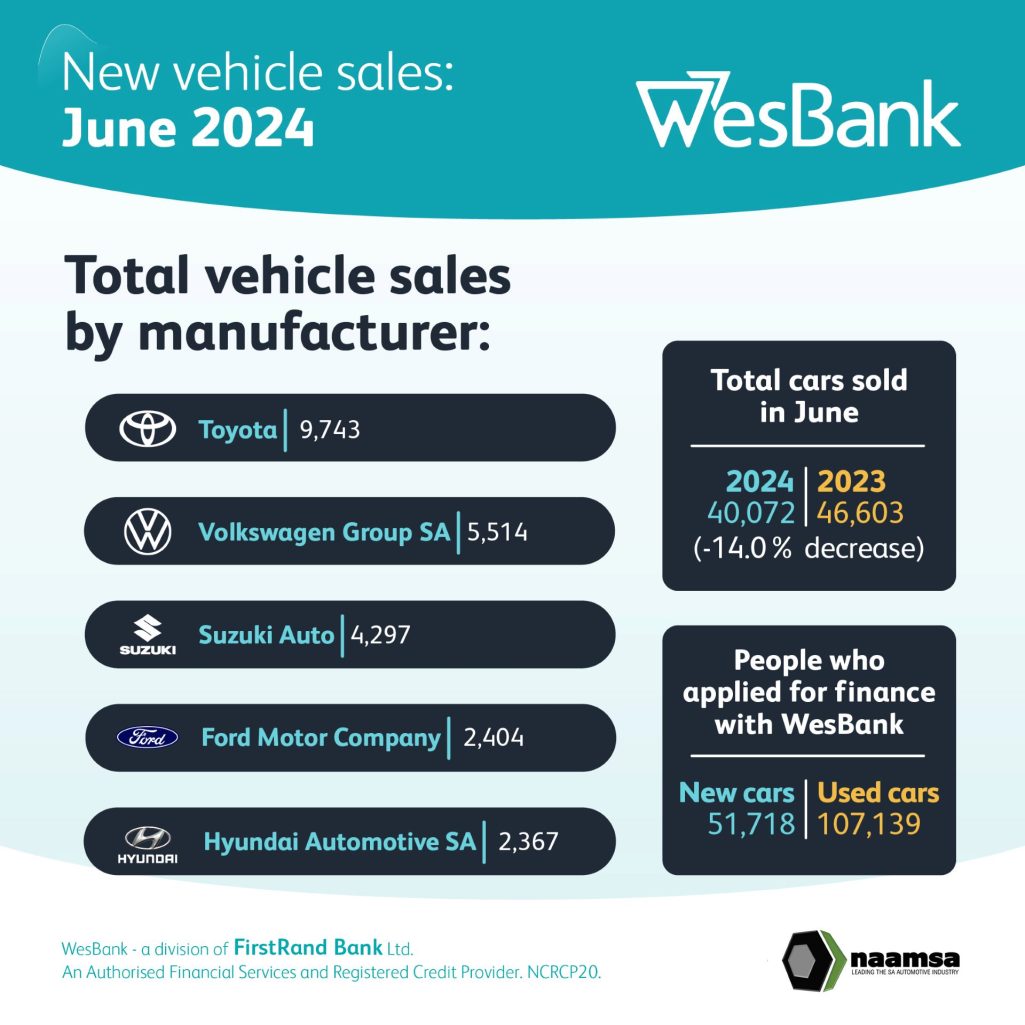
The latest figures from naamsa | the Automotive Business Council indicate a 14% year-on-year decline in the South African new vehicle market, with sales dropping to 40,072 units. Despite the year-on-year decrease, the industry finds some consolation in an 8% (2,967 units) month-on-month increase in sales volumes.
Passenger car sales fell by 9% to 26,928 units, while Light Commercial Vehicles saw a sharper decline of 24.3%, totaling 10,552 units.
The market’s performance over the first half of the year has been discouraging, with a 7.4% decline in year-to-date new vehicle sales, amounting to 246,052 units. This trend raises concerns that the market might not achieve 500,000 units this year.
“Vehicle price inflation, high interest rates, and the general rise in living costs are all factors hindering new car buyers from entering or remaining in the market,” Gaoaketse remarks. “Without relief in interest rates, more significant incentives from manufacturers, or a substantial change in inflation or earnings, the new vehicle market will likely continue to face significant pressure.”


