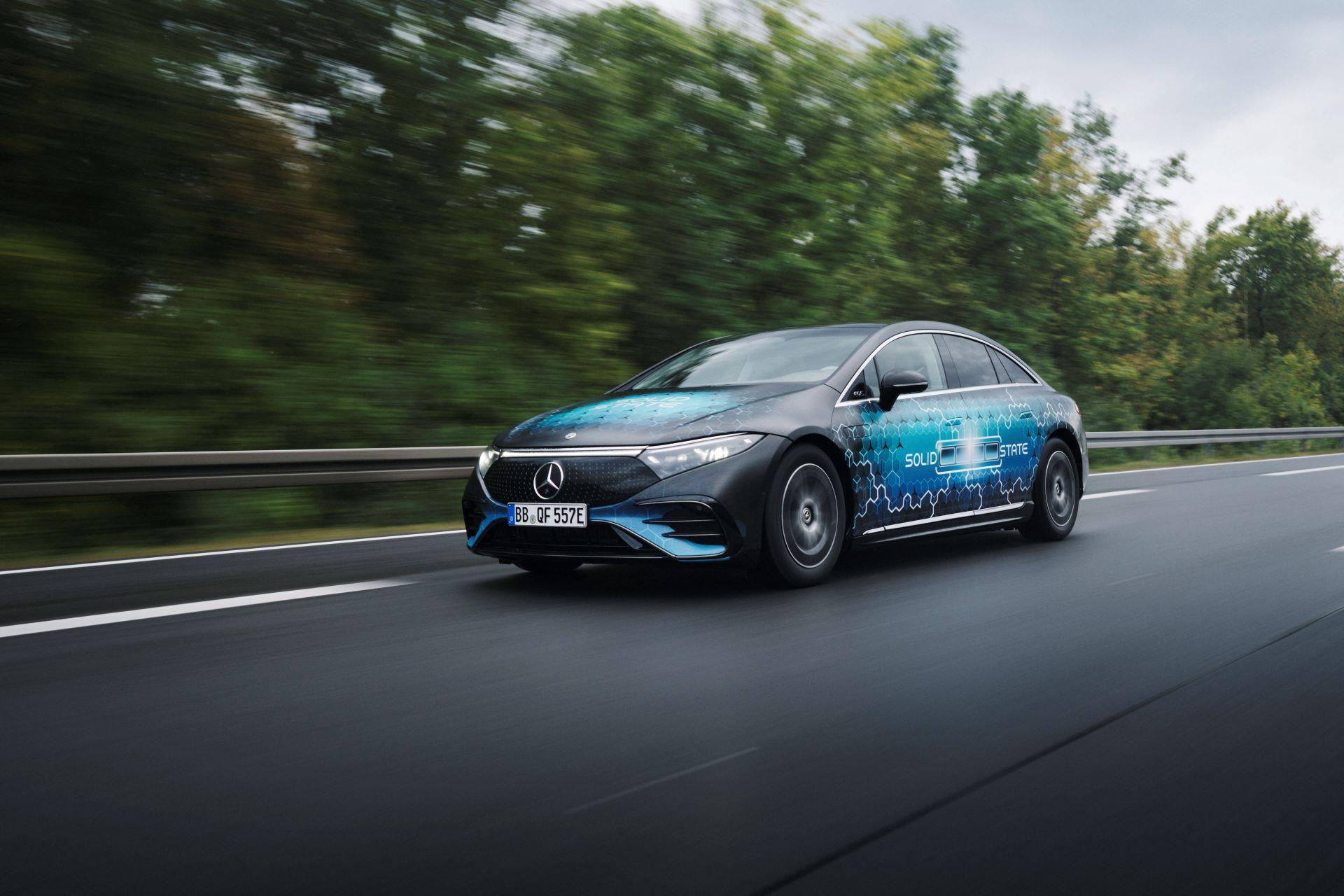
Mercedes-Benz continues to redefine the possibilities of electric mobility. At the end of August, a lightly modified EQS test vehicle equipped with a lithium-metal solid-state battery completed a 1,205-kilometer journey from Stuttgart, Germany, to Malmö, Sweden—without a single charging stop. Remarkably, the vehicle arrived with a remaining range of 137 kilometers, demonstrating that this next-generation technology is not just a laboratory marvel but a real-world solution ready to transform the EV landscape.
The trip surpassed the previous long-distance record set by the Vision EQXX by three kilometers, highlighting Mercedes-Benz’s commitment to pushing the limits of range, efficiency, and technological maturity. As the inventor of the automobile, Mercedes-Benz once again affirms its role at the forefront of innovation, shaping the future of sustainable mobility.
Real-World Validation for Future-Ready Technology
This milestone drive is part of an extensive validation program that began earlier this year with the announcement of initial road testing. Beyond simulations and laboratory assessments at Mercedes-Benz’s state-of-the-art facilities in Stuttgart-Untertürkheim and Sindelfingen, the solid-state battery is being rigorously evaluated under real-world conditions. Testing spans different climates, topographies, and traffic conditions, ensuring that the technology performs consistently across all scenarios.
The Stuttgart-to-Malmö route followed the A7 and E20 highways through Germany and Denmark, carefully optimised using Mercedes-Benz’s Electric Intelligence system. This software calculates energy requirements based on route profile, topography, traffic, and ambient temperature—including the energy needed for heating and cooling—without relying on ferries. Such precision planning ensured a seamless journey over international borders and long distances, validating the battery’s everyday usability.
“The solid-state battery is a true gamechanger for electric mobility,” said Markus Schäfer, Member of the Board of Management of Mercedes-Benz Group AG, Chief Technology Officer, Development & Procurement. “With the successful long-distance drive of the EQS, we show that this technology delivers not only in the lab but also on the road. Our goal is to bring innovations like this into series production by the end of the decade and offer our customers a new level of range and comfort.”

Formula 1 Innovation Meets Road-Ready EV Technology
At the heart of this achievement lies a battery system developed in collaboration with Mercedes-AMG High Performance Powertrains (HPP), the Group’s Formula 1 technology centre in Brixworth, UK. The lithium-metal cells powering the EQS are supplied by U.S.-based Factorial Energy and employ FEST® technology (Factorial Electrolyte System Technology).
Solid-state batteries, while highly efficient, face challenges from volume changes during charging and discharging. Mercedes-Benz has addressed this through pneumatic actuators that maintain precise contact pressure on the cells, ensuring long-term reliability. Despite a 25% increase in usable energy, the battery’s weight and dimensions remain comparable to the standard EQS battery. Additional weight and efficiency gains are achieved through passive airflow cooling, optimising performance without compromise.
Pioneering the Next Chapter of EV Mobility
This record-setting journey not only underscores the promise of solid-state technology but also marks a critical step toward series production. The combination of long range, efficiency, and durability signals that Mercedes-Benz is ready to deliver electric vehicles that meet the needs of everyday drivers—without compromise.
As the automotive industry prepares for a shift toward next-generation batteries, Mercedes-Benz continues to lead with innovation, blending real-world performance with advanced technology. The Stuttgart-to-Malmö drive is more than a milestone; it is a clear signal that the future of electric mobility is closer than ever—and Mercedes-Benz is driving it forward.