




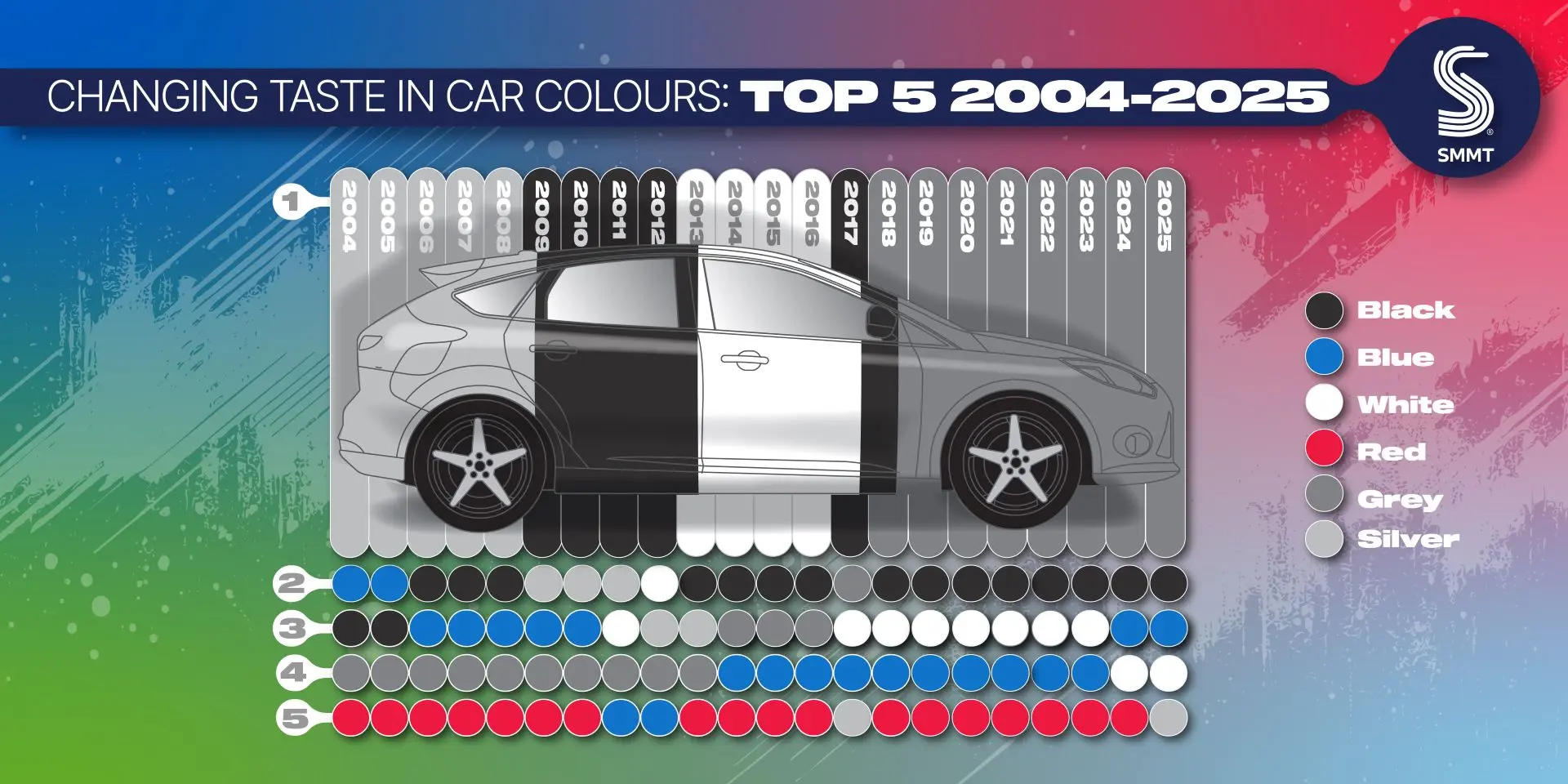
Britain’s car buyers may flirt with fashion, but when it comes to colour, their loyalty remains steadfast. For the eighth consecutive year, grey has emerged as the nation’s favourite new car colour, cementing its place as the dominant shade on UK roads. According to the latest figures from the Society of Motor Manufacturers and Traders (SMMT), more than half a million grey cars were registered last year, pushing the colour to a record total and giving it more than a quarter of the entire new car market.
In a year shaped by economic pressure, technological change and accelerating electrification, Britain’s colour preferences tell a familiar yet quietly evolving story. Monochrome tones continue to anchor the market, but beneath the surface, subtle shifts hint at changing attitudes, particularly as electrified powertrains gain ground.
Grey’s long reign continues
With 558,050 registrations in 2025, grey tightened its grip on the top spot, growing by 2.7% year on year. The colour now accounts for 27.6% of all new cars registered in Britain, an extraordinary level of dominance for what was once considered a safe, even conservative choice. Its appeal cuts across segments, price points and powertrains, making it the most universally accepted colour in the market.
That universality is especially clear in the electric vehicle space. Grey was once again the most popular choice among battery electric vehicle buyers, with nearly 132,000 grey BEVs joining UK roads last year. In a market still navigating questions of range, infrastructure and residual values, grey’s neutrality appears to offer reassurance.
Black and blue reinforce the monochrome stronghold
Black retained its second-place position, recording its strongest performance since 2019. Registrations climbed by 9.7% to 464,369 units, making it the biggest volume gainer of any colour in 2025. Its enduring association with premium design and executive appeal continues to resonate, particularly in higher-end segments such as luxury saloons and executive cars, where black remains the colour of choice.
Blue, meanwhile, held onto third place for the second consecutive year. With just over 306,000 registrations and growth of 4.9%, it remains Britain’s favourite non-monochrome option. While still a distant third behind grey and black, blue’s consistency underlines its role as the acceptable splash of colour for buyers unwilling to fully abandon restraint.
Together, grey, black and blue accounted for nearly two thirds of all new cars registered in the UK last year, reinforcing just how concentrated colour preference has become.
Silver’s return and red’s retreat
One of the more notable movements in the 2025 rankings was silver’s return to the top five for the first time in almost a decade. Once the defining colour of Britain’s roads in the early 2000s, silver had gradually faded from prominence. Its reappearance suggests a cyclical revival, perhaps driven by updated finishes and renewed interest in lighter metallic tones.
White held onto fourth place despite a significant decline in volume. Registrations fell by 9.0%, marking the steepest drop of any major colour, yet it remains a popular choice in specific use cases. Vans, in particular, continue to favour white overwhelmingly, with more than 60% of new working vehicles finished in the shade.
Red’s trajectory tells a different story. Long a staple of British car culture, red slipped to sixth place and recorded its lowest market share since detailed records began. At just 5.8%, its fall reflects a broader move away from expressive colours in favour of understated finishes.
Green’s electric moment
While monochrome tones still dominate, green was the standout performer of 2025. Registrations surged by 46.3% to nearly 100,000 units, the highest volume for the colour in more than 20 years. The rise is closely linked to the shift towards electrification, both symbolically and practically.
Registrations of green-tinted battery electric vehicles almost doubled year on year, accounting for one in every 20 new BEVs sold. Just a year earlier, green represented a negligible fraction of the electric market. The growth suggests that as electric cars become more mainstream, buyers are increasingly willing to pair new technology with colours that reflect environmental consciousness, even if subtly.
Regionally, Berkshire emerged as the epicentre of green car registrations, while also retaining its reputation as Britain’s hotspot for yellow cars, another niche but persistent presence in the market.
The forgotten colours
At the other end of the spectrum, Britain’s least popular car colours remained firmly out of favour. Maroon, pink and turquoise collectively accounted for just 342 registrations, with turquoise languishing at the very bottom. Only 12 turquoise cars were added to UK roads in 2025, a collapse of almost 97% compared with the previous year.
Yet even outside the top 10, there were flashes of unexpected growth. Cream-coloured cars surged dramatically, albeit from a very low base, while brown also recorded a solid increase. These movements suggest that while mainstream buyers remain cautious, there is still room for niche preferences at the margins.
Consistency with room for expression
Commenting on the findings, SMMT Chief Executive Mike Hawes noted that while UK car buyers’ preferences remain broadly consistent, the rise of green mirrors the growing popularity of electrified vehicles as the market decarbonises. Manufacturers, he added, are responding by expanding their colour palettes and finish options, giving drivers more opportunities to personalise their vehicles.
The message from the data is clear. Grey still matters most, anchoring Britain’s automotive identity in familiarity and neutrality. But as the industry transforms and electrification reshapes the market, colour is once again becoming a quiet indicator of change. Not loud, not radical, but unmistakably there, shimmering beneath the surface of an otherwise grey horizon.


