
In the early 1930s, speed was more than a metric of performance. It was theatre, ideology, and engineering ambition colliding at full throttle. Against this backdrop of relentless competition and national prestige, Auto Union carved its name into motorsport history with a machine that would become one of the most evocative symbols of pre-war innovation: the Auto Union Lucca.
Now, nearly a century later, that story returns to life. Audi Tradition has recreated the legendary Rennlimousine and will present it dynamically for the first time at the Goodwood Festival of Speed in July 2026, placing a roaring chapter of engineering history back onto the world stage.
The original car was born in a time when record-breaking runs were as fiercely contested as Grand Prix victories. On 15 February 1935, on a straight stretch of Italian autostrada near Lucca, Hans Stuck pushed the original machine to a flying-start mile average of 320.267 km/h, with a measured peak of 326.975 km/h. In doing so, the Auto Union machine briefly became the fastest road racing car in the world, a title earned not in fantasy but in the grit of wind, fuel, and mechanical defiance.
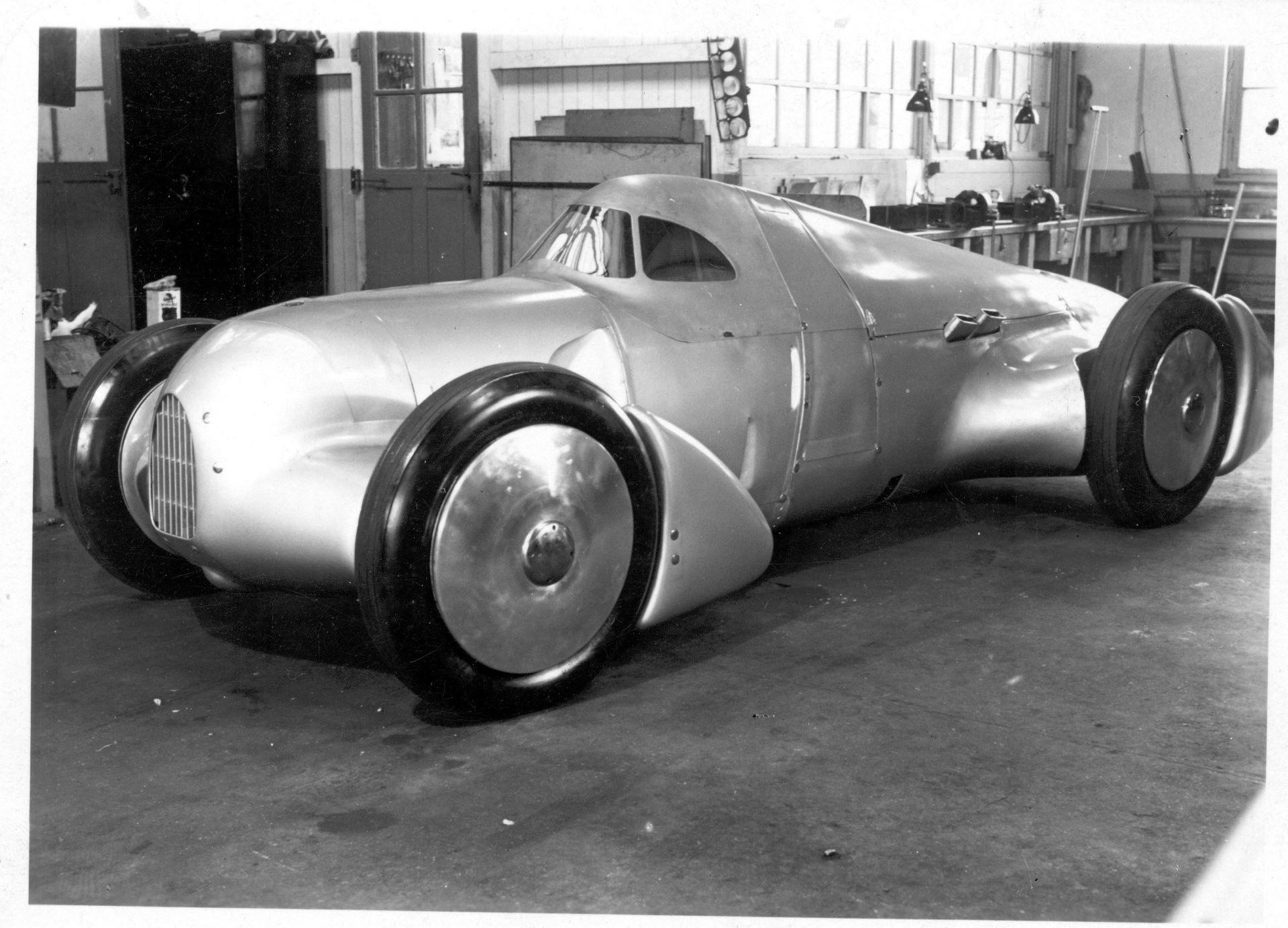
The path to that moment was anything but direct. Rivalry between Auto Union and Mercedes-Benz had escalated through 1934, with Rudolf Caracciola setting a benchmark that demanded immediate response. Auto Union’s engineers, operating under immense pressure, entered a winter of rapid iteration. Wind tunnel testing at Berlin-Adlershof reshaped the car’s identity, transforming it from a conventional racing machine into a streamlined arrow of metal and intent. Open cockpit trials gave way to enclosed aerodynamic refinement, while every surface was reconsidered for airflow, stability, and speed.
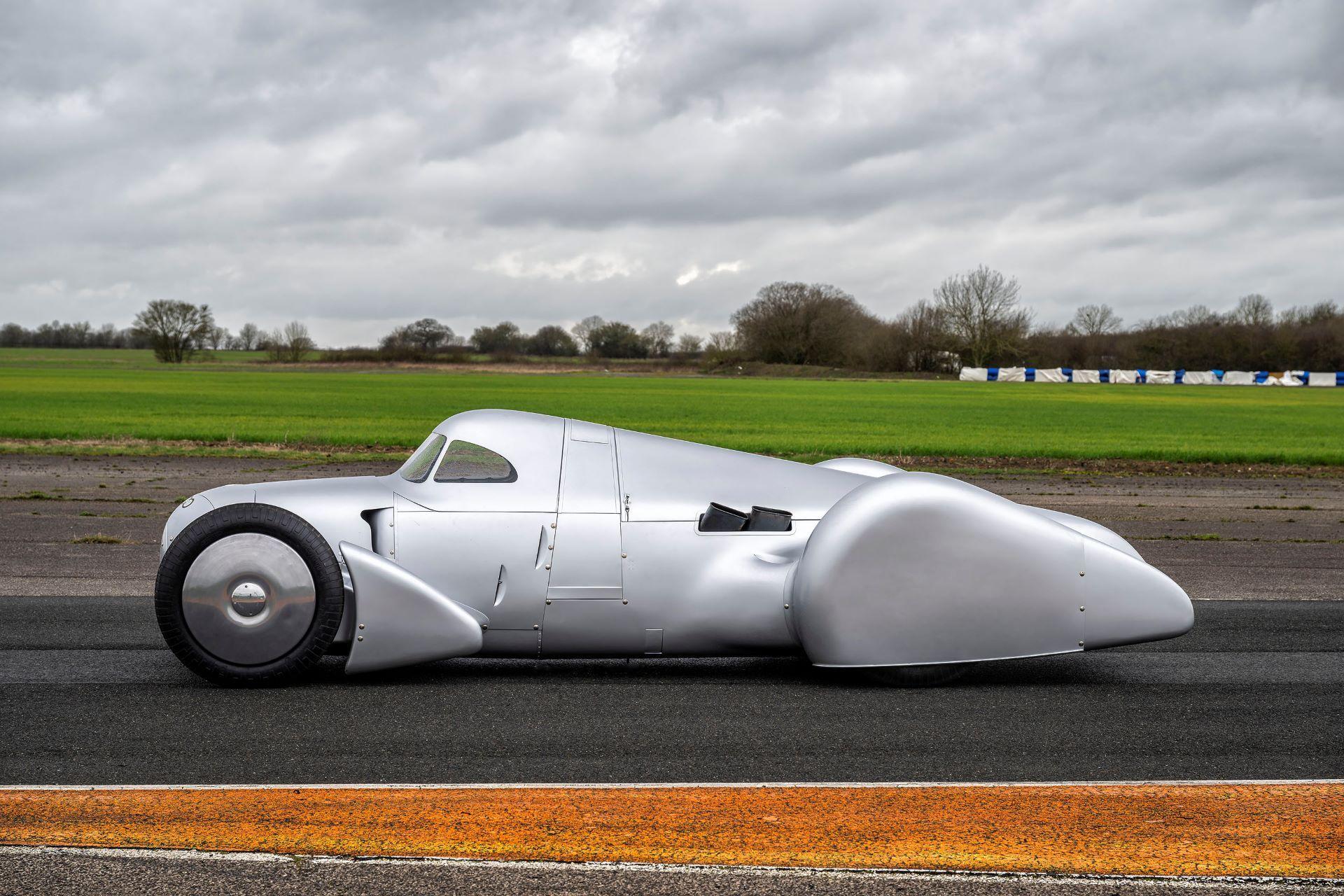
The result was a silhouette that looked almost alien for its time. The body was hand-finished, polished smooth, and sealed in lacquer. Wheel covers reduced turbulence, while the fin-like rear and elongated teardrop arches created a profile that seemed less built and more carved by velocity itself. Beneath the skin, a mid-mounted 16-cylinder engine, enlarged to approximately five litres in its early record form, delivered over 340 PS in its initial configuration, later evolving further within the season.
Development did not happen in controlled laboratory conditions alone. It was chaotic, adaptive, and constantly on the move. Initial testing near Gyón in Hungary was disrupted by mechanical failure and deteriorating weather. What followed was a continental chase for suitable conditions, shifting from Hungary to northern Italy, then further south until a viable stretch of road was found near Lucca, between Pescia and Altopascio. There, a flat, almost ruler-straight five-kilometre section of public road became the stage for history.
On the morning of the record attempt, anticipation had already gathered crowds. Independent timekeepers equipped with early photocell technology stood ready as Stuck took the wheel. Fine adjustments were made in real time, including aerodynamic sealing of the radiator opening, before the decisive runs began. When the numbers were finally confirmed, the result was not just a record but a statement: engineering pushed to its edge, and briefly beyond it.
The achievement did not remain confined to Italy. Almost simultaneously, a second version of the car appeared at the International Motor Show in Berlin, signalling its dual identity as both competition machine and technological showcase. Even as celebrations unfolded, development pressure continued, with engineers already analysing data for the next iteration.
By May 1935, the Lucca-derived machines were back on track at the Avus circuit in Berlin, now competing not against the clock but directly against rivals in full race conditions. The results were less triumphant but equally instructive. Mechanical stress, tyre failures, and cooling challenges revealed the limits of endurance at extreme speeds. Yet in motorsport terms, even failure was a form of progress.
Today’s recreated Auto Union Lucca, completed in early 2026 by Crosthwaite & Gardiner after more than three years of meticulous craftsmanship, carries that same duality of beauty and brutality. Every component has been handcrafted to match historical documentation, yet subtly adapted for durability and demonstration use. In Audi wind tunnel testing, the car achieved a measured drag coefficient of 0.43, reinforcing just how advanced its original concept was for its era.
Under its recreated skin sits a 16-cylinder engine derived from the Auto Union Type C lineage, producing 520 PS in its modern specification. It is not merely a reconstruction but a living interpretation, capable of being configured between record-era and race-era aerodynamic forms.
According to Audi Tradition engineers, the goal was not only authenticity but functionality, ensuring the machine can safely demonstrate its historical performance character in modern conditions. That balance between preservation and motion is what allows the Lucca to leave the museum floor and return to a track environment nearly a century later.
When it takes to the hill at Goodwood, the Lucca will not simply be a display piece. It will be a moving archive of ambition, a mechanical echo of a time when speed was the ultimate frontier. In its silhouette lies the tension between elegance and violence, between precision and risk, between what engineering was and what it dared to become.
The Auto Union Lucca stands as a reminder that innovation is rarely linear. It is shaped by competition, by urgency, and by the relentless pursuit of something just beyond reach. And when it accelerates again in July, it will not just be revisiting history. It will be reanimating it.