



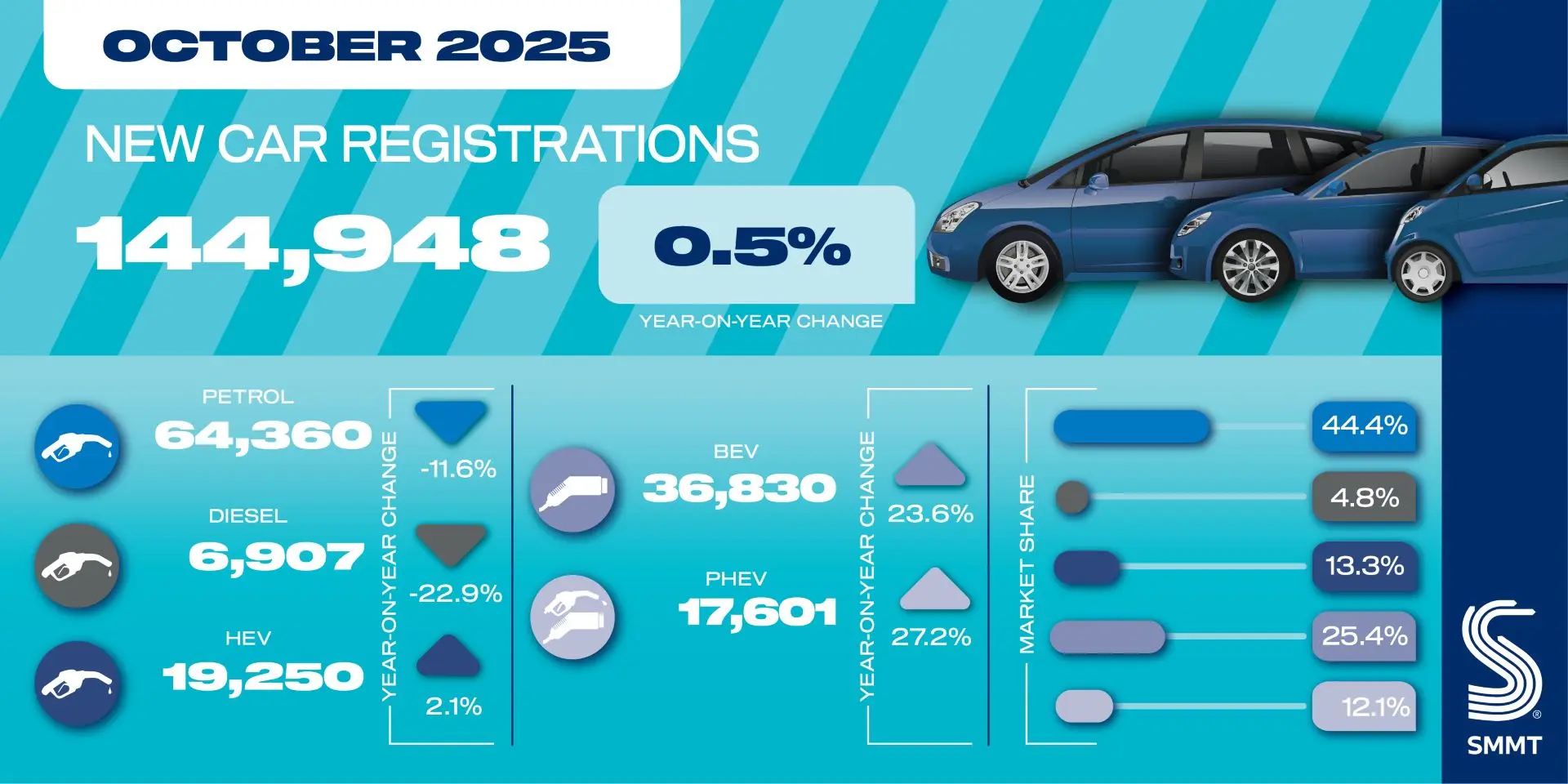
The UK new car market showed steady performance in October, with registrations rising modestly by 0.5% to 144,948 units, according to the latest figures from the Society of Motor Manufacturers and Traders (SMMT). The data reflects a market increasingly dominated by electrified vehicles, even as traditional fleet sales see a slight decline.
Private buyer registrations edged up by 2.0%, offsetting a 1.5% drop in fleet registrations, while business registrations saw a sharp increase of 32.7%. However, as a relatively small segment, business volumes remain volatile.
Electrified Vehicles Lead Growth
Battery electric vehicles (BEVs) continue to drive the market forward. October saw BEV registrations rise 23.6%, adding 7,028 units and pushing their market share to 25.4%—the second-highest share recorded this year. Plug-in hybrid vehicles (PHEVs) also posted strong gains, climbing 27.2% to capture 12.1% of the market, while hybrid electric vehicles (HEVs) grew by 2.1% to account for 13.3%. Collectively, electrified vehicles now represent a majority of new car registrations for the second consecutive month, comprising 50.8% of the market.
Year-to-date, BEV sales have surged 28.9% to 386,244 units, surpassing total BEV registrations for the whole of 2024, with two months remaining in 2025. Government support through the Electric Car Grant and continued manufacturer investment have played a key role in this growth, helping BEVs reach 22.4% of total new car sales.
Industry Outlook Remains Positive
The latest SMMT quarterly industry outlook forecasts that the UK new car market will exceed two million units in 2025 for the first time since 2019, reaching 2.012 million. BEVs are projected to account for 23.3% of new car registrations this year. For 2026, the market is expected to grow further to 2.032 million units, with BEV market share projected at 28.2%. While this reflects notable progress, these figures still fall short of the zero-emission vehicle targets for 2026, which aim for one in three new cars to be zero-emission. By 2027, the gap is set to widen, with BEVs anticipated to reach 32.2% of registrations against a 38% target.
Concerns Over Employee Car Ownership Schemes
Despite the positive trends, the sector faces potential headwinds from government plans to end Employee Car Ownership Schemes (ECOS). These schemes allow employees to access the vehicles they produce and sell in an affordable way. Scrapping ECOS—by making such vehicles liable for company car tax—would reduce the availability of new and zero-emission vehicles and depress market growth.
With around 100,000 cars supplied through ECOS each year, equivalent to roughly 5% of annual new car sales, the measure could result in more than £1 billion in lost revenue for the automotive sector and put 5,000 manufacturing jobs at risk. The Treasury could also see a half-billion-pound reduction in VAT and Vehicle Excise Duty receipts. Industry leaders argue that the policy could wipe out the growth stimulated by the Electric Car Grant.
Mike Hawes, SMMT Chief Executive, warned: “The government has backed the UK automotive sector with EV incentives and global trade deals, helping drive growth and encourage decarbonisation. But scrapping ECOS would undermine that progress—penalising workers, reducing Exchequer income and putting green investment at risk. At a time when the Budget should fuel growth, the measure will do the exact opposite. It is time for a rethink.”


