



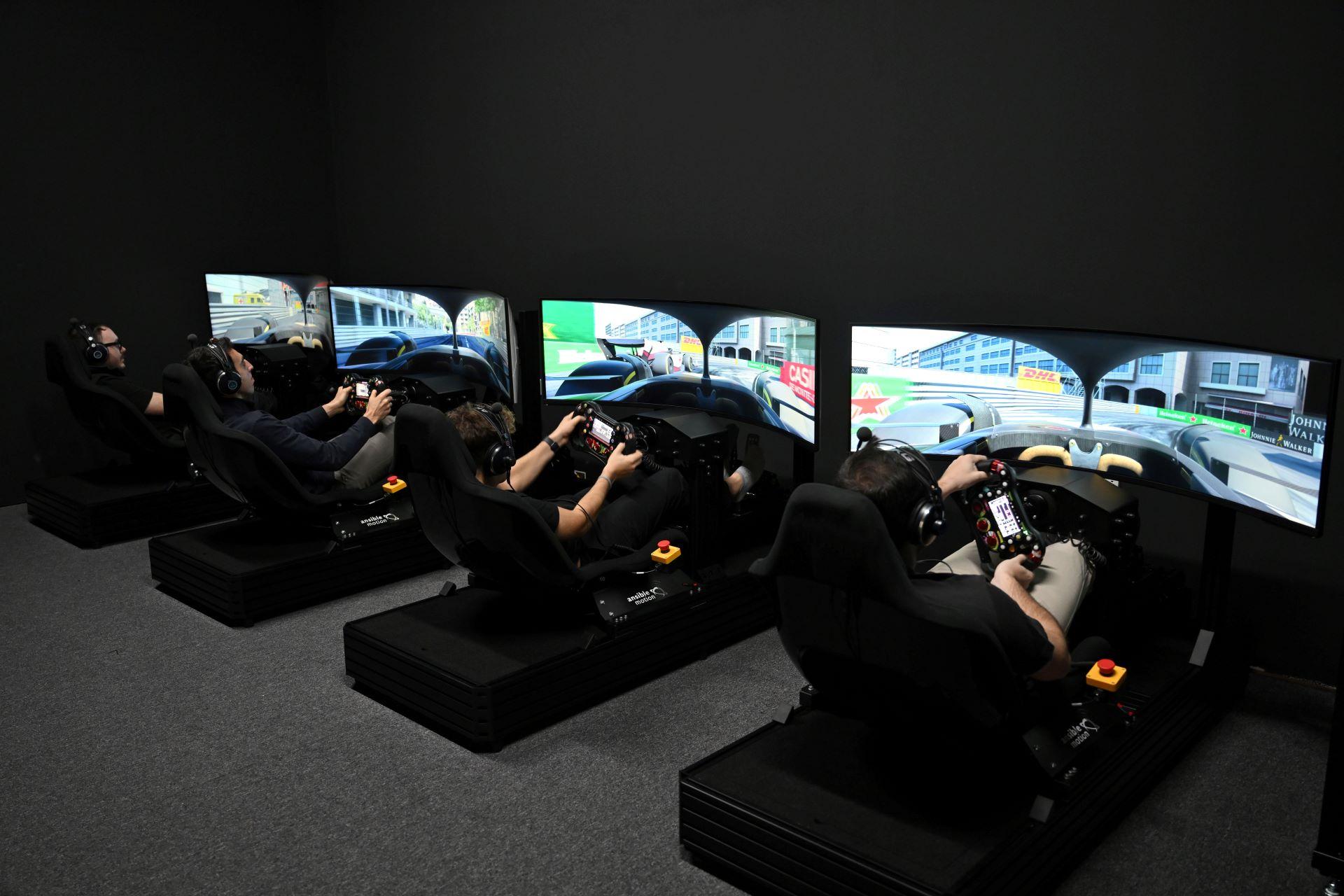
In an exciting development for motorsport simulation, Ansible Motion has significantly deepened its partnership with Penske Autosport, delivering four cutting-edge Theta Seat Sport simulators to the racing team. Building upon the success of the Delta S3 Driver-in-the-Loop (DIL) simulator already installed at DS Penske, this latest expansion establishes a comprehensive multi-sim testing and development centre, enabling unprecedented advancements in vehicle and driver performance.
This expanded simulator suite is designed to push the boundaries of race car setup and strategy development. With the introduction of five interconnected simulators, the existing Delta S3 simulator at DS Penske now allows drivers to interact in real-time with four additional drivers, all stationed in separate Theta Seat Sport simulators. The ability to simulate multi-vehicle interaction marks a breakthrough in racing simulation technology, providing a unique platform for studying complex on-track scenarios and improving driver performance through multi-vehicle coordination.
Transforming the Simulation Landscape
The integrated multi-sim environment at Penske Autosport represents a quantum leap in how racing teams approach virtual testing. Thanks to AVL RACETECH’s advanced vehicle dynamics simulation software, which supplies the unified vehicle modelling network, these simulators work together to simulate highly realistic race conditions, including traffic scenarios, overtaking strategies, and energy management. This highly dynamic environment is key to developing and refining setups in a way that mirrors the real-world challenges drivers face during a race.
Phil Charles, Deputy Team Principal and President at DS Penske, expressed his enthusiasm for the new technology: “Having already experienced the superlative capabilities of Ansible Motion’s Delta S3 simulator, we were keen to expand our simulator programme to include multiple, simultaneous drivers. This new Theta Seat Sport suite is enabling us to explore inter-vehicle and inter-driver dynamics, unlocking a whole new level of development for our racing team.”
The multi-sim setup’s innovative nature also addresses critical areas of race car development, particularly when it comes to replicating on-track environments with high fidelity. The AVL VSM™ RACE software models the physical effects of racing in traffic, ensuring that Penske Autosport’s drivers and engineers can simulate race situations with exceptional accuracy. This tool helps to develop not only race car setups but also energy management strategies, which are increasingly important in Formula E and other motorsport series.
Theta Seat Sport: A New Era of Motorsport Simulators
The Theta Seat Sport simulators are the flagship product of Ansible Motion’s new motorsport-focused series, designed to meet the rigorous demands of professional racing teams. Built with a sophisticated computational architecture, these simulators offer immersive, real-world physics and high-fidelity track simulations, specifically developed for motorsport applications. With integrated motorsport driver controls, high-torque steering feedback, and modular physical structures, the Theta Seat Sport can scale from entry-level gaming setups to highly advanced simulators featuring active cueing systems for steering torque, pedal actuation, and even helmet forces.
The modularity of the Theta Seat Sport also allows for seamless adaptation to various racing series, enabling Penske Autosport to customize their setups based on specific event requirements, from the dynamic environments of Formula E to the precision needed for endurance racing.

Enhanced Integration with rFpro Software
Adding another layer of sophistication, Ansible Motion’s integration with rFpro software ensures that the simulators are paired with the world’s most advanced, engineering-grade driving simulation tools. rFpro’s highly detailed track models for Formula E and other series bring unparalleled realism to the experience, further enhancing driver immersion. This synergy between Ansible Motion’s simulation hardware and rFpro’s simulation software marks a major milestone in the development of multi-sim technology for motorsport teams.
Dan Clark, Managing Director of Ansible Motion, commented on the new partnership, saying: “We are thrilled that Penske Autosport has recognised the advantages of our Theta Seat Sport simulators, becoming the first to adopt this multi-sim technology. As they prepare for their Formula E title challenge in 2025, we believe these advanced simulators will play a key role in their success. This development represents a major leap forward in the potential of racing simulators, and we’re excited to introduce even more innovations in the near future.”
A Fast Track to Performance Development
Manufactured at Ansible Motion’s UK facility, the new Theta Seat Sport simulators were delivered to Penske Autosport in January 2025, a remarkably quick turnaround time of just three months after order placement. Already operational, these simulators are playing a crucial role as the team prepares for the eleventh season of Formula E. The introduction of these advanced simulators is a testament to Ansible Motion’s commitment to providing cutting-edge tools for motorsport teams across the globe.
With over 14 years of experience in delivering high-precision driving simulators for a wide range of motorsport categories, including Formula 1, WRC, WEC, NASCAR, INDYCAR, and Formula E, Ansible Motion continues to shape the future of racing simulation. This new partnership with Penske Autosport signals the beginning of an exciting chapter in the evolution of multi-sim testing environments that are set to redefine the way racing teams prepare for competition.
For more information and to download high-resolution images, please visit [here].
This collaboration underscores Ansible Motion’s position at the forefront of driving simulation technology, transforming how professional motorsport teams develop their vehicles and strategies. Through this partnership with Penske Autosport, the future of racing simulation looks faster, more immersive, and more interconnected than ever before.


