


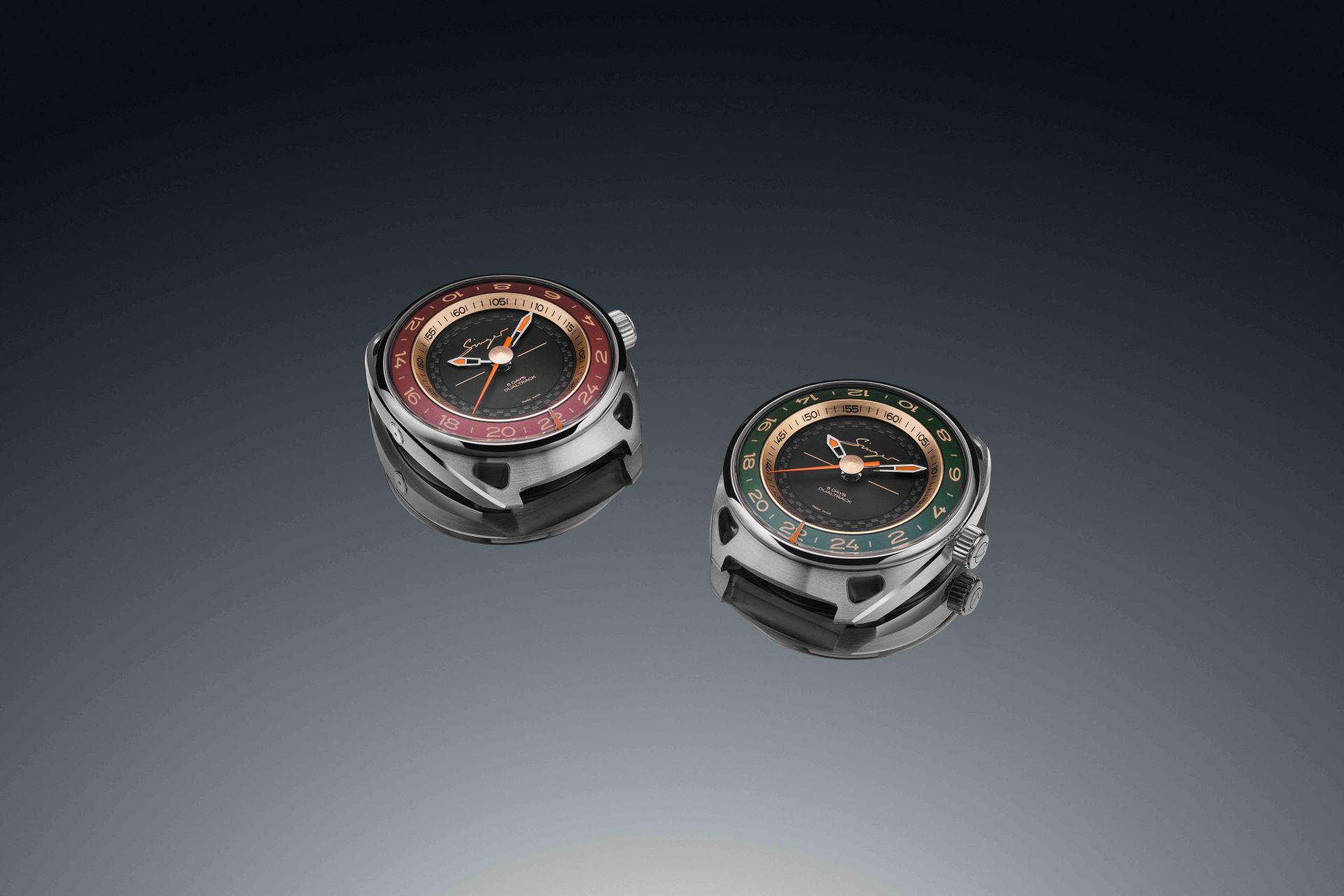
Singer Reimagined’s latest creation does not arrive like an announcement so much as a quiet recalibration of how time itself is meant to be experienced. In Geneva, where mechanical language is often spoken in complication and excess, the DualTrack steps forward with a different kind of confidence. It does not try to impress by multiplication. It simplifies until clarity feels like inevitability.
At its core, DualTrack is an answer to a modern condition that rarely gets treated with mechanical seriousness. Life is no longer anchored to a single horizon. It stretches, fragments, and reconnects across cities, time zones, and overlapping realities. Work happens in one hemisphere while relationships unfold in another. The complication here is not performance but connection, and Singer approaches it with the same philosophy that shaped the Track1: remove distraction until function becomes instinct.
Where Track1 reimagined the chronograph as a central, almost intuitive instrument of elapsed time, DualTrack turns its attention to the quieter, more persistent need to live in more than one place at once. Local time sits confidently at the center, expressed through traditional hands and immediate legibility. It is the present tense made physical, the time you inhabit without translation or effort.
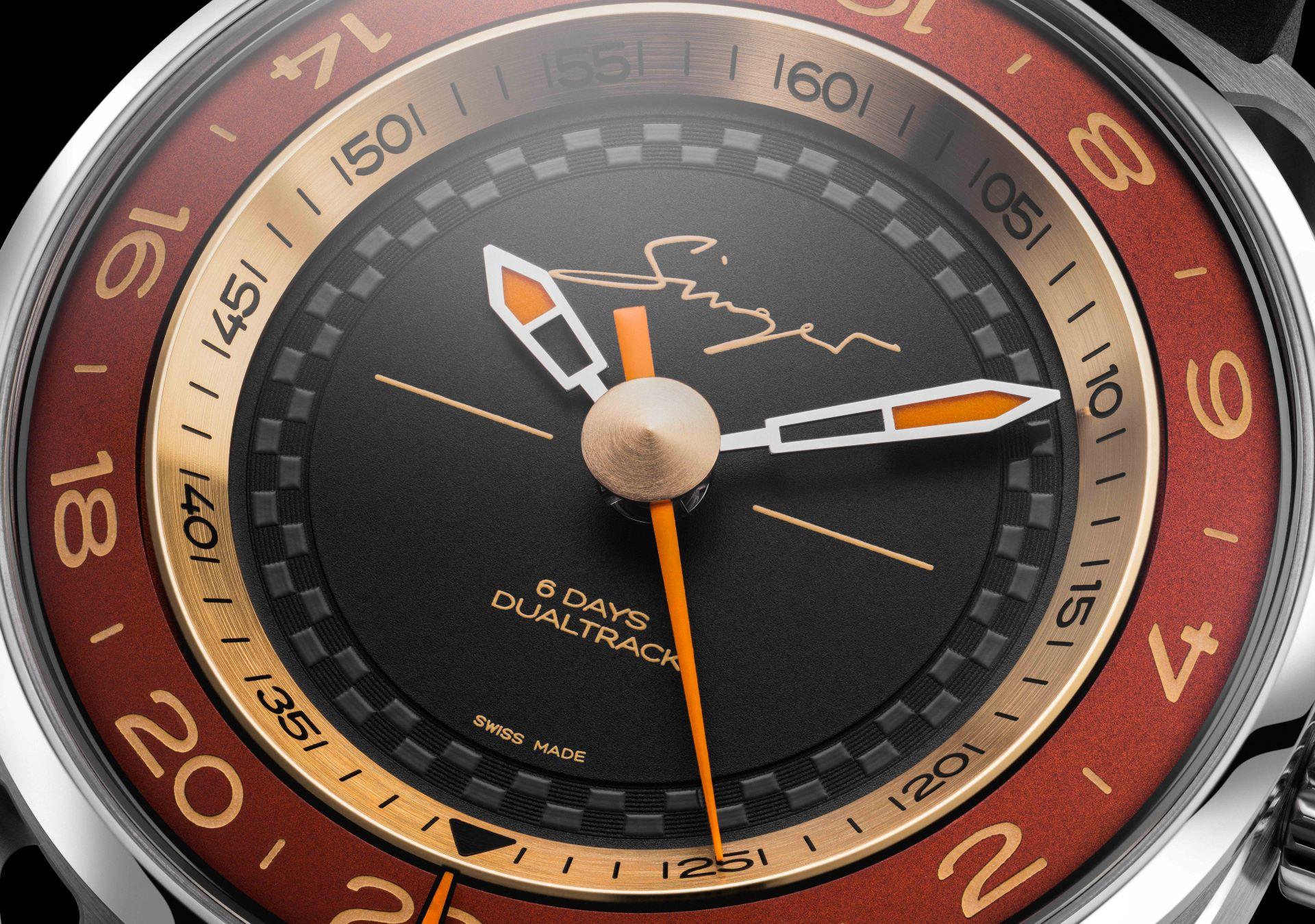
The second time zone is treated with a different kind of respect. Instead of burying it in a sub dial or disguising it as a secondary gesture, Singer places it on a peripheral 24-hour disc that orbits the dial with constant motion. It reads like a boundary line that never stops moving, positioned at six o’clock where it can be absorbed without searching. There is no interruption in interpretation. A glance is enough, and the information arrives intact.
What elevates this system beyond aesthetic decision is the way it is operated. A discreet corrector on the left side of the case allows the wearer to advance the 24-hour disc in one-hour increments with each press. It is a tactile, almost conversational interaction. No instruction manual energy, no procedural memory required. The watch adapts through repetition rather than the wearer adapting to complexity. It is mechanical empathy expressed in steel and spring.
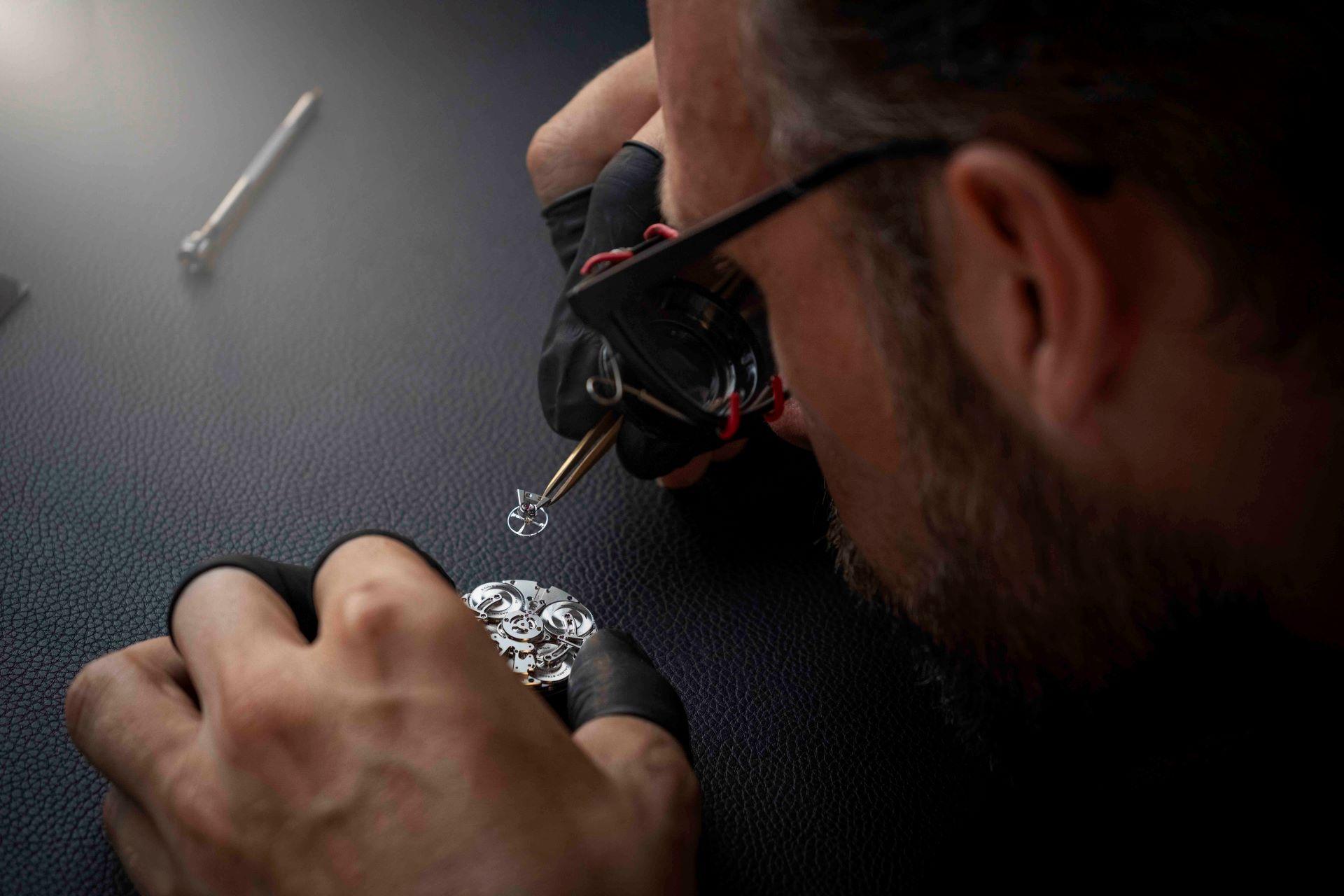
Turn the watch over and the philosophy deepens into architecture. The Calibre 4 Dual Time movement is not an adaptation of an existing engine but a ground-up construction designed to serve Singer’s ideas directly. Visible through a sapphire caseback, its structure is anchored by four barrels working in parallel, delivering a six-day power reserve that is less about duration and more about consistency. The intention is not simply to extend time between winds but to stabilise how energy is delivered across the entire cycle.
This stability is where the engineering becomes philosophy. The twin double-barrel configuration ensures a flat, controlled torque curve, reducing the fluctuations that typically mark long power reserve movements. The result is a rhythm that does not waver between fresh wind and depletion. It remains composed throughout, like a system designed to avoid emotional extremes in favour of continuity. In horological terms, it is not just endurance. It is equilibrium.
The 43 mm stainless steel case carries this same discipline into form. It is familiar in presence but sharpened in detail, with openwork lugs that introduce architectural lightness and visual tension. Circular brushed surfaces meet mirror-polished chamfers in a deliberate contrast that feels less decorative than structural, as though each finish is assigned a role rather than an aesthetic preference. The silhouette is recognisably Singer, yet more resolved, more assertive in its geometry.
The dial continues this language of controlled contrast. A velvet black surface provides depth without distraction, while a subtle chequered decal introduces a restrained performance reference. A circular brushed golden flange frames the minutes and seconds scale with precision, anchoring the visual field in clarity. The second time zone disc, rendered in sandblasted anodised aluminium, introduces colour with purpose rather than flourish. Meridian Green draws from the invisible architecture of global timekeeping, while Horizon Red suggests transition, movement, and the emotional geography of travel.
Legibility is never compromised in the pursuit of character. Ecru luminous detailing and beige Super-LumiNova numerals reinforce clarity even as the composition becomes more expressive. Every element appears considered, yet nothing feels overworked. The result is a dial that behaves like a well-edited conversation, where every sentence earns its place.
DualTrack ultimately reads less like a complication and more like a response to how people actually live now. It acknowledges that time is no longer a single stream but a network of overlapping realities. Instead of complicating that truth further, Singer distils it into something immediate, tactile, and calm. A watch not designed to explain time, but to make it feel usable again.
Availability begins in early June 2026, with pricing set at CHF 22,500 excluding VAT and local taxes. Offered through authorised retailers and directly via Singer Reimagined, DualTrack arrives not as a reinvention of dual time, but as a refinement of how dual time should feel when stripped of noise.