



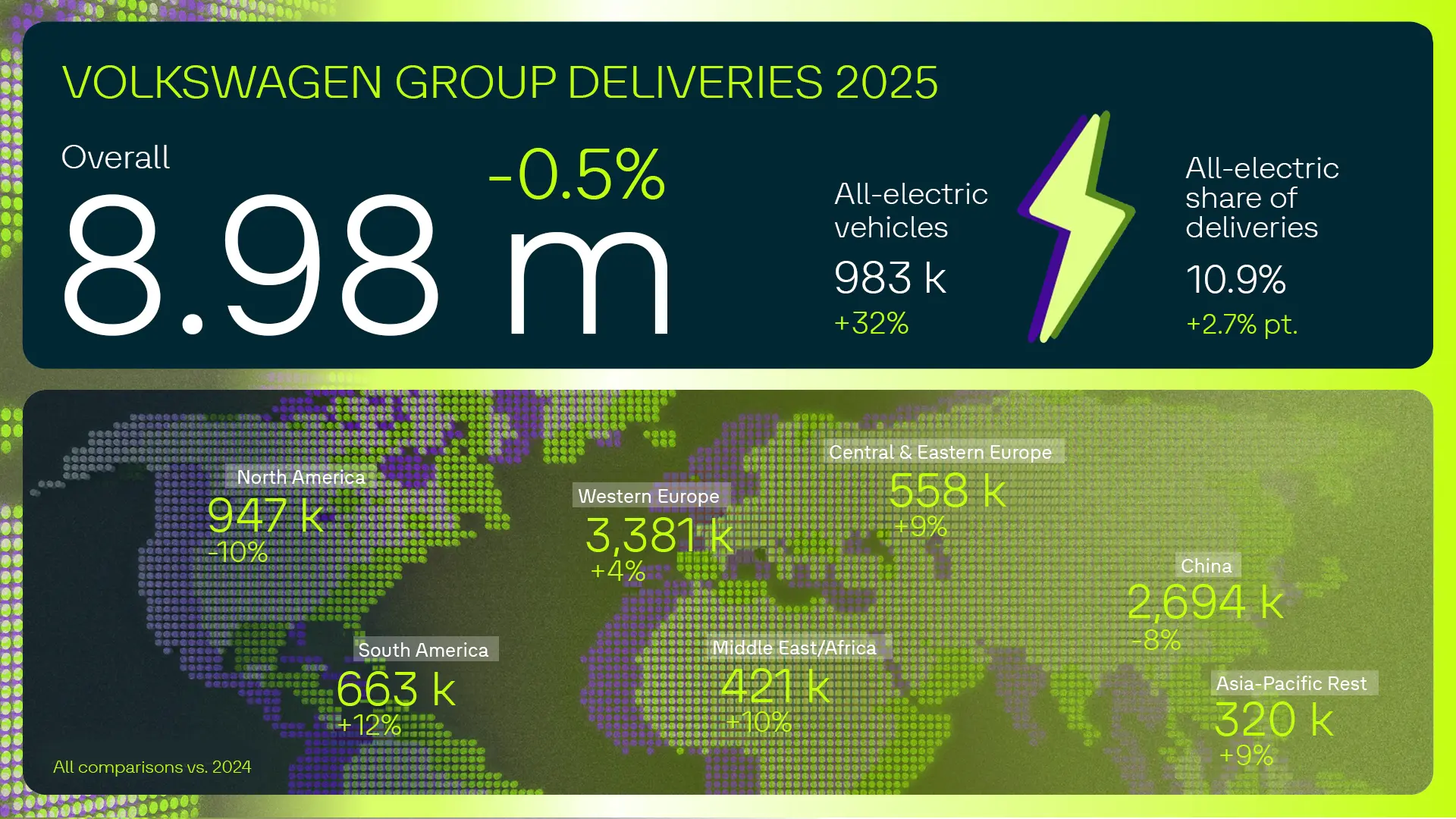
The Volkswagen Group closed 2025 with a message of measured confidence and strategic momentum. In a year shaped by volatile global markets, intensifying competition and shifting regulatory frameworks, the Group delivered close to nine million vehicles worldwide, underscoring the resilience of its multi-brand, multi-powertrain strategy. While total deliveries of 8.98 million units represented a marginal 0.5 per cent decline year on year, the underlying performance tells a far more nuanced story, one defined by regional strength, accelerating electrification and a product portfolio that continues to resonate with customers.
Speaking on the Group’s performance, CEO Oliver Blume highlighted the importance of product renewal and innovation as key stabilising forces. With more than 20 new models planned for 2026, spanning electric, hybrid and combustion technologies, Volkswagen Group is positioning itself not simply to defend market share, but to advance its ambition of becoming a global automotive technology leader.
A stable global picture shaped by regional contrasts
At a global level, 2025 was characterised by pronounced regional divergence. Strong growth in Europe and South America helped offset expected declines in North America and China, both of which faced structural and policy-driven headwinds.
Europe once again emerged as the Group’s anchor market. Deliveries rose by 4.5 per cent to 3.94 million vehicles, with Western Europe growing by 3.8 per cent and Central and Eastern Europe recording an even stronger 9.0 per cent increase. Germany, Volkswagen Group’s home market, also delivered solid momentum, with customer handovers up 5.6 per cent. This performance pushed the Group’s European market share to a new high of around 25 per cent, despite the arrival of new competitors across multiple segments.
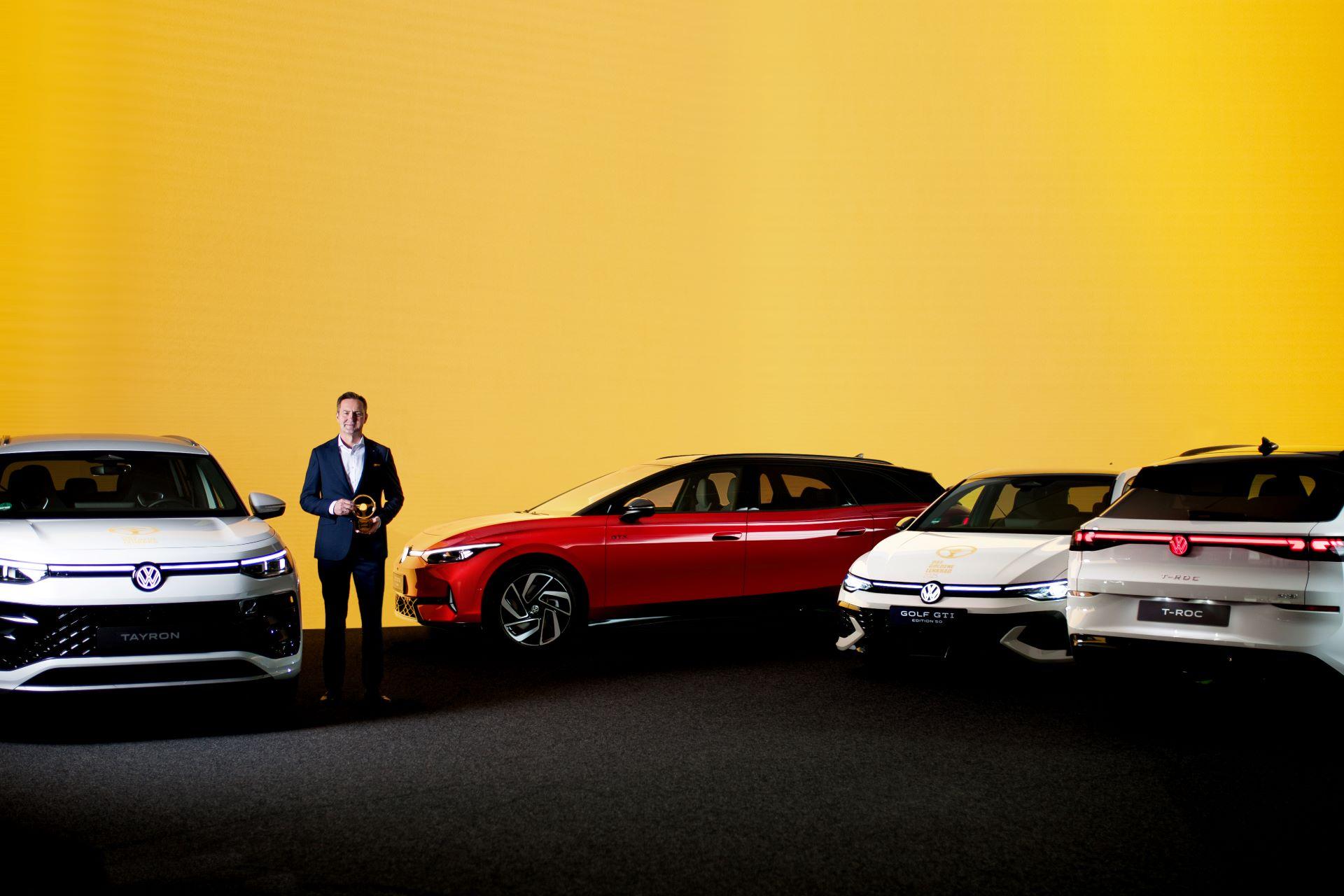
Key models played a decisive role. The Volkswagen T-Roc and Tiguan each secured first place in two of Europe’s most important growth segments, reinforcing the strength of the Group’s core SUV offering and its ability to balance scale with profitability.
South America was the fastest-growing region in 2025, with deliveries increasing by 11.6 per cent to 663,000 vehicles, the highest level since 2014. Brazil, the region’s largest market, grew by 5.7 per cent, while the successful introduction of new models helped expand Volkswagen Group’s footprint despite intense competitive pressure. A standout example was the Volkswagen Tera, which attracted more than 56,000 customers in its first year alone, underlining the importance of regionally tailored products.
North America, by contrast, proved more challenging. Deliveries declined by 10.4 per cent to 946,800 vehicles, driven largely by a 13.6 per cent drop in the United States. A difficult tariff environment and the discontinuation of electric vehicle subsidies weighed heavily on demand, particularly in the context of heightened competition.
In the Asia-Pacific region, deliveries fell by 6.5 per cent to 3.01 million vehicles. China remained the primary pressure point, with an 8.0 per cent decline reflecting an intensely competitive market and the Group’s deliberate transition phase ahead of new locally developed electric models. Even so, there were notable bright spots. Audi reclaimed the top position in China’s premium segment for the first time in six years, while Volkswagen, including the Jetta brand, strengthened its leadership in the combustion engine market.
Electrification gathers pace across global markets
Perhaps the most compelling narrative of 2025 was Volkswagen Group’s accelerating shift towards electrified mobility. Battery-electric vehicle deliveries rose by 32 per cent year on year to 983,100 units, lifting the global BEV share of total deliveries from 8 to 11 per cent.
Europe was once again at the forefront of this transformation. BEV deliveries surged by 66 per cent, enabling the Group to further expand its electric market leadership to around 27 per cent. Five Volkswagen Group models ranked among the top 10 best-selling BEVs in Europe, a testament to both breadth and depth in the electric portfolio. BEV order intake in Europe climbed by approximately 55 per cent, pushing the electric order book to more than 200,000 vehicles and raising the BEV share of total orders to around 22 per cent.
The United States also recorded strong BEV growth of 46 per cent, despite broader market challenges. In China, BEV deliveries declined by 44 per cent, a planned contraction designed to pave the way for the launch of a new generation of locally developed electric vehicles better aligned with customer expectations and regulatory requirements.
Plug-in hybrid vehicles provided another important growth pillar. Global PHEV deliveries rose by around 58 per cent to 428,000 units, driven by strong customer demand for second-generation plug-in hybrid systems offering pure electric ranges of up to 143 kilometres. Europe led this trend, with PHEV deliveries increasing by 72 per cent, reflecting the appeal of flexible electrification solutions during the transition phase.
A diversified electric portfolio driving volume
Volkswagen Group’s electric momentum in 2025 was underpinned by a broad and competitive model lineup spanning multiple brands and segments. The Volkswagen ID.4 and ID.5 duo led global BEV sales with 163,400 units, followed by the Volkswagen ID.3 with 117,700 deliveries. Škoda’s rapid ascent in the electric space was evident in the performance of the Elroq, which reached 95,300 units, while the Enyaq family added a further 79,600 deliveries.
Audi’s electric offensive gained traction with the Q4 e-tron and the newly introduced Q6 e-tron, each contributing around 85,000 units. The Volkswagen ID.7, including the Tourer variant, matched that momentum, highlighting growing acceptance of electric vehicles in the midsize and upper segments. Niche but strategically important models such as the ID. Buzz, Porsche Macan Electric and CUPRA Born further reinforced the Group’s presence across lifestyle, performance and premium categories.
Positioned for an ambitious 2026
Looking ahead, Volkswagen Group enters 2026 with a renewed sense of purpose. As Marco Schubert, Member of the Group’s Extended Executive Committee for Sales, noted, the strong delivery performance of 2025 was built on attractive products capable of meeting diverse customer tastes across all drive types. With order intake across all powertrains up around 13 per cent, and a rapidly expanding electrified order book, the foundation for future growth is firmly in place.
The next phase will be defined by scale and speed. More than 20 new models are set to launch in 2026, including further vehicles from the Group’s Electric Urban Car Family and an expanded model offensive in China. By combining entry-level e-mobility with advanced technology across Volkswagen, CUPRA and Škoda, the Group aims to make electric mobility more accessible while continuing to innovate at the upper end of the market.
In a global automotive landscape marked by uncertainty, Volkswagen Group’s 2025 performance demonstrates the value of strategic consistency paired with product agility. Stable volumes, accelerating electrification and targeted regional growth have positioned the Group not just to navigate the transition, but to help define its direction in the years ahead.