

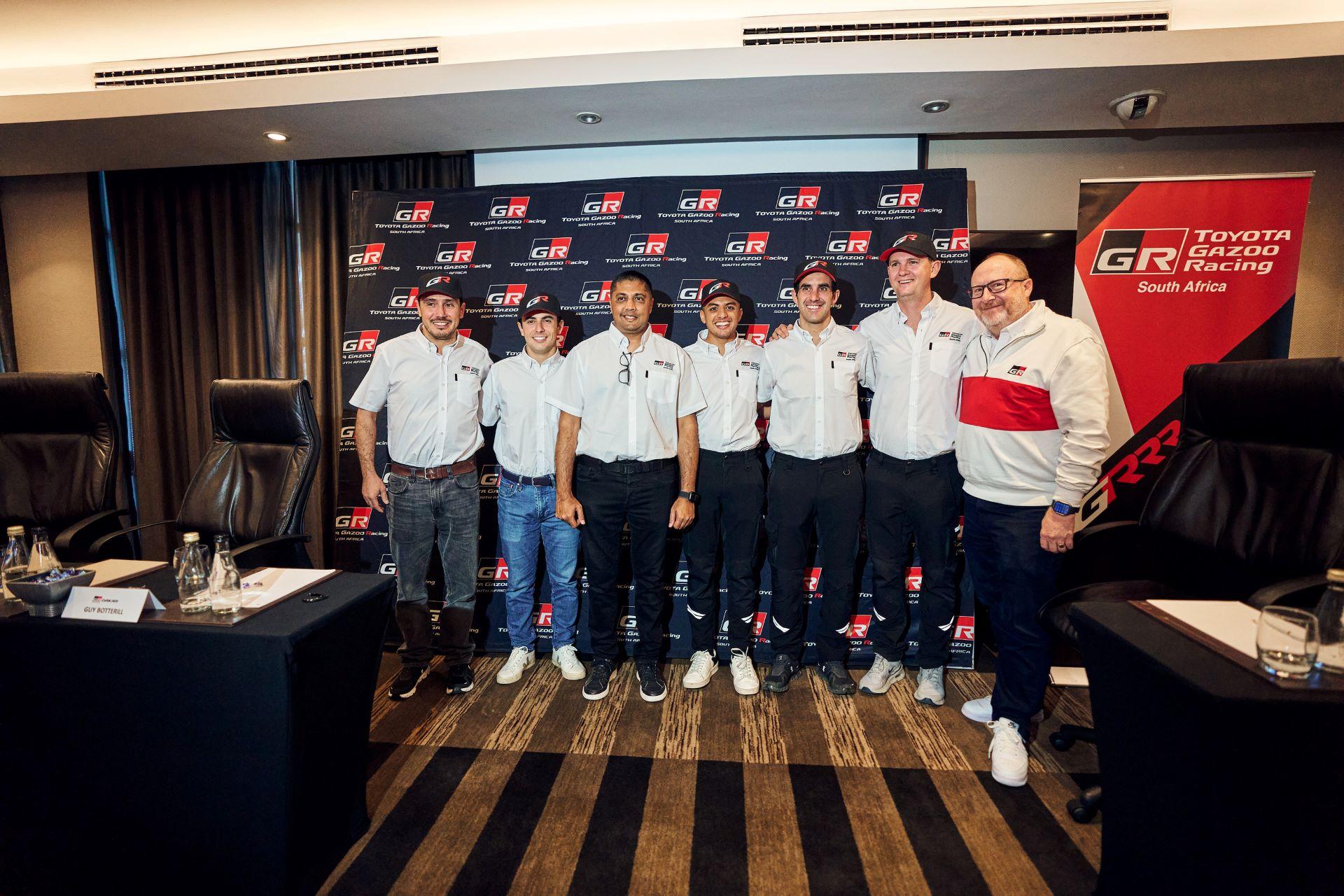
Toyota Gazoo Racing South Africa’s return to OR Tambo International Airport on the morning of 20 January 2026 marked more than the end of another Dakar Rally. It marked the conclusion of a campaign defined by endurance, discipline and an unshakeable belief in process over short-term reward. After more than 7,000 kilometres across the punishing terrain of Saudi Arabia, Dakar 2026 once again reminded the motorsport world why this rally remains the ultimate measure of both human resolve and mechanical integrity.
This year’s event was widely regarded as one of the toughest in recent memory. The pace was relentless from the opening stages, the margins tighter than ever, and the attrition rate a stark indicator of how unforgiving modern Dakar has become. In that context, simply reaching the final podium in Yanbu was an achievement that carried weight. As Toyota South Africa Motors Vice-President of Marketing Glenn Crompton reflected on the team’s performance, the emphasis was firmly on what lay beneath the headline results.
“This is an incredibly difficult race to finish,” Crompton said. “When you look beyond the final results and study the performance day by day, waypoint by waypoint, we were consistently at the front of the race. Unfortunately, punctures were the one element we couldn’t control, and that clouded the overall picture. But this was a very strong Dakar for us as a team.”
That underlying competitiveness was not confined to a single car or moment. Across all three GR Hilux IMT EVO entries, Toyota Gazoo Racing South Africa demonstrated front-running pace at various points during the rally, validating both the technical package and the strategic approach brought into Dakar 2026.
Team Principal Shameer Variawa explained that the campaign was built around a deliberately conservative opening phase, designed to balance speed with survival. The plan was to emerge from the first week intact and positioned to attack in the second half. It was a strategy rooted in experience, but one that was tested by an unusually high number of tyre failures.
“Our strategy was to get through the first week cleanly and set ourselves up for the second half of the rally,” Variawa said. “What we couldn’t anticipate was the sheer number of punctures we encountered. We went through close to 36 flat tyres during the race. Mechanically, the cars were strong and reliable, and from a performance point of view, we were where we needed to be.”
In many ways, that statistic tells the story of Dakar 2026. As stages became faster and rockier, the rally increasingly resembled a flat-out sprint rather than a measured endurance contest. The margins for error shrank, and external variables, particularly tyre damage, played an outsized role in shaping the leaderboard. Yet through it all, the durability of the GR Hilux IMT EVO remained a constant.
“The benchmark has risen across the board,” Variawa noted. “Everyone is pushing harder, every day, and our Hiluxes took an incredible beating and still finished. That speaks volumes about the work done by the engineers and mechanics.”
One of the defining highlights of the rally came on Stage 8, where Saood Variawa and co-driver Francois Cazalet delivered a hard-earned stage victory that showcased both pace and composure under pressure. Starting deep in the field, the pair had to fight through dust, traffic and constantly changing terrain, making their win all the more significant.
For Saood, who ultimately finished as the top-placed South African driver at Dakar 2026, the result was a reward for persistence in the face of repeated setbacks. “Every stage we gave it everything,” he said. “Up until the point where punctures or small errors crept in, we were always running inside the top five. Winning a stage like that, by just a few seconds, showed we have the pace to run at the front.”
Cazalet described the victory as a moment that crystallised the crew’s potential and the team’s collective effort. “From the first kilometres, we knew we were on a mission,” he said. “We were focused on small details, on finding the best lines, and motivating each other until the end. That win meant a lot, not just for us in the car, but for the entire team.”
If Saood Variawa and Cazalet’s rally was defined by a breakthrough moment, then Dakar 2026 for Guy Botterill and navigator Oriol Mena was a test of resilience and mental strength. A sequence of early setbacks, including a damaged hydraulic jack and a brutally long stage completed without power steering, compromised their overall classification despite flashes of genuine pace.
“There were days where we had genuinely unforeseen issues that cost us a lot of time,” Botterill explained. “But even then, we managed to claw back time on the leaders. When you strip out a few of those major incidents, we were right there in the fight.”

For Mena, who joined the team midway through the 2025 South African Rally-Raid Championship season, Dakar represented both an education and an investment in the future. “The numbers don’t reflect the effort,” he said. “From the people in the kitchen to the engineers and mechanics, everyone gave everything. We’re building something strong, and that takes time.”
João Ferreira and co-driver Filipe Palmeiro completed the trio of GR Hilux IMT EVO crews, showing podium-contending speed particularly in the early dune stages. Their rally, however, was also shaped by tyre damage and the difficult decisions required to nurse a compromised car to the finish.
“We showed that we had the pace to fight for a podium, but Dakar doesn’t always go to plan,” Ferreira said on arrival back in South Africa. “Even so, being part of this team is special. You arrive with a damaged car at night, and by morning it’s perfect again. That gives you confidence to keep pushing.”
That ability to reset, repair and return stronger each day speaks to the unseen backbone of any Dakar campaign. Behind the scenes, mechanics, engineers and support staff worked late into the night, often on minimal sleep, ensuring that all three cars made it to the start line every morning. It is a rhythm of sacrifice and professionalism that defines Toyota Gazoo Racing South Africa’s approach to the sport.
“For us, it’s about development, not just of cars, but of people,” Crompton explained. “Drivers, navigators, mechanics, engineers, everyone grows through this process. That’s why we do Dakar. The results matter, but how you achieve them matters more.”
As the dust settles on Dakar 2026 and the focus shifts to the remainder of the season and the long road toward Dakar 2027, the prevailing mood within the team is one of pride rather than regret. The campaign delivered proof of competitiveness, highlighted areas for refinement, and reinforced the values that underpin Toyota Gazoo Racing South Africa’s presence at the world’s toughest rally.
“There’s a huge amount of sacrifice involved,” Crompton concluded. “When you see what this team puts in, the professionalism, the passion, the resilience, you realise that every single person can take pride in what was achieved. That, more than any trophy, is what this journey is really about.”
In a rally where perfection is an illusion and survival is never guaranteed, Toyota Gazoo Racing South Africa once again demonstrated that Dakar is as much about character as it is about classification. And on that measure, Dakar 2026 was a campaign worthy of respect.