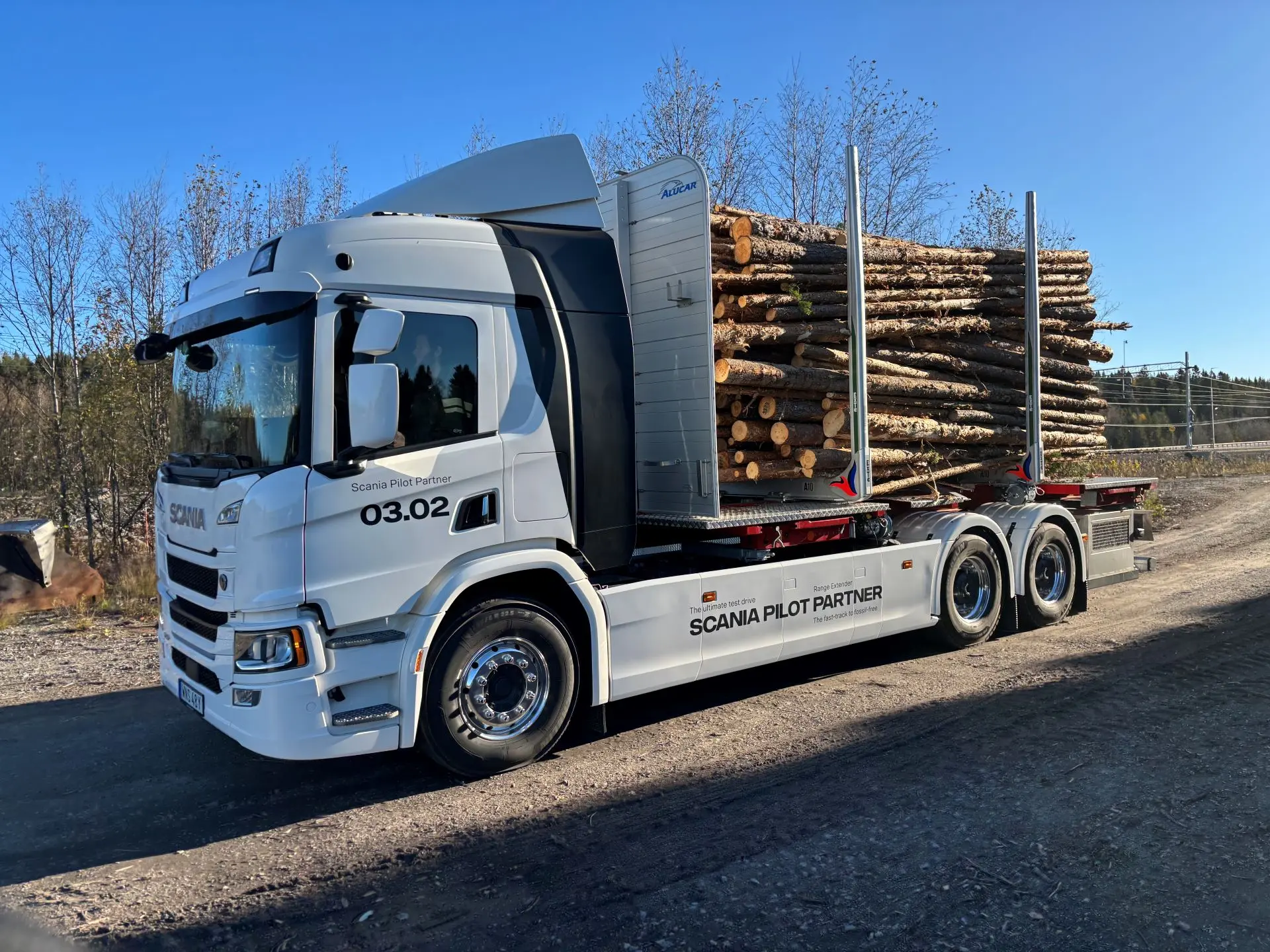
LONDON (2 December 2025) — In one of the most ambitious steps yet toward decarbonising heavy-duty transport in remote regions, Scania and Horse Powertrain have launched a real-world pilot to evaluate range-extended hybrid technology in timber haulage. The trial, now underway in northern Sweden, pairs Scania’s battery-electric drivetrain with an advanced high-efficiency generator developed in Sweden by Horse Powertrain’s Aurobay Technologies division.
Operating under SCA — one of Europe’s largest and most experienced forestry companies — the pilot truck is engineered to tackle Sweden’s harshest timber routes. These corridors are defined by steep inclines, heavy loads, unpredictable weather and, critically, a lack of reliable charging infrastructure. The goal: deliver diesel-like productivity with significantly reduced emissions.
A Practical Pathway to Low-Carbon Heavy Transport
While fully battery-electric long-haul transport is progressing rapidly, charging limitations remain a real operational barrier in remote industries such as forestry. This collaboration takes a pragmatic approach: combining zero-emission capability with a compact, reliable range-extender that acts purely as an onboard charger.
The truck’s electric drivetrain is supported by a 120-kW generator based on Horse Powertrain’s 2.0-litre high-efficiency multi-fuel engine. The generator never powers the wheels directly — instead, it tops up the batteries when needed during long distances, extreme temperatures or unexpected delays.
On its 16-km timber route, the pilot aims to complete 7–8 daily rounds — on par with diesel operations — and slightly outperforms a pure BEV by eliminating charging downtime.
Industry Leaders Share Insights
Matias Giannini, CEO at Horse Powertrain, highlights the challenge this technology is built to meet:
“Forestry logistics represents one of the toughest challenges for electrification. The forest roads of northern Sweden demand strength, range and reliability. Charging stations are few, but the timber never waits. You can think of our range-extender as a powerbank for a heavy-duty truck: silent, efficient, and always there when you need it… It’s a technology that cuts CO₂ now.”
Scania’s earlier work helps shape this trial. Tony Sandberg, Vice President at Scania Pilot Partner, emphasised how previous learnings support the Swedish project:
“Our 100-day trial in Germany logged nearly 22,000 km, running more than 90% on pure electric power and cutting CO₂ by over 90% versus diesel. Those insights give us a strong foundation as we tailor the system for demanding Nordic timber operations.”
For Ingo Scholten, CTO at Horse Powertrain and Managing Director Sweden for Aurobay Technologies, the value lies in studying real-world operator needs:
“Long stretches without charging, variable loads, rapidly changing weather — this pilot lets us understand those realities hour by hour. The range-extender’s role is simple: provide stable, efficient energy so drivers can finish their shift without interruption and with far lower emissions than diesel.”

Modular Technology Adapted for Heavy-Duty Demands
Horse Powertrain’s system draws on proven hybrid technology from its passenger and light-commercial applications but is re-engineered for the power density, durability and reliability required in heavy transport.
Unlike traditional fixed-speed gensets, the engine can operate across its full power band, allowing it to match output demand efficiently while reducing fuel use, noise and vibration. This flexibility is key in forestry operations, where conditions shift rapidly over the course of a single route.
Driving Decarbonisation in Hard-To-Electrify Sectors
The pilot truck is now in regular service, hauling full timber loads while gathering data on performance, efficiency and driver experience. Findings from this trial will shape future electrified powertrains for forestry and other demanding applications such as mining, construction and long-distance haulage.
Horse Powertrain stresses that technologies like range-extenders are an essential bridge for industries that cannot yet rely on widespread charging infrastructure.
By enabling dramatic CO₂ reductions today — rather than waiting for a perfect charging ecosystem — hybrid-electric solutions offer a practical and scalable route toward net-zero operations in the toughest corners of the transport world.