



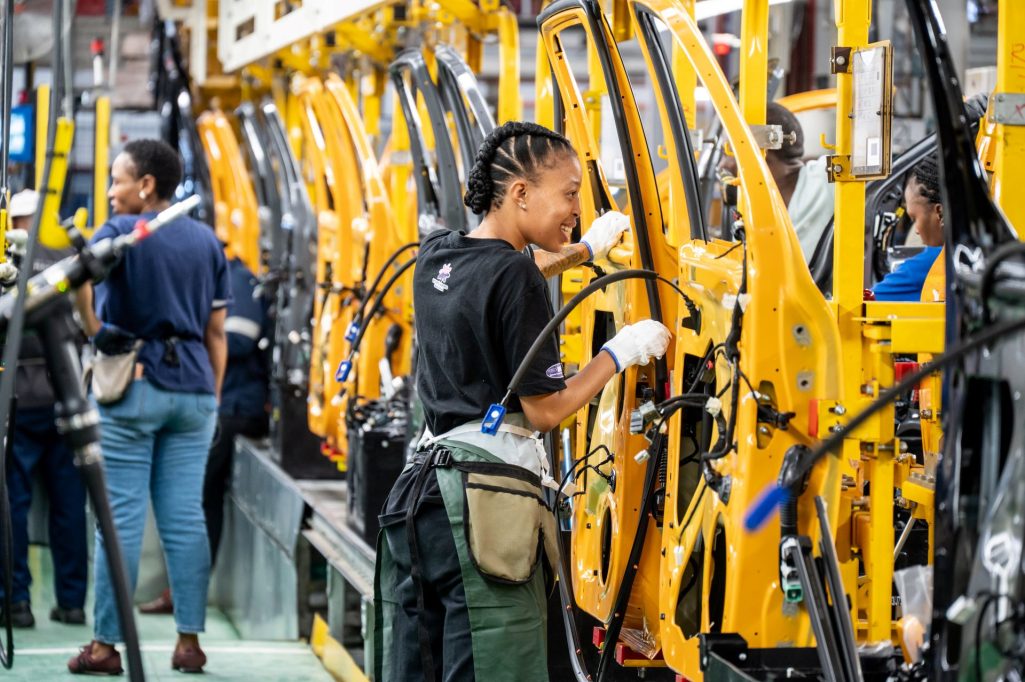
At Ford’s Silverton Manufacturing Plant in Pretoria, South Africa, an innovative shift is underway in the way weatherproof shields are installed in Ranger doors. This shift is driven by the integration of collaborative robots, or “cobots,” which are transforming traditional assembly line operations. These advanced machines are not replacing human workers but are enhancing their efficiency and workplace safety. Here’s how these cobots are making a significant impact on both productivity and employee well-being.
The Role of Collaborative Robots in Assembly Line Operations
Collaborative robots, such as the UR10e models deployed at the Silverton Plant, are engineered to work alongside human operators in a shared workspace. These robots have a one-metre reach and are strategically positioned along the door assembly line to perform the precise task of installing weatherproof shields.
The primary function of these cobots is to apply constant pressure to the adhesive bead on the weatherproof liner, ensuring a secure seal against the door’s sheet metal. This task, which requires both strength and precision, is ideal for automation, given its repetitive nature and the high standards of accuracy required.
How Cobots Improve Precision and Quality
The cobots are equipped with sensors that detect the arrival of each door and ensure its millimetre-perfect positioning. This level of precision is crucial for the installation process. The robots use a roller attached to their ‘wrist’ to apply the adhesive bead, exerting a controlled force of up to 5 kilograms.
According to Suresh Babu, Plant Manager of Silverton Vehicle Operations, “The cobots know exactly how much force to apply and can do so more easily and precisely than a human. They follow a complex path, avoiding any no-go zones on the door, which ensures the shield is completely sealed against water ingress. And they can do it the same every single time, which helps us achieve the quality expected.”
Benefits for Workers and Production Efficiency
Before the introduction of the cobots, the installation of weatherproof liners was a physically demanding task. Workers used hand-held rollers to apply the adhesive, which led to strain on their wrists, elbows, and shoulders. This repetitive work not only affected the health of the workers but also posed challenges in maintaining consistent quality.
The integration of cobots has addressed these issues by removing the physical strain from workers. The robots’ ability to perform the task with consistent pressure and precision has resulted in higher quality and faster installation times. “The cobot doesn’t get tired or ever need a break. It’s made a big difference to quality and health on the line,” Babu notes.
The use of collaborative robots in the assembly line at Ford’s Silverton Plant is a testament to the advantages of integrating automation in manufacturing processes. By taking over the repetitive and physically demanding task of installing weatherproof shields, these cobots enhance both the efficiency of production and the well-being of employees. As the automotive industry continues to evolve, the role of such advanced technologies will likely become even more integral in achieving high standards of quality and productivity.