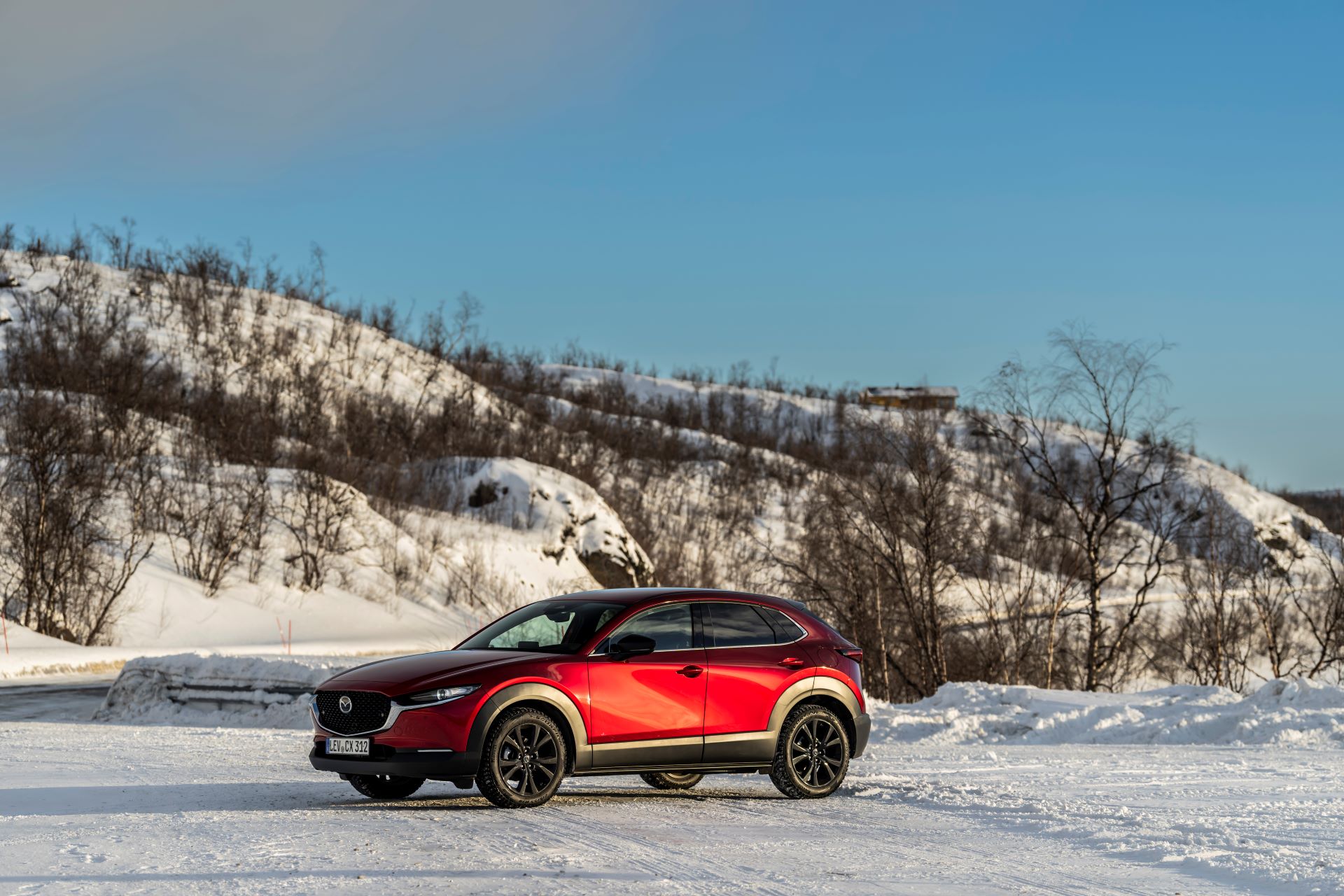
In a bold demonstration of its unwavering commitment to sustainable mobility, Mazda has driven home the real-world viability of advanced biofuels. Twelve Mazda CX-30s, each equipped with the brand’s new 140ps e-Skyactiv G petrol engine, recently embarked on an epic 1,344-mile journey from Malmö, Sweden, to Tromsø, Norway – a route that spans three Nordic countries and crosses into the Arctic Circle. The defining feature? Every vehicle ran exclusively on SUSTAIN 100% biofuel, a fossil-free alternative made from agricultural waste.
This expedition wasn’t just a feat of endurance or an ode to scenic driving. It was a compelling showcase of Mazda’s multi-solution powertrain strategy, which views electrification as just one of several critical tools in the path toward climate neutrality. At the heart of this journey was the newly introduced 2.5-litre e-Skyactiv G engine for the 2025 Mazda CX-30 – a refined, cylinder-deactivating powertrain paired with Mazda’s M Hybrid mild-hybrid system, delivering greater fuel efficiency and lower emissions than the outgoing 2.0-litre engine.
Yet, what truly made this transcontinental voyage significant was not the engine alone, but the fuel it burned. Developed by SUSTAIN, this second-generation biofuel repurposes carbon already in the natural cycle – captured by plants during growth and then re-released during combustion – unlike fossil fuels, which add long-buried carbon into the atmosphere. The result? A drastic reduction in net greenhouse gas emissions without requiring any engine modifications. On average, each CX-30 returned more than 40mpg throughout the journey, all while avoiding an estimated 317kg of CO₂ emissions per car.
A Real-World Laboratory
This journey served as a rolling laboratory for sustainable innovation. Facing cold, variable terrain and travelling over 200 miles north of the Arctic Circle, the convoy showcased the capability of Mazda’s combustion technology under demanding conditions. For Jeremy Thomson, Managing Director of Mazda Motors UK, the drive was a clear signal: “We will continue to develop the internal combustion engine to meet consumer demand in parallel with our battery electric development. Our drive to the very north of Europe demonstrates not only the capability of the Mazda CX-30 but also the potential of advanced biofuels in reducing vehicle emissions.”
The mission also aligned with broader goals at Mazda, which is not only part of the European eFuel Alliance but also actively researching future fuels such as algae-based and synthetic alternatives in Japan.
More Than Just a One-Off
This isn’t Mazda’s first foray into the sustainable fuel arena. Since June 2023, Mazda UK’s Heritage Fleet has been running exclusively on SUSTAIN biofuel. That same year, a Mazda MX-5 completed the first lap of race tracks in all four UK nations on sustainable fuel. More recently, a team of four MX-5s travelled from Land’s End to John O’Groats – again, without using a drop of fossil fuel.
These efforts underscore how sustainable fuels can bridge the gap between today’s vast population of internal combustion vehicles and tomorrow’s greener automotive landscape.
Scaling the Solution
David Richardson, Director at SUSTAIN, believes this journey offers a clear call to action: “Electric vehicles are increasing in numbers, but there are still millions of combustion cars on our roads. Activities like this show how emissions can be reduced today, without waiting for a full EV transition. If we want to make the most of this technology, we need to raise awareness, correct misconceptions, and support the scaling up of sustainable fuel production.”
Indeed, the message is clear: while electric mobility continues to grow, there is no one-size-fits-all solution. Mazda’s drive to the Arctic proves that with the right fuel and innovative engineering, the combustion engine still has a key role to play in decarbonising transport.
In a world searching for scalable, immediate solutions to climate change, Mazda’s Arctic expedition – powered entirely by waste-derived fuel – is more than a road trip. It’s a roadmap.