



There are more comfortable SUVs. There are quieter ones, more efficient ones, more polished ones, and plenty that ask far less of their owners. Yet the Jeep Wrangler keeps holding on to something many modern vehicles have quietly lost: character you can feel before you even turn the key.
That is what makes the Wrangler so special.
It is not special because it is perfect. In fact, part of its appeal is that it never pretends to be. The Wrangler does not try to smooth away its edges until it feels like every other family SUV with a rugged marketing package. It still feels mechanical, honest, and slightly stubborn. It still asks you to meet it halfway. For the people who love them, that is not a flaw. That is the whole point.
For Wrangler owners and enthusiasts, the attraction runs deeper than styling or badge value. It is about heritage, freedom, capability, and a kind of emotional connection that only a few vehicles ever manage to earn.
It still feels connected to something bigger than itself
The Wrangler carries one of the clearest lines of heritage in the automotive world.
Even people who know very little about Jeeps can look at a Wrangler and recognise that it belongs to a story older than most modern SUVs. It still carries the visual memory of wartime utility, post-war adventure, farm roads, mountain tracks, beach runs, and generations of owners who wanted a vehicle that felt useful first and fashionable second.
That continuity matters.
A lot of vehicles borrow from the past in cosmetic ways. The Wrangler feels different because its identity was never built as a retro exercise. It evolved, but it did not abandon the core idea. That is why it still carries so much weight with enthusiasts. A Wrangler does not feel like it was invented by a lifestyle department. It feels like it came from a long, lived-in tradition.
The design is iconic because it never chased approval
You could recognise a Wrangler by silhouette alone.
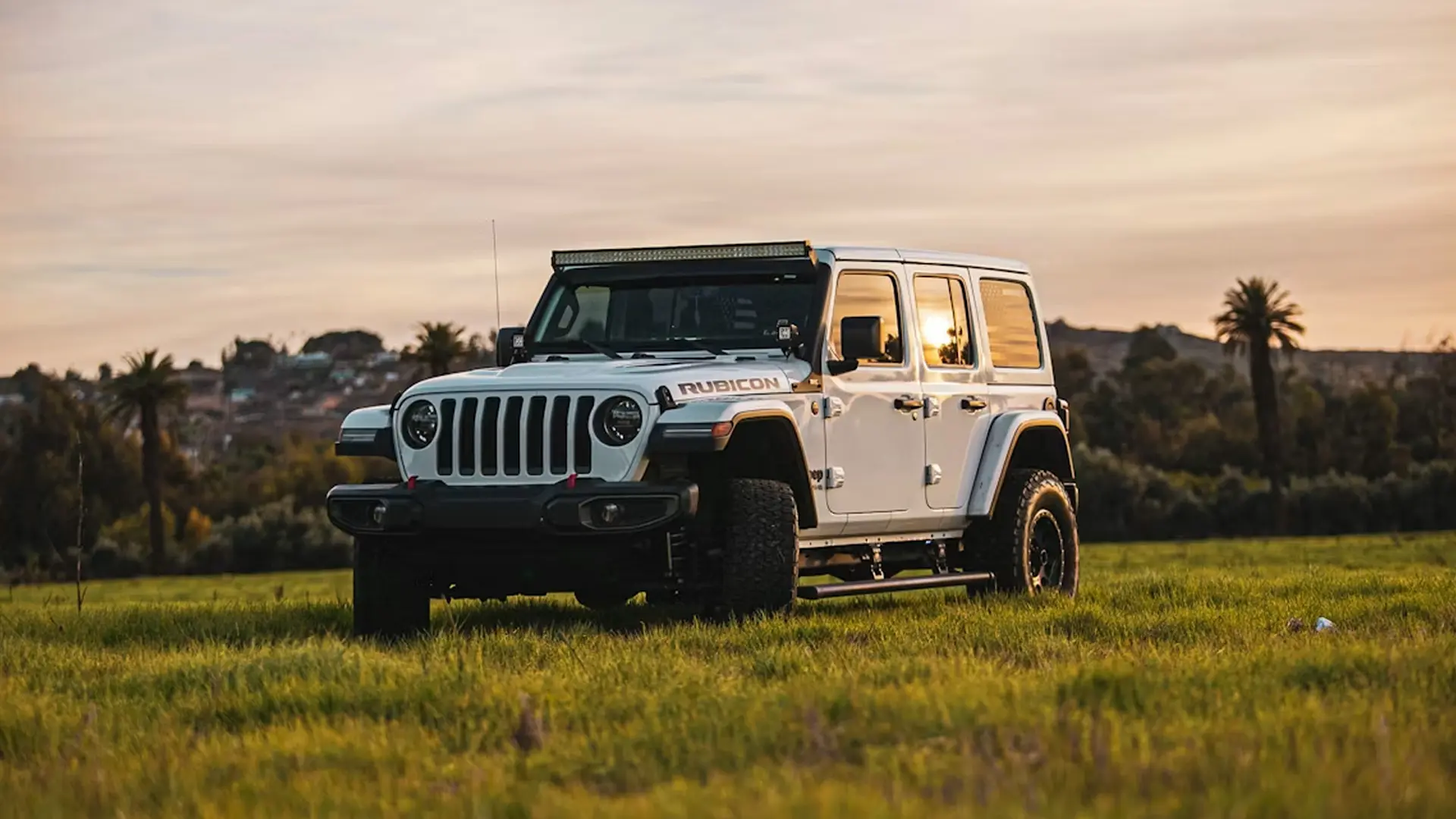
The upright windscreen, the exposed hinges, the boxy body, the round headlamps, the seven-slot grille, the short overhangs, the removable roof and doors — none of it looks accidental. The Wrangler stands apart because it was never shaped by the same rules as most mainstream SUVs.
That design has survived because it means something.
It tells you, immediately, that this is a vehicle built around a purpose. It does not hide its shape under sweeping curves or overworked details. It is simple in the way old tools are simple. Functional, direct, and full of identity.
And that identity matters enormously in a market full of vehicles that blur together after ten seconds in traffic.
Open-air freedom changes the whole relationship
Few things separate the Wrangler from the rest of the market quite like the open-air experience.
This is not a styling gimmick. It changes the emotional tone of the vehicle completely.
Take the roof off, remove the doors, fold the wind into the cabin, and suddenly the drive feels less sealed-off and less routine. A short trip becomes an event. A familiar road feels different. The vehicle stops feeling like a capsule and starts feeling like part of the landscape around you.
That is a huge part of Wrangler loyalty.
Owners often talk about the feeling more than the feature itself. It is not only about sun or scenery. It is about the way the Wrangler makes driving feel less filtered. In a world where so many vehicles try to isolate you from everything outside, the Wrangler does the opposite. It invites the world in.
Off-road credibility is not a costume here
A lot of vehicles like to look adventurous. The Wrangler still feels like it expects you to use it properly.
Its appeal is rooted in real off-road honesty. Approach a Wrangler and you can see that its proportions, stance, and design priorities come from capability, not from image-making. It looks ready because it was built around being ready.
That matters to enthusiasts, even those who are not climbing rock faces every weekend.
The Wrangler carries a kind of credibility that cannot be faked. Owners know there is substance behind the look. Whether it is trail driving, overlanding, beach use, mountain routes, or simply the comfort of knowing the vehicle can go much further than the average SUV ever should, that capability becomes part of the bond.
And perhaps more importantly, the Wrangler makes capability feel accessible. It encourages curiosity. It makes people want to take the long road, the dirt road, the road that may not really be a road at all.
Wrangler ownership feels like belonging to a tribe
The Wrangler does not just have customers. It has a culture.
That culture is one of the reasons owners stay so emotionally invested. Wrangler people tend to spot each other quickly. There is shared language, shared humour, shared knowledge, shared stories about trips, modifications, breakages, weather, mud, roadside fixes, and the weird satisfaction of driving something that non-owners do not always fully understand.
The famous wave is not important because it is cute. It is important because it reflects recognition. It says: I know why you chose that. I know what you like about it. I know what it asks of you, and why you keep coming back.
That sense of belonging is hard to manufacture. Wrangler culture has endured because it grew around a vehicle with a distinct identity and a loyal, hands-on owner base.
Few vehicles invite personal expression like a Wrangler
The Wrangler may be one of the most customisable mainstream vehicles on the road.
That matters because owners rarely want their Wrangler to remain generic for long. Some build them for trails. Some for touring. Some for beach life. Some for urban presence. Some keep them close to stock but personalise the small details. Others transform them almost beyond recognition.
Either way, the Wrangler seems to invite participation.
It feels less like something you merely purchase and more like something you shape over time. Wheels, tyres, roof setups, bumpers, racks, lights, recovery gear, interior touches, suspension changes, graphics, storage solutions — every owner reveals something of themselves through the vehicle.
That customisation culture deepens attachment. The vehicle becomes personal in a very literal sense.
The quirks are part of the story, not separate from it
Wrangler owners are usually more honest about the vehicle than outsiders expect.
They know the ride may not be the smoothest. They know there are compromises. They know daily life in a Wrangler can involve wind noise, awkwardness, old-school behaviour, and a level of mechanical personality that some buyers would reject immediately.
But that honesty is part of the loyalty.
People do not stay devoted to Wranglers because they are blind to the quirks. They stay loyal because the Wrangler gives them things other vehicles do not. The compromises feel connected to the same qualities that make the vehicle worth loving in the first place.
That is a very different kind of ownership relationship from the one most modern cars offer. Many cars are easier to live with, but easier is not always more memorable.
It creates emotional memory better than most cars ever will
Some vehicles are impressive. Fewer become part of people’s personal mythology.
The Wrangler has a remarkable ability to attach itself to moments: first trail drives, sunset roof-off runs, muddy weekends away, convoy trips with friends, awkward recoveries, campfire photos, mountain passes, unexpected breakdown laughs, and the feeling of seeing your own Jeep dirty, scratched, and fully in its element.
That emotional memory is the real fuel of Wrangler loyalty.
Owners do not just remember how the vehicle drove. They remember what they were doing in it, who they were with, and how it made them feel. Over time, the Wrangler becomes bound up with freedom, self-expression, adventure, resilience, and identity.
Very few vehicles manage that.
Why owners keep coming back
The simple answer is that the Wrangler offers an experience, not just transport.
It gives owners:
- a clear connection to heritage
- unmistakable design
- genuine open-air character
- real off-road credibility
- a strong owner community
- endless room for personalisation
- an emotional payoff that outlasts the inconveniences
That combination is rare.
You can replace comfort with comfort. You can replace features with features. You can replace one polished SUV with another polished SUV. What is much harder to replace is a vehicle that feels like it has a soul of its own.
Final thoughts: the Wrangler is special because it still feels alive
The Jeep Wrangler is special because it still resists becoming bland.
It is a vehicle with history in its shape, purpose in its design, freedom in its experience, and personality in the way it asks to be owned. It is not for everyone, and that is part of why the people who love them love them so fiercely.
A Wrangler is not simply something you drive. For many owners, it becomes part of how they see themselves and how they want to move through the world: a little less filtered, a little more curious, a little more willing to get dusty on the way somewhere worth remembering.
That is why people stay loyal.
Not because the Wrangler is flawless, but because it makes ordinary driving feel less ordinary — and because once a vehicle gives you that, it is very hard to forget.


