Volkswagen’s Brand Group Core, which encompasses its popular Volkswagen Passenger Cars, Škoda Auto, SEAT/CUPRA, and Volkswagen Commercial Vehicles, has released its third-quarter financials for 2024. The results offer insight into the group’s resilience amid rising market pressures and operational challenges, marked by robust sales performance but impacted profitability due to escalating fixed costs.
Stable Sales, New Model Launches, and Rising Fixed Costs
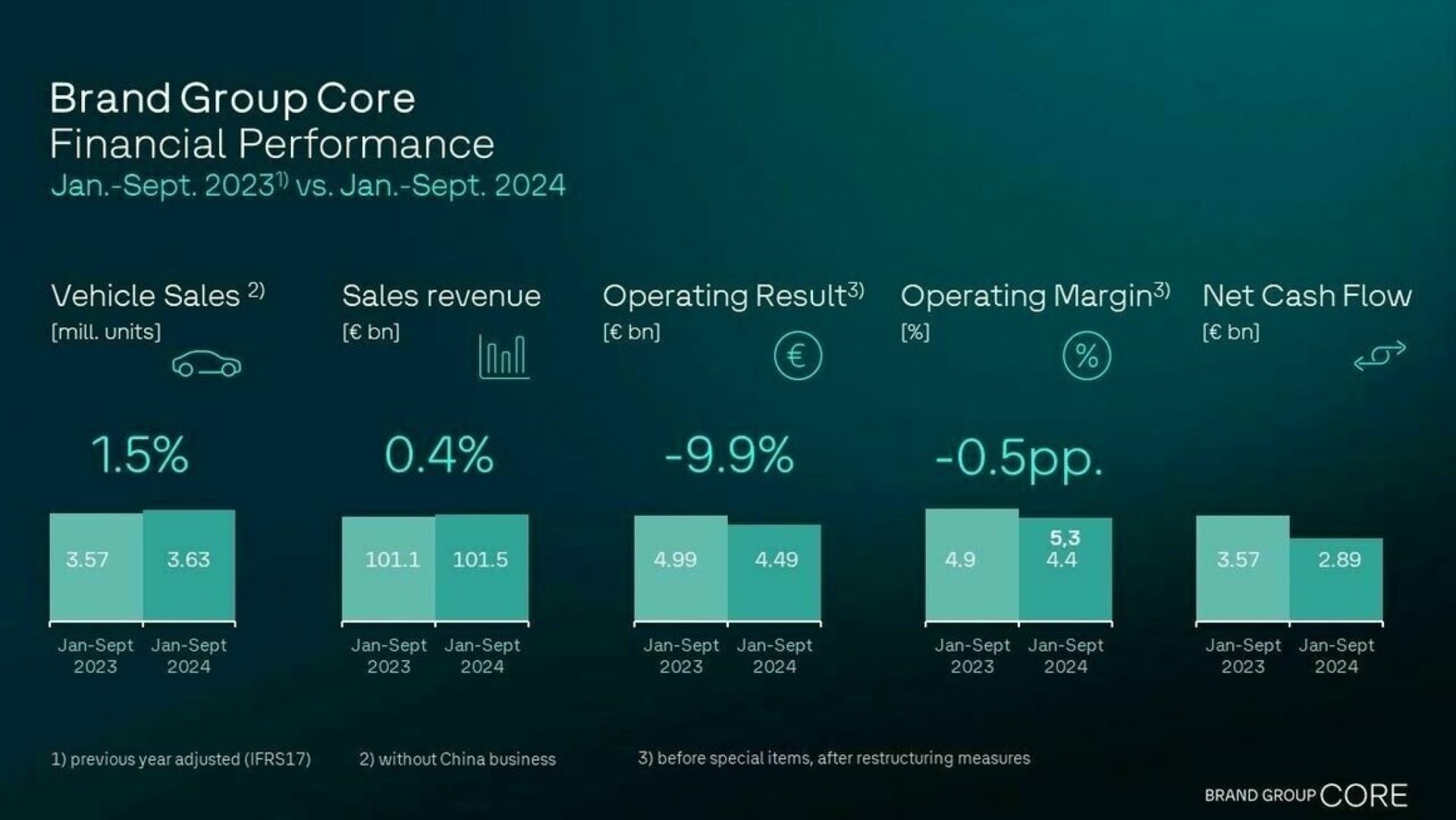
From January to September 2024, Volkswagen’s Brand Group Core achieved unit sales of 3.63 million vehicles, reflecting a modest year-on-year increase of 1.5%. Key new launches, such as the all-electric ID.7 Tourer, the new Volkswagen Tiguan, and the iconic Golf, helped maintain stable sales and bolster Volkswagen’s market presence despite the rising competition.
David Powels, who joined as the new Member of the Board of Management for Finance at Volkswagen on October 1, highlighted that while these product introductions have positively impacted sales, they could not entirely offset higher operational costs in Q3. “Despite stable vehicle sales… we were not able to offset higher fixed costs in the third quarter, especially at the VW brand,” Powels noted.
As a result, the Brand Group Core’s operating result reached €4.49 billion, a 9.9% decrease from the previous year’s €4.99 billion. The operating margin before special items settled at 4.4% for the first three quarters, down from 4.9% during the same period in 2023. Additionally, the brand group reported a 19% drop in net cash flow, now at €2.89 billion, primarily driven by an increase in inventory due to Volkswagen’s model expansion and heightened receivables.
Financial Overview by Brand
The Brand Group Core’s overall performance across its key brands reveals both resilience and challenges:
Volkswagen Passenger Cars: The brand delivered 2.26 million vehicles by September 2024, marking a 1% increase from the previous year. However, despite achieving €63.5 billion in revenue, higher fixed costs and restructuring measures reduced its operating result by 36.9% to €1.34 billion, resulting in a decrease in operating margin from 3.4% to 2.1%.
Škoda Auto: Škoda demonstrated significant growth, with deliveries reaching 671,300 units, a 4.5% increase. Škoda’s revenue rose to €20.4 billion, accompanied by a robust 8.3% operating margin. The brand’s streamlined cost structure and broad model range contributed to this performance, resulting in a notable 34.8% rise in operating profit to €1.7 billion.
SEAT/CUPRA: SEAT and CUPRA achieved moderate growth with 466,374 vehicle deliveries, a 2.6% increase. However, revenue saw a slight decline to €10.5 billion, accompanied by a 3.9% operating margin, which decreased by 0.7 percentage points compared to the prior year.
Volkswagen Commercial Vehicles: Volkswagen Commercial Vehicles maintained stability with 310,000 units sold and a revenue close to €11.09 billion. Nonetheless, the operating return decreased to 5.5% due to anticipated restructuring expenses, which impacted the operating result, now at €606 million.
Outlook: Strategic Cost Measures and Profitability Goals
The Brand Group Core remains focused on navigating a challenging environment marked by intensifying competition and geopolitical uncertainties. To secure future investments and profitability, Volkswagen plans to implement comprehensive cost-cutting measures across its brands. These initiatives aim to enhance operational efficiency, drive cost discipline, and leverage synergies within the Brand Group Core to maintain a competitive edge.
Powels reiterated the necessity for these measures, stating, “In order to increase our profitability, we must vigorously expand and execute our performance programmes.” He emphasized that by focusing on “strict cost efficiency and the realization of synergies generated by cooperation,” the group aims to position itself for long-term success. Key priorities include enhancing productivity, bolstering competitiveness, and building on Volkswagen’s quality leadership and innovation.
Model Demand Trends and Upcoming Momentum
Volkswagen’s recent model debuts, including the ID.7, Tiguan, Golf, and Škoda’s Elroq, continue to generate customer interest, with increasing demand for models like the Polo and ID.7. Volkswagen anticipates this demand, combined with an expanded product lineup, will generate additional market momentum in the months ahead.
By strengthening its cost efficiency initiatives and focusing on high-quality, innovative vehicles across internal combustion engines (ICE), hybrids, and electric models, Volkswagen’s Brand Group Core aims to overcome current market challenges and enhance its global position in the automotive industry.