



Toyota’s legacy at Le Mans is one of passion, perseverance and progress—and as the brand marks its 40th year in the world’s most iconic endurance race, TOYOTA GAZOO Racing is set to honour the milestone in a way that fuses nostalgia with cutting-edge ambition.
At the 93rd running of the 24 Hours of Le Mans on 14–15 June 2025, Toyota will field two GR010 HYBRID Hypercars adorned in bespoke liveries—each telling a distinct story of the marque’s past and present journey through motorsport’s most grueling battlefield.
A Tribute to the TS020: The #7 GR010 HYBRID
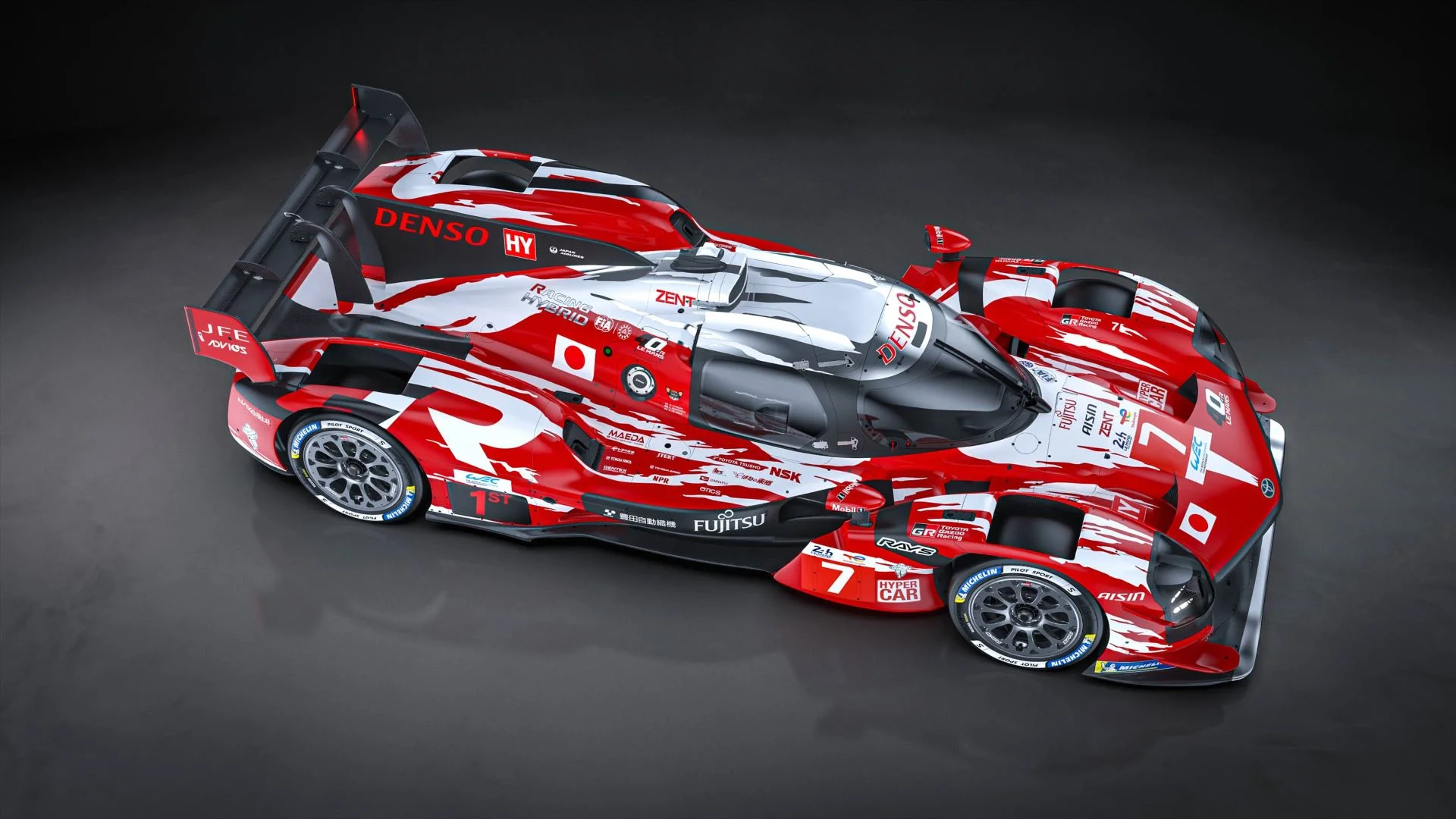
Driven by Mike Conway, Kamui Kobayashi and Nyck de Vries, the #7 GR010 HYBRID will proudly wear a livery inspired by one of Toyota’s most revered Le Mans machines—the TS020, also known as the GT-One. Competing in 1998 and 1999, the TS020 left an indelible mark on fans and the racing world alike with its futuristic aerodynamics and unmistakable red-and-white livery. It wasn’t just a car—it was a pop-culture icon, capturing imaginations through its inclusion in the original Gran Turismo video game and setting the stage for Toyota’s first-ever Le Mans pole position in 1999.
Now, more than two decades later, the TS020’s spirit lives on. The #7’s 2025-spec livery features a bold red base punctuated by jagged white flashes—an electrifying reinterpretation of the GT-One’s iconic colour scheme. It’s a celebration not just of Toyota’s racing pedigree, but of the enduring emotional connection between car, competition and community.
Racing into the Present: The #8 GR010 HYBRID
While the #7 looks to the past, the #8 GR010 HYBRID carries the banner of Toyota’s present-day determination. Piloted by Sébastien Buemi, Brendon Hartley and Ryo Hirakawa, the car sports a sleek matt black livery built around a vivid GR (GAZOO Racing) logo motif. This design embodies the team’s core philosophy of “Speed” and a relentless “Hate to lose” attitude—values that continue to drive innovation in the Hypercar era.
The #8’s look also reflects the spirit of the “Prototype” concept: a visual and technological manifestation of Toyota’s commitment to developing ever-better, motorsport-bred vehicles through continuous evolution. It’s not just about aesthetics—it’s about identity, purpose and pushing the envelope of performance.
Both cars will carry a special 40th anniversary logo, a symbol of Toyota’s long-standing commitment to endurance racing and its enduring presence at La Sarthe.
Honouring the Past, Shaping the Future
Beyond the visual celebration, Toyota’s 40th Le Mans campaign also marks a moment to reflect on four decades of highs and lows that have defined the manufacturer’s journey at the Circuit de la Sarthe. Since its debut in 1985 with the 85C—a machine powered by a road-car-derived engine—Toyota has fielded 61 cars across 26 editions of the 24-hour race, earning five victories, 18 podiums and eight pole positions.
From the GT-One’s near-triumphs at the turn of the millennium, to the heartbreak of narrow defeats, and finally to redemption with the TS050 HYBRID’s three consecutive wins beginning in 2018, Toyota’s path to the top has been anything but straightforward. Its latest chapter, the Hypercar era, has already seen wins in 2021 and 2022 with the GR010 HYBRID, reaffirming Toyota’s place at the pinnacle of endurance racing.
And yet, while the #7 and #8 cars honour Toyota’s past and present, the brand is also casting its gaze toward the future. At this year’s Le Mans, TOYOTA GAZOO Racing will shine a spotlight on its hydrogen-powered racing initiatives—proof of how motorsport continues to serve as a laboratory for sustainable, cutting-edge technologies. Through these efforts, Toyota reaffirms its commitment to carbon-neutral mobility without compromising on excitement, performance, or passion.
More Than a Race
In 2025, Toyota’s 40th anniversary at Le Mans is more than a milestone—it’s a testament to endurance in every sense of the word. From the earliest days of the 85C to the futuristic GR010 HYBRIDs lining up this June, the journey has been driven by vision, shaped by competition, and fuelled by fans.
As the flag drops on this year’s edition, the red-and-white echoes of the past will race alongside the stealthy defiance of the present, both aiming for victory—not just to win another trophy, but to further engrave Toyota’s story into the hallowed tarmac of La Sarthe.
Because at Le Mans, heritage matters—but it’s what comes next that defines the legacy.