


Mercedes Benz Aeroacoustic wind tunnel

Mercedes Benz Aeroacoustic wind tunnel

The new aeroacoustic wind tunnel: New tool in the battle against wind resistance and wind noise With the more than 70 year-old wind tunnel in Stuttgart-Untertürkheim, Mercedes-Benz was the first automobile manufacturer to possess a wind tunnel. With the new aeroacoustic wind tunnel at the development centre in Sindelfingen, the company has once again placed […]
By Ronel Ferreira15 February 20134 min read

The new aeroacoustic wind tunnel: New tool in the battle against wind resistance and wind noise

Mercedes-Benz Wind Tunnel

With the more than 70 year-old wind tunnel in Stuttgart-Untertürkheim, Mercedes-Benz was the first automobile manufacturer to possess a wind tunnel. With the new aeroacoustic wind tunnel at the development centre in Sindelfingen, the company has once again placed itself at the forefront of aerodynamic testing.

As a measure of the company’s confidence in the future, the go-ahead for the construction of the new Mercedes-Benz aeroacoustic wind tunnel was given in 2008 – in the middle of the most severe economic crisis for decades. This means that from mid-2013, Mercedes-Benz developers will for the first time have the right facilities directly at the passenger car development centre in Sindelfingen. Joining the climate tunnel taken into operation two years ago and the new driving simulator centre, this rounds off the new test facilities at the Mercedes-Benz Technology Centre and strengthens the development potential of Mercedes-Benz in Germany.

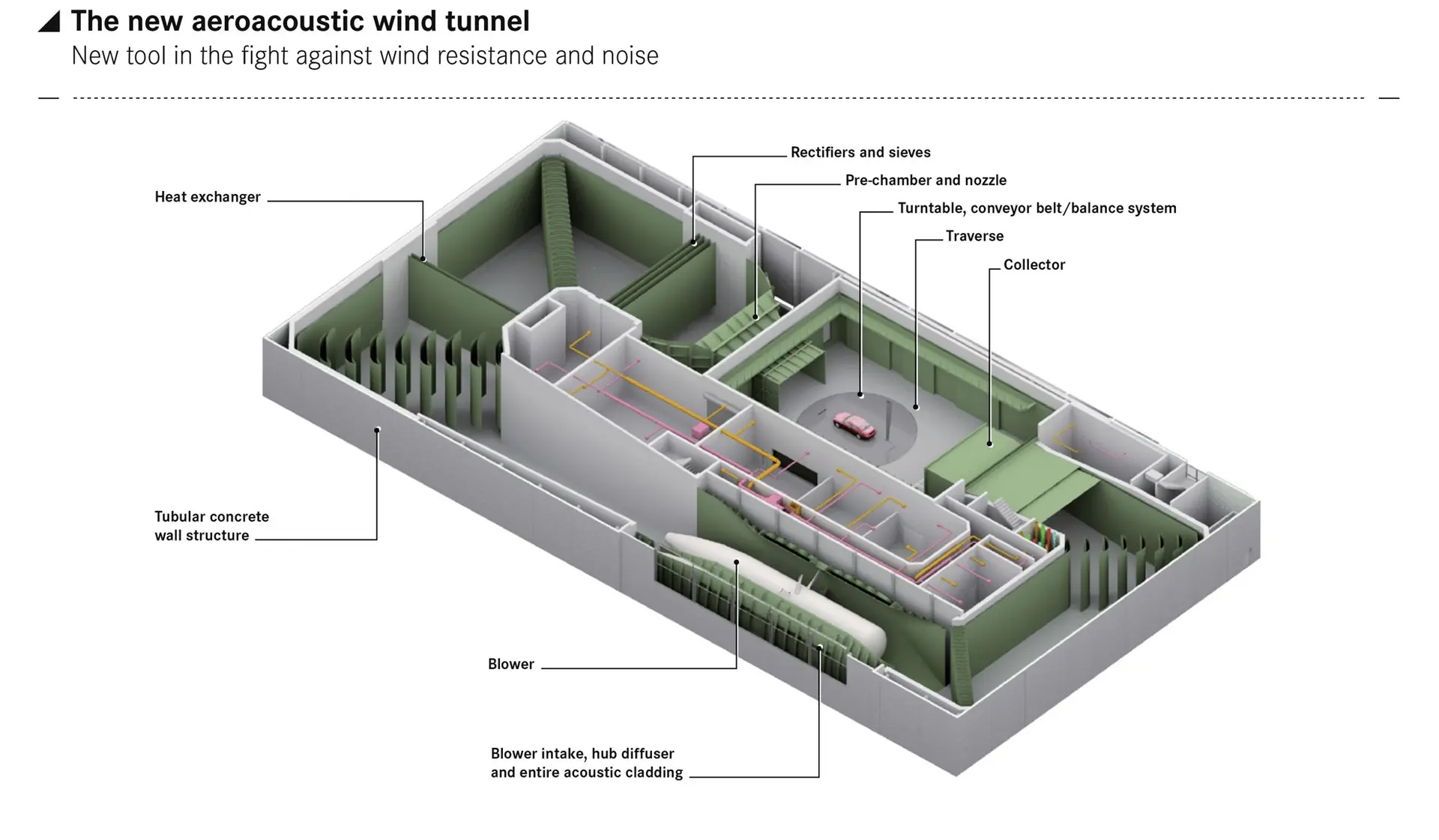
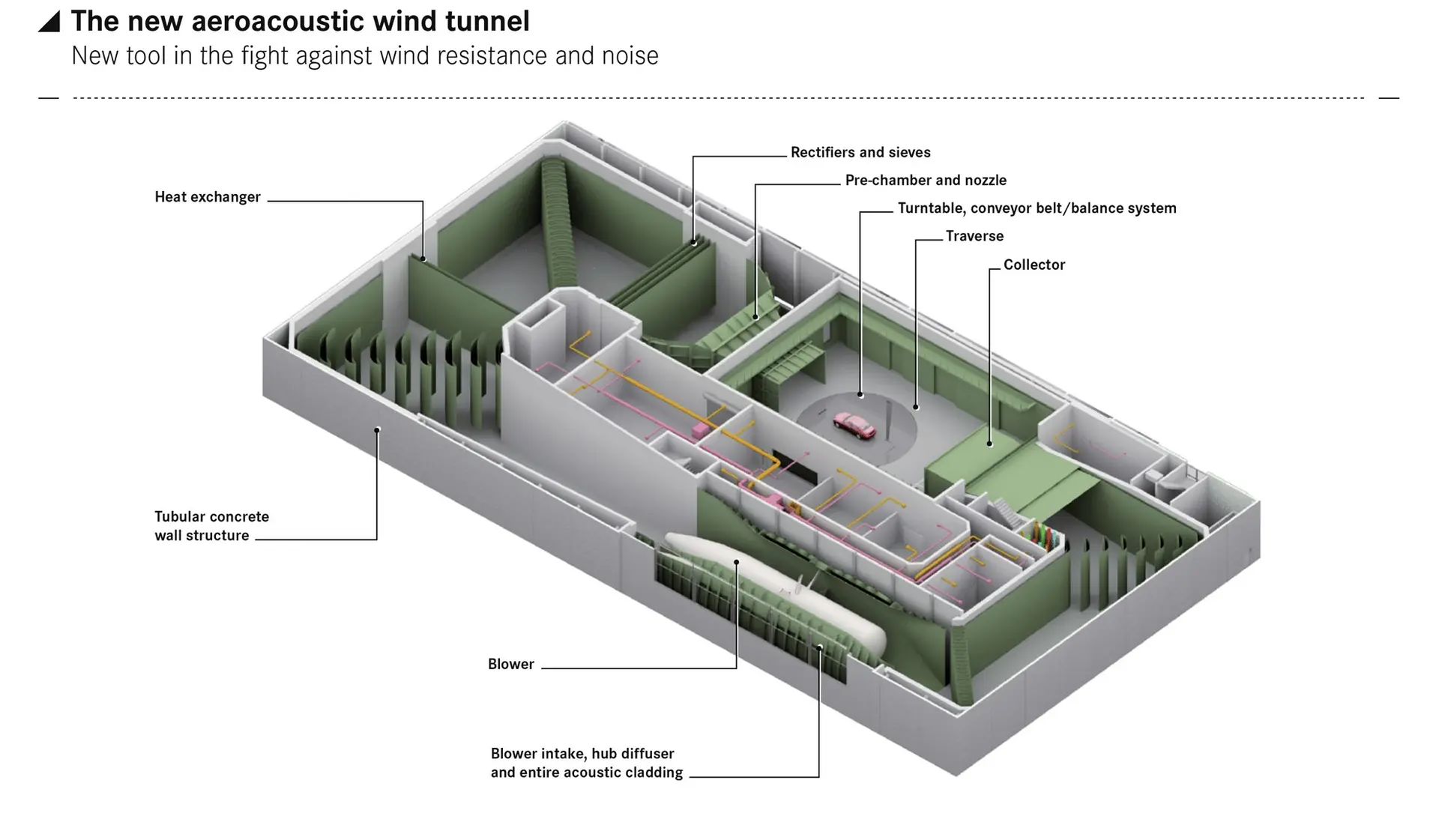
Blower: wind speed of 265 km/h, 5 MW output

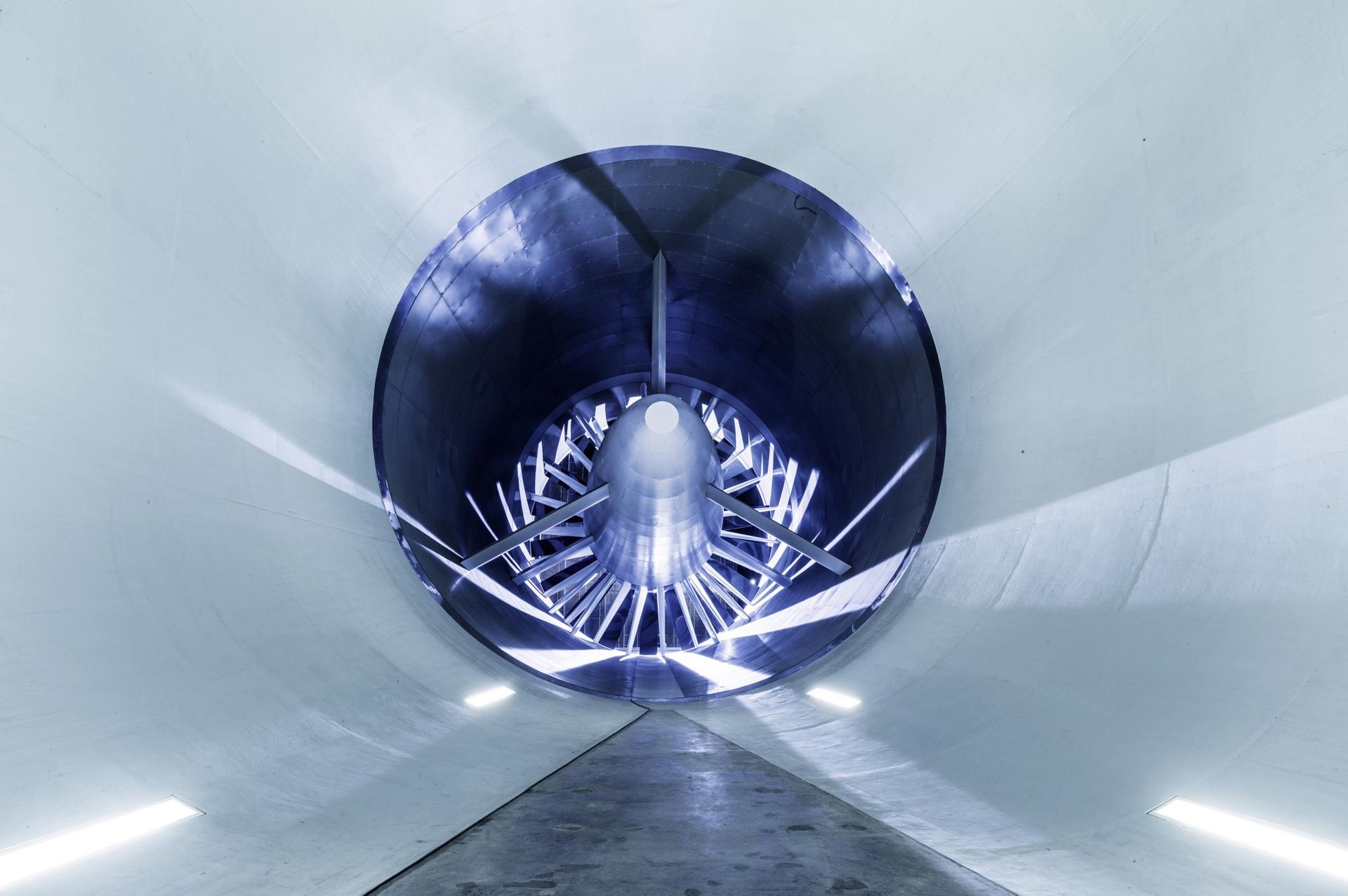
The new wind tunnel follows the Göttingen design, i.e. the air is redirected to the blower after the measuring stretch and re-accelerated, which saves a great deal of energy. The blower has a diameter of nine metres and has 18 vanes which set the air into motion. At 202,150 Nm the maximum torque of the electric drive motor is approx. 1000 times that of a powerful automobile. At a wind speed of 250 km/h the power consumption is five megawatts. The blower is then rotating at 238 rpm, and the volume of air passing through it is 2000 cu. m. or around three family houses per second. The maximum wind speed is 265 km/h.

The air temperature in the wind tunnel is maintained at 23 to 24°C. To ensure that measurements are precise even in wintry outside temperatures, the concrete shell of the tunnel is surrounded by an outside wall and therefore insulated. During operation, the drive motor of the blower heats up the air circulating within the wind tunnel. In warm outside temperatures it is therefore cooled by a heat exchanger located downstream of the blower.

Before the air accelerated by the blower reaches the measuring stretch via a nozzle system covering 28 sq. m., it must be directed and smoothed to eliminate unwanted turbulence and eddies. This done using rectifiers and sieves.

Extensive noise insulation measures are integrated to allow use as an acoustic tunnel where interior and exterior wind noise can be measured for the relevant test vehicle. Even at 140 km/h the air flowing through the measuring stretch is therefore as quiet as a whisper

Measuring stretch: five conveyor belts up to 265 km/h

The centrepiece of the 19-metre long measuring stretch in the wind tunnel is the roughly 90-tonne conveyor belt/balance system with a turntable. The new wind tunnel has a 5-belt system to simulate the road: a small conveyor belt runs under each wheel, and a central belt with a length of nine metres and a width of over one metre runs between the wheels. All five belts are synchronised with the wind, so that up to 265 km/h they exactly simulate the road conditions. The 24-tonne balance on which the vehicles are fixed in place is extremely sensitive, with a weighing precision of a few grams. Even the measuring cables must be routed so that they do not introduce extraneous forces into the system. The values obtained with the help of the aerodynamic balance are used as the basis for calculating the coefficients of wind resistance, lateral forces and lift at each axle, and pitching, rolling and yawing movements.

The conveyor belt/balance system is integrated into a turntable with a diameter of twelve metres. This also enables the test vehicles to be subjected to an angled airflow to simulate cross-winds. The turntable also allows vehicles in the test stretch to be exchanged rapidly. The test vehicles are prepared in workshops within the wind tunnel building, immediately adjacent to the measuring stretch. Great attention was paid to a rapid exchange of test vehicles, so that the wind tunnel can be used as effectively as possible.

Traversing system: precise measurements even at 265 km/h

The traversing system enables the engineers to position a variety of aerodynamic sensors and microphones around the test object with a high degree of precision, so that pressure, acoustic and speed measurements are exact. The system in the new Sindelfingen wind tunnel has seven axes (three translation [parallel movement] and four rotation axes), enabling it to cover a measuring volume of 19 x 14 x 5 metres. The weight of this system is 26 tonnes, as the measuring sensors must remain exactly in place with no vibrations even at the maximum wind speed.

In addition to advanced computer simulation programmes, Mercedes-Benz now has all the facilities required to further consolidate its leading position in aerodynamic efficiency and further improve the acoustic comfort of its vehicles. Dr. Teddy Woll, Head of the Aerodynamics/Wind Tunnels department at Daimler AG, explains: “Computers and wind tunnels are outstanding tools that complement each other perfectly: using numerical flow calculations we are able to examine very complex airflow phenomena and follow even the smallest turbulence back to its source. And in the wind tunnel we are able to test a large number of variations very rapidly – which means that one day in the wind tunnel can often lead to major improvements both outside and inside the vehicle.”

Comments

Sign in to comment.Sign in

No comments yet. Be the first to share your thoughts.

Rightcharge collaborates with Mercedes-Benz Vans in the UK to make it easier for businesses to transition to electric
32
0
ArticleMarch 7, 2024

Rightcharge collaborates with Mercedes-Benz Vans in the UK to make it easier for businesses to transition to electric

London, UK, 5th March 2024: Leading EV charging software company Rightcharge has joined forces with Mercedes-Benz Vans in the UK to help make it more affordable and accessible for businesses looking to operate and charge electric vehicles. Rightcharge provides electric van drivers with a comprehensive end-to-end solution for charge point installations, ensuring a hassle-free experience […]

New UNI-TOUCH operating system for the Mercedes-Benz Unimog implement carrier
18
0
ArticleJanuary 12, 2024

New UNI-TOUCH operating system for the Mercedes-Benz Unimog implement carrier

Mercedes-Benz Trucks UK has announced the all-new UNI-TOUCH operating system for the Unimog implement carrier, which is available to order now ahead of first deliveries in the second half of the year. The manufacturer is making the announcement at LAMMA 2024 – the UK’s leading agricultural machinery, equipment and technology show – where it is […]

Mercedes-Benz South Africa invests substantial funds into local Electric Vehicle charging infrastructure
15
5,276
ArticleNovember 13, 2023

Mercedes-Benz South Africa invests substantial funds into local Electric Vehicle charging infrastructure

Pretoria – Mercedes-Benz South Africa is advancing its sustainability strategy for South Africa through a substantial investment into the local electric vehicle (EV) charging infrastructure. As the demand for EVs continues to grow, ensuring a robust infrastructure is essential. Mercedes-Benz South Africa boasts the country’s most extensive range of electric vehicles, including the EQ and […]

Mercedes-Maybach EQS SUV
13
0
ArticleApril 17, 2023

Mercedes-Maybach EQS SUV

Shanghai/Stuttgart. With the Mercedes-Maybach EQS 680 SUV (provisional figures: combined power consumption: 24.4-22.5 kWh/100 km; CO2 emissions: 0 g/km)1, the legendary brand is presenting its first all- electric series model. It is based on the technology of the EQS SUV from Mercedes-EQ and combines it with the exclusivity of Maybach – in line with Karl […]

Mercedes-Benz AMG powerboat
25
22,980
ArticleFebruary 11, 2016

Mercedes-Benz AMG powerboat

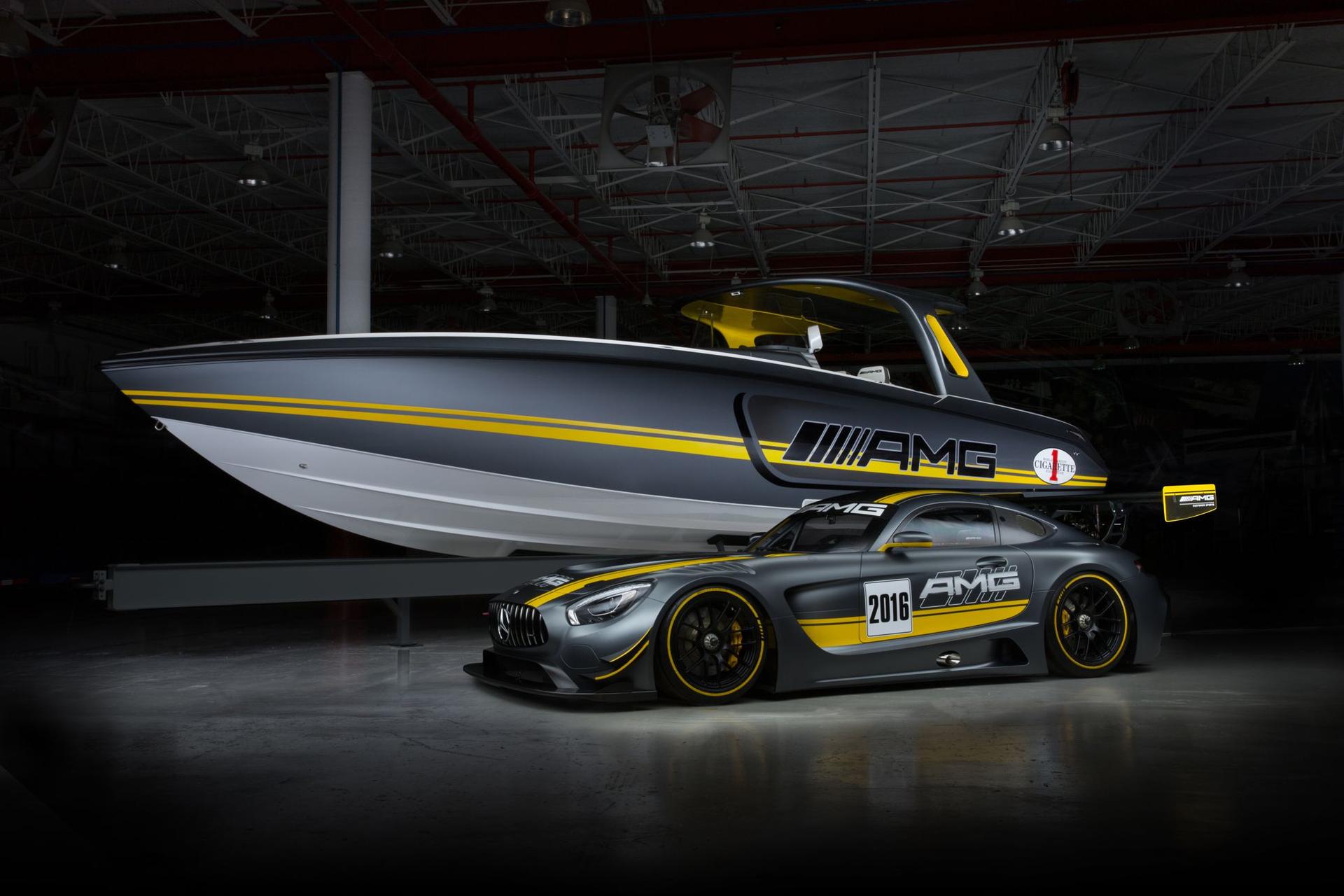
Mercedes-AMG GT3 inspires most powerful “Open Performance” boat ever produced by the Cigarette Racing Team: Two Powerhouses Roar into the Miami International Boat Show
Mercedes- AMG GT3 racecar
Cigarette Racing

Frankfurt Motor Show Premieres – Mercedes Benz
17
0
ArticleSeptember 11, 2015

Frankfurt Motor Show Premieres – Mercedes Benz

Stuttgart/Frankfurt. Mercedes me provides personalised access to the individual and exclusive world of Mercedes-Benz, which revolves around the customer. One part of this initiative is Mercedes connect me.

Mercedes-Benz ESP 25 Years
14
17,000
ArticleApril 30, 2015

Mercedes-Benz ESP 25 Years

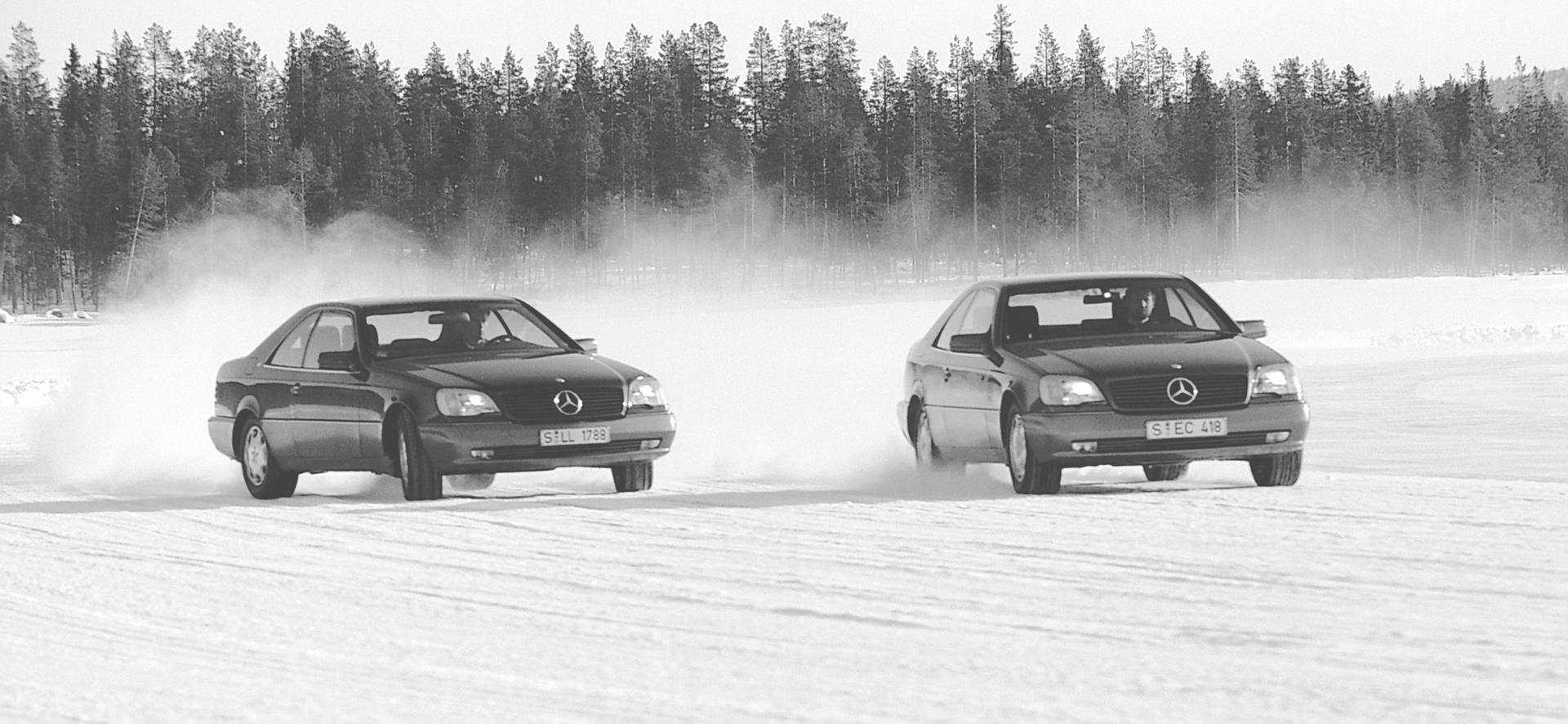
First series production application in March 1995 at Mercedes-Benz From a bold idea to a Europe-wide requirement:  ESP® reaches 20 years of saving lives Stuttgart.  A guardian angel is celebrating a milestone anniversary: in March 1995, Mercedes-Benz introduced the Electronic Stability Program ESP®. Alongside the seat belt, airbag and ABS, the Daimler invention is by […]

New Mercedes-Benz Lights Technology
11
0
ArticleJune 17, 2014

New Mercedes-Benz Lights Technology

NEW GENERATION CLS WITH THE FUTURE’S HIGH-RESOLUTION PRECISION LED TECHNOLOGY: LEADING THE WAY WITH BETTER LIGHT Stuttgart – In the new generation of the CLS-Class, Mercedes-Benz is using the new technology of MULTIBEAM LED headlamps for the first time. High-resolution precision LED modules, each with 24 individually controlled high-performance LEDs, automatically illuminate the road with […]

Mercedes-Benz Autonomous Driving
12
0
ArticleSeptember 10, 2013

Mercedes-Benz Autonomous Driving

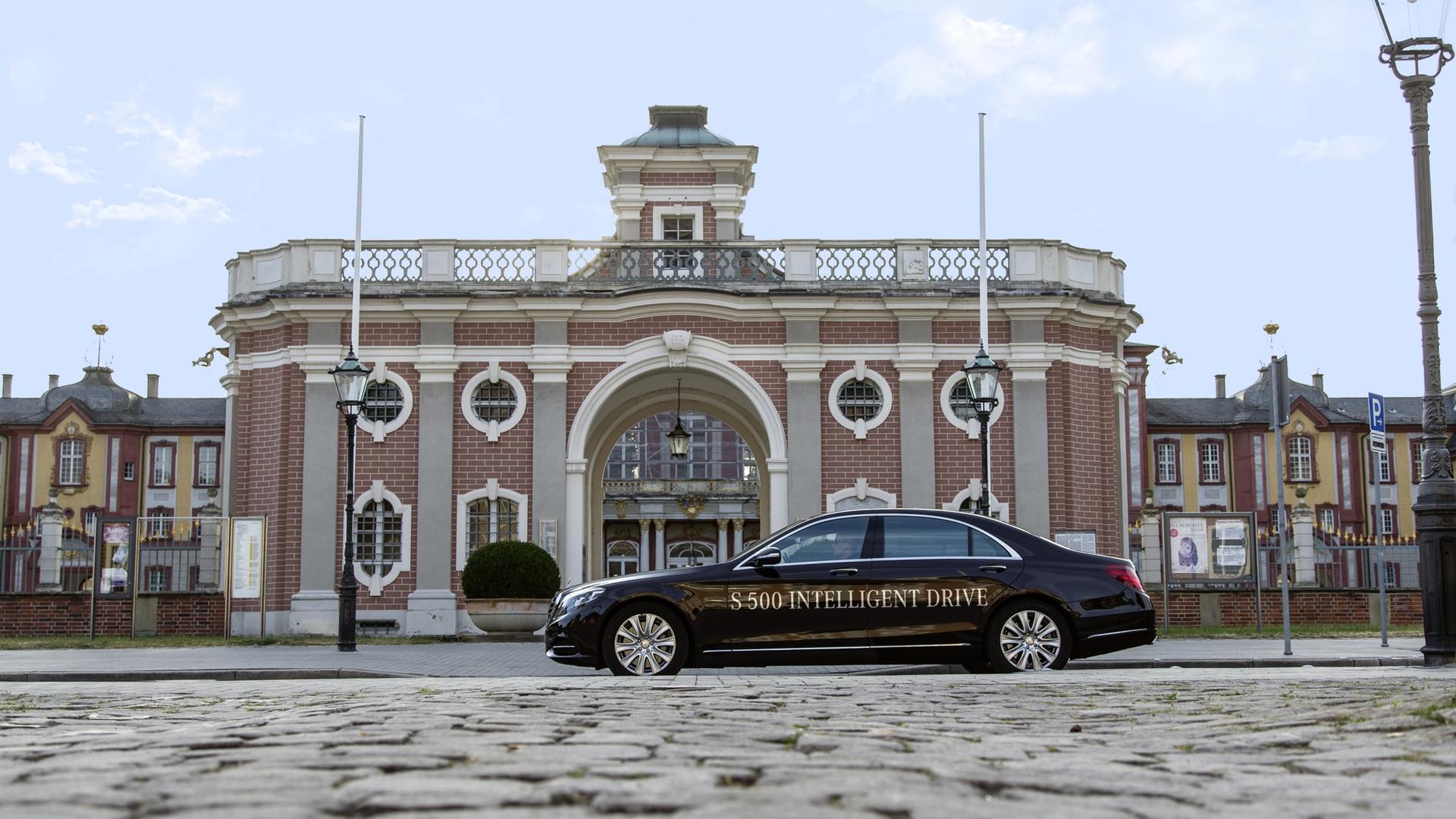
Pioneering achievement: Autonomous long-distance drive in rural and urban traffic – Mercedes-Benz S-Class “INTELLIGENT DRIVE” drives autonomously in the tracks of Bertha Benz With its S 500 INTELLIGENT DRIVE research vehicle, Mercedes-Benz in August 2013 became the world’s first automobile manufacturer to demonstrate that autonomous driving in rural and urban traffic is possible – and […]

Mercedes-Benz Google I/O
213,757
18,298
ArticleMay 14, 2013

Mercedes-Benz Google I/O

Innovation made in Silicon Valley: Mercedes-Benz presents new features of its Digital DriveStyle App at Google I/O Product of ongoing partnership between Google and Mercedes-Benz New version of Digital DriveStyle App to feature additional Google services in the first half of 2013 San Francisco. Google I/O is an annual developer conference featuring highly technical, in-depth […]

Developments in aerodynamics
122,111
14,169
ArticleFebruary 15, 2013

Developments in aerodynamics

 Under the microscope: development in aerodynamics From the Kamm rear to the CLA Aerodynamics first became a focus of scientific research almost 100 years ago – but it is only after the second oil crisis some 30 years ago that it was really given a high priority in vehicle development. Nowadays aerodynamics make a major […]

Dr. Teddy Woll, head of Mercedes Benz Aerodynamics
152,474
10,679
ArticleFebruary 15, 2013

Dr. Teddy Woll, head of Mercedes Benz Aerodynamics

Interview: Dr. Teddy Woll, head of aerodynamics “We fight for every third decimal place” Dr. Teddy Woll, 50, has headed the Aerodynamics/Wind Tunnels department at Daimler AG since April 1999. We spoke to this doctor of industrial engineering about efficiency improvements and airflow simulation.