- Under the microscope: development in aerodynamics
- From the Kamm rear to the CLA
Aerodynamics first became a focus of scientific research almost 100 years ago – but it is only after the second oil crisis some 30 years ago that it was really given a high priority in vehicle development. Nowadays aerodynamics make a major contribution to the energy efficiency of passenger cars.
The first passenger cars were not only derived from the horse-drawn coach, they were not in the least concerned with wind resistance because of the low speeds which were possible. Even the first “real” cars marketed by Daimler under the Mercedes brand from 1901 presented all manner of resistance to the rush of oncoming wind. The Mercedes Simplex of 1902, for example, not only had a frontal area of around 3 sq. m. – its Cd figure of 1.05 also meant that the wind encountered almost ten times the resistance offered by a modern passenger car.
Shortly after the First World War, specialists inspired by advances in the world of aviation began to examine the aerodynamics of automobiles. In 1921 the aircraft designer Eduard Rumpler (1872 – 1940) presented his “teardrop car”, whose slim bodywork not only addressed the problem of frontal area (2,4 sq. m.), but whose teardrop shape broke new ground in minimising air turbulence both at the front and especially behind the rear. The result looked unusual, but was a highly significant advance with its Cd figure of 0.28 and the resulting wind resistance of 0.67 sq. m.
Paul Jaray (1889 – 1974), the other “father of streamlining”, also came from the world of aviation. In 1921 he registered a patent which still reads like a list of instructions for building a modern passenger car body: “The lower half of the vehicle body takes the form of a streamlined construction covering the chassis with the wheels, engine compartment and passenger compartment. Its underside is smooth and runs parallel with the ground. This main structure carries a considerably slimmer streamlined construction supported by a lattice-like frame likewise mounted on the chassis.” For the first time the wheels were no longer exposed, but were integrated into the bodywork, while the “fastback” rear end minimised turbulence in this area. As conventional drive technology could be incorporated into Jaray’s body form, a number of car manufacturers built vehicles following the same principles – including Mercedes-Benz, which built a corresponding prototype in 1935. In series production Tatra had a measure of success with streamlining, starting with the Model 87 produced from 1936 to 1950. The VW Beetle also had a streamlined appearance, though with no effect: with a Cd figure of 0.49 it crawled into the wind rather laboriously.
The great disadvantage of Jaray’s streamlining was the long, tapering rear end – the longer, the more aerodynamically efficient. This “dead” space was an obstacle to practical implementation, which is why Tatra placed the engine there. In the 1930s the solution was found by Wunibald Kamm (1893 – 1966), the first professor of automobile engineering at the Technical University of Stuttgart and founder of the private, non profit-making research institute for automobile engineering and vehicle engines (FKFS) in Stuttgart in 1930. Kamm abruptly cut off the streamlined rear end and developed the “K-car” between 1938 and 1941, a prototype for an aerodynamically innovative passenger car. The term “Kamm rear” is still in use to denote an airflow breakaway edge at the rear. The K3 car was based on a Mercedes-Benz 170 V, and excelled with a frontal area of 2.1 sq. m. and a Cd figure of 0.23, as measured in the model wind tunnel at the time.
In the 1950s, increasing affluence and falling fuel prices caused efforts to reduce aerodynamic drag to fade into the background, with performance achieved by large-capacity engines. While the classic, large tailfin sedans of this era used a feature familiar from aircraft engineering, this was only for decoration: with Cd figures of around 0.60 and large frontal areas, they were roughly as streamlined as Elvis Presley’s villa Graceland.
It was only the second oil crisis in 1980 that drew the industry’s attention back to minimising fuel consumption, and to an effective means of achieving this: lowering the wind resistance. Audi achieved an initial success with the 100 in 1982 (Cd = 0.30), in 1984 Mercedes-Benz took the continuing lead for saloon cars with the W124-series E-Class (Cd = 0.29), and in 1991 Opel’s Calibra showed what is possible for a coupé (Cd = 0.26).
Despite unfavourable parameters (e.g. increasing tyre widths and the greater cooling requirement of powerful engines) there has been a downward trend in wind resistance since then. Especially at Mercedes-Benz, which now leads the industry in practically all vehicle segments with respect to wind resistance and the other aerodynamic disciplines (see the chapter “Aerodynamics world champion in every vehicle class”).
A milestone: the “large wind tunnel” in Stuttgart-Untertürkheim
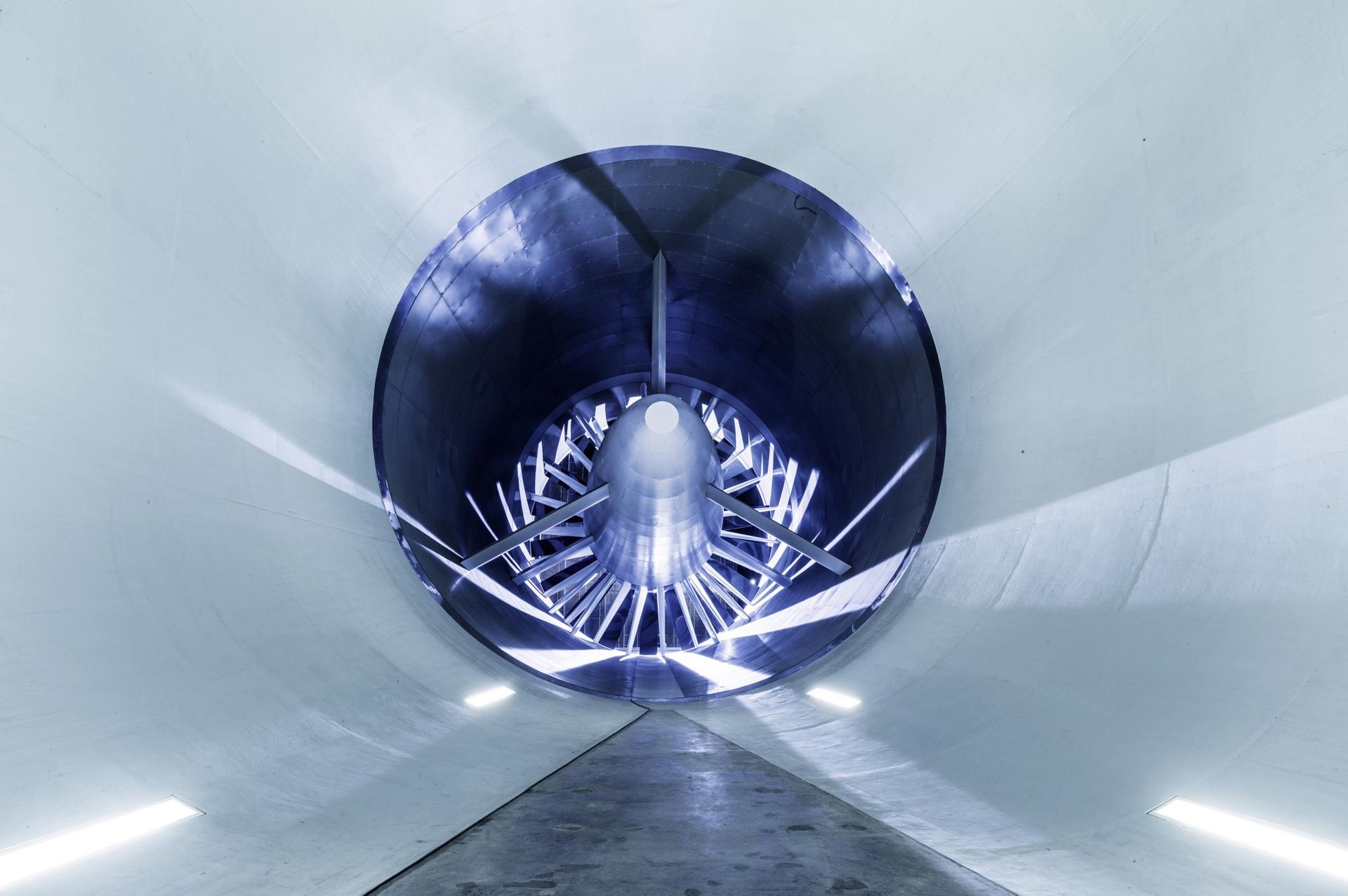
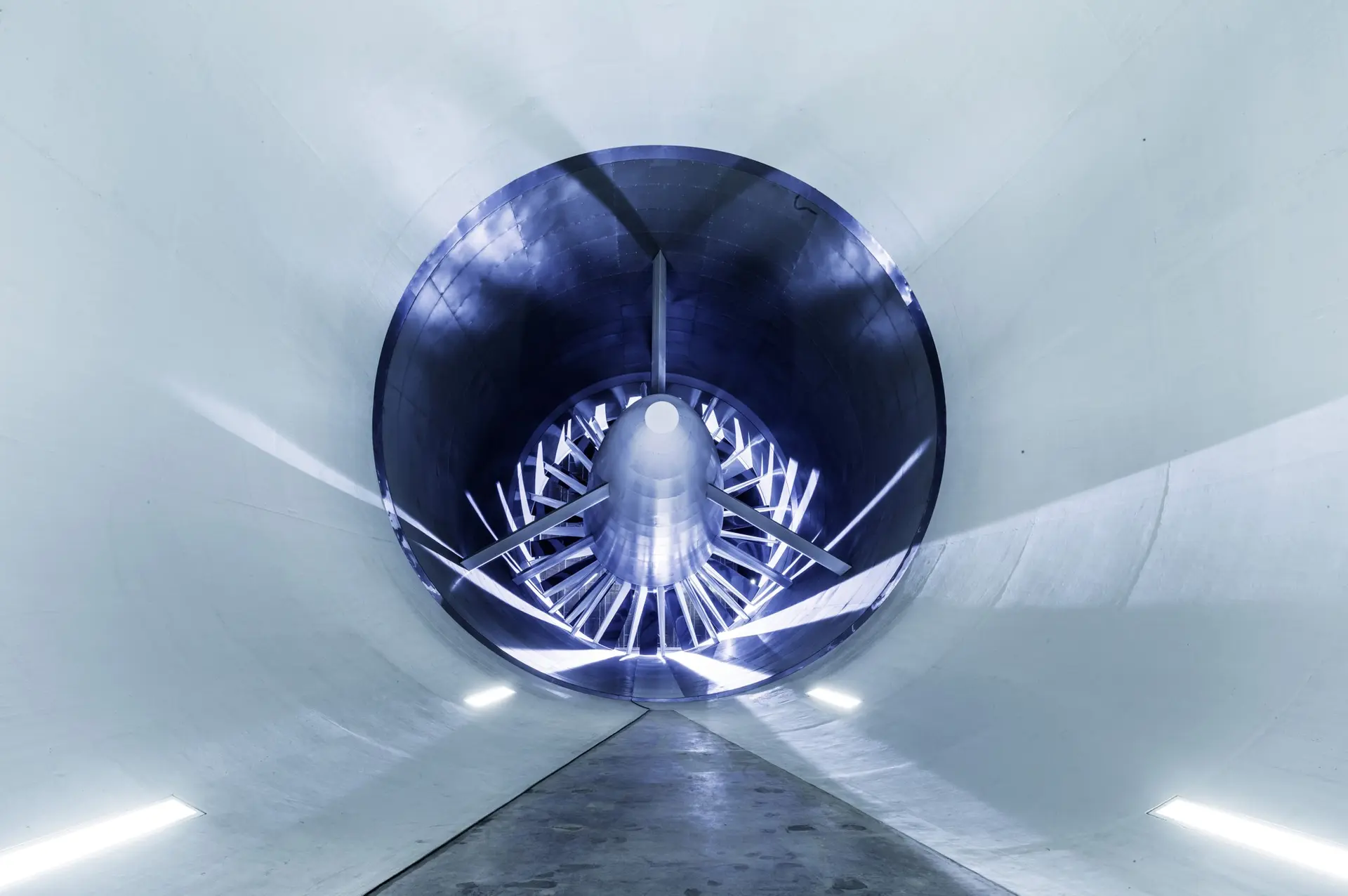
The first documented measurement took place exactly 70 years ago, on 5 February 1943: Daimler AG’s “large wind tunnel” at its parent plant in Stuttgart-Untertürkheim was the first in the world to be designed specifically for analysing the aerodynamic properties of motor vehicles. The building work began in 1939, inspired by the legendary aerodynamics pioneer Wunibald Kamm.
Because of the war, it was not until 1954 that the wind tunnel became the first in the world to be regularly used for measurements on full-size passenger cars. Since then it has played a key role in developing the aerodynamic efficiency of the car – especially models bearing the Mercedes star. But not exclusively: up until the 1970s, the wind tunnel was operated by FKFS, an independent institute, and was therefore available for general research as well as being open to other manufacturers. Daimler, the current owner, was one of the most frequent hirers – much as at the new FKFS wind tunnel on the university campus in Stuttgart-Vaihingen, which went into operation in 1988 and will be thoroughly overhauled in 2014.
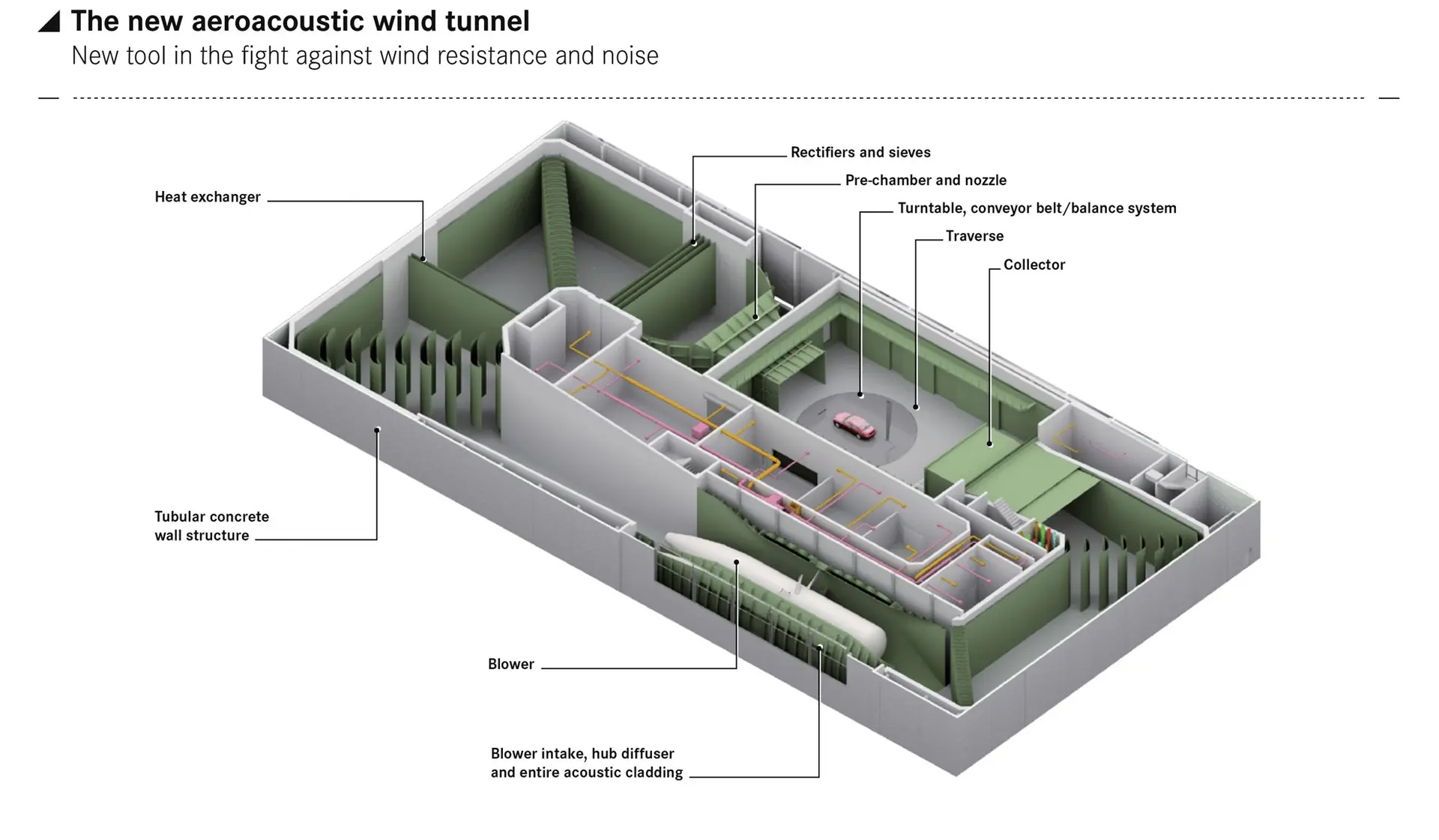
Yet the wind tunnel in Untertürkheim, which has been repeatedly technically updated, is still indispensable for the Mercedes-Benz developers. Not just for optimising aerodynamic design, but also for soiling analyses or windscreen wiper testing. Furthermore, the “large wind tunnel” more than lives up to its name, for it is here that Mercedes-Benz commercial vehicles are also honed to perfection.
As well as hosting these tests, the facility is also often used for completely unrelated activities: ZDF, Germany’s second TV channel, has shot film sequences for a hurricane report here; bobsleighs are optimised here; and speed skaters perfect their technique here. In short, anyone who has to work with or against the wind is welcome in Untertürkheim. Another major challenge overcome here was the aerodynamic testing of the revolutionary roof for Munich’s Olympic Stadium.