




- Ford Motor Company has released its 13th annual Sustainability Report titled “Blueprint for Sustainability: Accelerating Ahead” – a voluntary and comprehensive annual account highlighting all things sustainable, from people to products
- Ford’s success cutting energy use in its vehicle manufacturing process – and its announcement to cut another 25 percent in the next five years – comes as global energy use is being projected to soar 53 percent between 2008 and 2035
- Other progress highlighted includes reduction in waste-to-landfill, water use and CO2 emissions; a summary of company financial health; improvement in vehicle fuel economy; and safety achievements
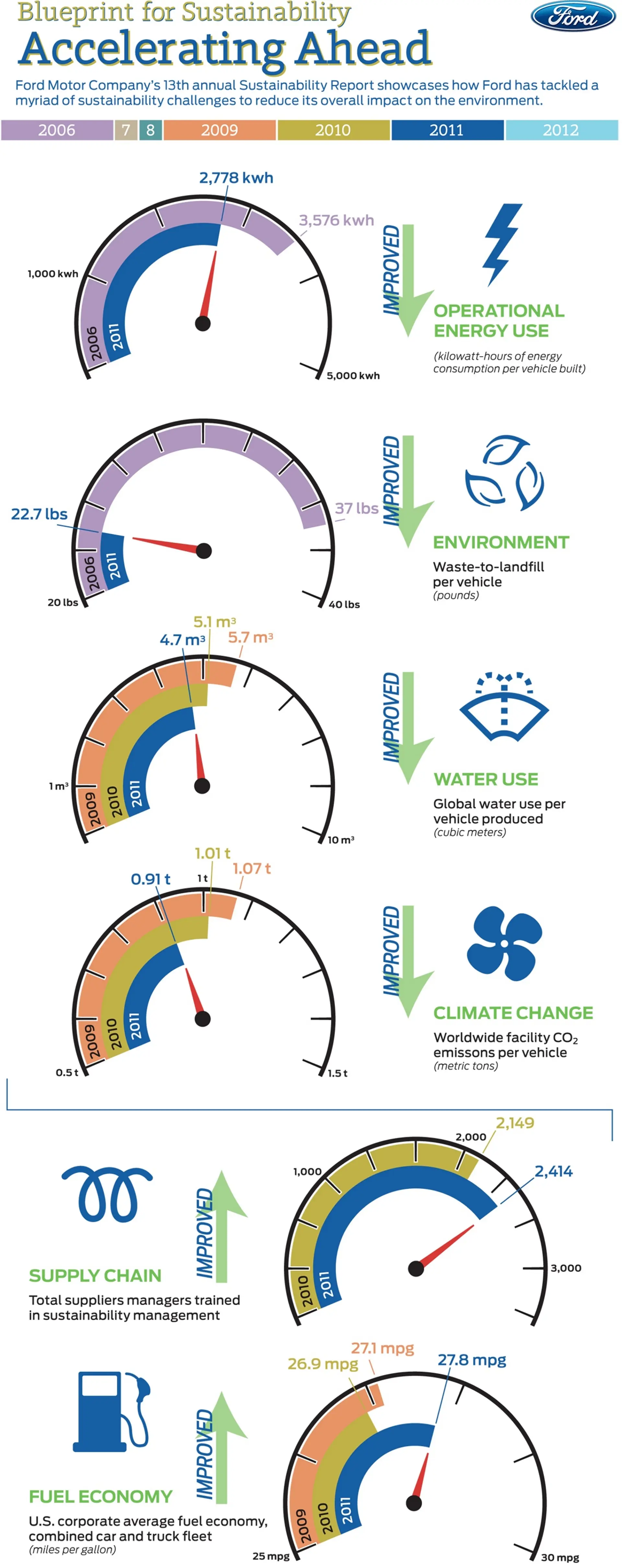
DEARBORN, Mich., June 15, 2012 – Ford announced today in its annual Sustainability Report that it has reduced the amount of energy required to produce each vehicle in its manufacturing facilities by 22 percent in the last six years. The company also announced plans to reduce usage another 25 percent on a per-vehicle basis by 2016.
Decreased energy consumption during vehicle manufacturing is just one highlight of Ford’s 13th annual Sustainability Report. The report – “Blueprint for Sustainability: Accelerating Ahead” – is a comprehensive showcase of the company’s efforts to tackle a myriad of sustainability challenges in a rapidly changing world.
Other successful initiatives featured include reductions in water use, waste-to-landfill and CO2 emissions as well as improvements in vehicle fuel economy and safety.
“Sustainability has moved from the periphery to the center of our strategy for succeeding in the marketplace and helping to address global challenges,” said Robert Brown, vice president, Sustainability, Environment and Safety Engineering.
Ford issued its first Sustainability Report in 1999 to address the company’s initiatives regarding social, economic and environmental issues. Like Ford’s sustainability-related processes and results, the report has evolved, too. New this year are sections highlighting Ford’s regional sustainability initiatives in Europe, South America and Asia; commentary from third-party subject matter experts like Nobel Peace Prize winner Dr. Rajendra K. Pachauri, and multimedia elements.
“Our sustainability report is far from a bunch of tables and charts,” said John Viera, global director, Sustainability and Vehicle Environmental Matters. “Anyone who spends any amount of time with it will truly get a sense of just how committed Ford is to supporting positive change and reducing the environmental impact of its products and facilities.”
Consider the drop in energy consumption: The amount of electricity used to produce each vehicle in Ford’s manufacturing facilities has been reduced by about 800 kilowatt-hours – from 3,576 kwh in 2006 to 2,778 kwh in 2011. By comparison, average households in states like California, New York, Illinois and Michigan use between 562 kwh and 799 kwh monthly.
Ford’s progress has been achieved by investing in energy-saving practices and equipment. At Michigan Assembly Plant in Wayne, Mich., for example, the company uses a new “three-wet” paint application that reduces electricity use along with CO2 and Volatile Organic Compound (VOC) emissions.
At the same plant, a new 500-kilowatt solar panel system has been installed to generate renewable energy for production of Ford vehicles like Focus and Focus Electric.
Thanks to such efforts already in place and Ford’s commitment to making further progress, the company projects a continued drop in energy consumption – 25 percent between 2011 and 2016.
This commitment is made against a backdrop of the U.S. Department of Energy announcement last September that global energy demand will increase 53 percent between 2008 and 2035.
Environmental
Reduction in energy consumption is just one result of Ford’s focus on minimizing the environmental impact of the vehicles it produces and the facilities where they are made.
Each Ford facility uses measured environmental targets to track and accelerate improvements designed with the environment in mind. The targets are reviewed and updated annually.
In addition to its commitment to further reducing energy consumption, Ford also:
- Reduced the total amount of waste sent to landfills globally by 11.3 percent from 2010 to 2011
- Plans to further reduce its waste to landfill by 10 percent per vehicle this year, building on existing efforts that have reduced global waste by 100 million pounds (44 percent) in the last five years
- Reduced CO2 emissions from global operations in 2011 by 8 percent on a per-vehicle basis compared with 2010
- Turned what would have been 163 tons of recovered paint solids into enough power for 20 residential homes for one year through just one of many new ways the company is converting waste to energy
- Advanced water-treatment technologies to allow the reuse of water and reduce water supply requirements, water discharges and use of treatment chemicals and the generation of solid waste
- Reduced water use to 4.7 cubic meters per vehicle in 2011 within a corporate goal of reducing the amount of water used per vehicle by 30 percent between 2009 and 2015
“Integration of our sustainability initiatives into the Ford production system has enabled us to accelerate environmental improvements at our manufacturing facilities,” said Andy Hobbs, director, Environmental Quality Office. “This enables all members of the Ford manufacturing team to contribute to meeting our environmental targets.”
Sustainable Materials
Ford vehicles continue to be a major focal point of the company’s efforts to reduce environmental impact. For example, the seat fabric in most of Ford’s new or redesigned vehicles must now consist of at least 25 percent post-industrial or post-consumer recycled content. A total of 37 fabrics now meet the requirements and have been incorporated into Ford vehicles. Other highlights include:
- A seat fabric containing a fiber made from recycled plastic water bottles is being used in the Focus Electric, Fusion Hybrid and Fusion Energi
- Nonwoven headliner fabrics now contain 50 to 75 percent recycled yarns, depending on the color
- Post-consumer recycled nylon is used in some underhood parts, including air cleaner housings, engine fans, fan shrouds, HVAC temperature valves, engine covers, cam covers and carbon canisters
- Nearly 4.1 million pounds of carpet has been recycled into cylinder head covers, the equivalent of a carpet the size of more than 150 football fields – eliminating the use of more than 430,000 gallons of oil
- Use of seat foam made with soy oil in all North America vehicles, also reducing dependency oil-use and CO2 emissions
Societal
Because Ford affects such a broad range of stakeholders – employees, dealers, investors, communities – the Sustainability Report also details some of the ways the company interacted with those parties in 2011, said David Berdish, manager, Social Sustainability.
For example, the report outlines how Ford revised its “Code of Human Rights, Basic Working Conditions and Corporate Responsibility,” which applies to not only Ford itself, but its $75 billion supply chain. The code deals with subjects such as working hours and conditions, nondiscrimination and other health, safety and environmental issues. Nearly 400 suppliers around the world were trained in 2011 through Ford-led and joint industry programs.
“Detailing our progress on human rights and sharing stories of our projects in the sustainability report is our primary source of communication regarding issues of social sustainability – and not just to media and customers,” said Berdish. “Investors are paying attention to working conditions, conflict minerals and trafficking more intensely, and our stakeholders want to be kept updated on all developments.”
Safety
Ford also is committed to customers and helping to keep them safe is a priority. That’s why the company works hard to develop and offer an array of advanced safety technologies across its entire vehicle lineup. Specific milestones achieved in the last year include:
- Twelve Ford Motor Company vehicles earned Top Safety Picks from the IIHS in 2012: Ford Fiesta (sedan and hatchback), Focus, Fusion, Taurus, Edge, Explorer, Flex and F-150 (Crew Cab) and the Lincoln MKX, MKS, MKT and MKZ
- Ford Fusion has been an IIHS Top Safety Pick for four years in a row starting with the 2009 model year
- The 2012 Ford Fiesta is the first vehicle in its class to offer a driver’s knee airbag
- Reaching 35,000 teen drivers in 2011 through the Ford Driving Skills for Life program – a driver education program designed for teens
- Winning numerous awards for its available rear-seat inflatable safety belts that launched on the 2011 Ford Explorer and are an automotive industry exclusive. For the 2012 model year, Ford expanded the availability of these safety belts in North America to the Ford Flex and Lincoln MKT


