



This article forms part of CarSite’s historical motorsport archive and has been enhanced for modern readers while preserving the original context and core events.
Perfect autumn racing conditions greeted teams and fans at Killarney Raceway, but for Alfa Romeo Squadra Corse, the third and fourth rounds of the South African Production Car Championship delivered a weekend defined less by opportunity and more by frustration. What began with optimism and technical promise quickly became a story of regulatory setbacks, lost momentum, and the disappointment of watching potential go unrealised.
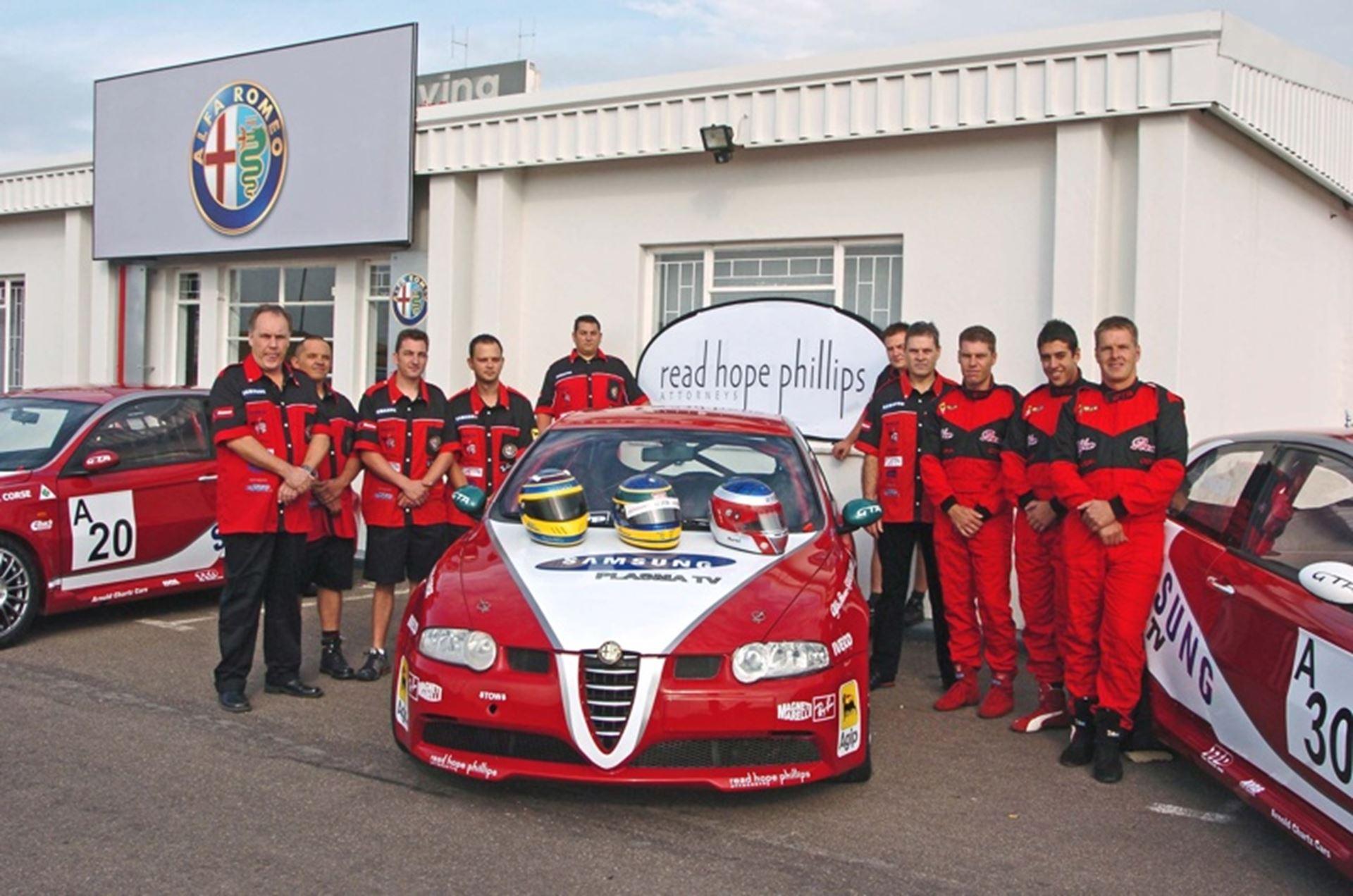
The second round of the Vodacom Power Tour drew more than 21,000 spectators to the Cape Town circuit, underlining the growing popularity of South African production car racing at the time. For Alfa Romeo, the weekend carried particular significance. The team arrived ready to build on earlier development work and eager to demonstrate the competitiveness of its line-up, which included the highly anticipated Alfa Romeo 147 GTA models alongside the established Alfa Romeo 156 GTA.
There were early reasons for confidence. The two Alfa Romeo 147 GTA cars were permitted to take part in practice and qualifying, giving the team and its drivers a chance to gauge pace and balance under competitive conditions. However, that optimism was cut short when outstanding homologation issues prevented both Alfa Romeo 147 GTA entries from taking their places on the starting grid. It was a bitter blow for the team, especially after the effort invested in preparing the cars for the event.
As a result, Martin Steyn and Morne Jurgens were left as unwilling spectators, forced to stand aside while teammate Marco da Cunha carried Alfa Romeo’s challenge alone in the Alfa Romeo 156 GTA. The weekend also marked the team’s first outing on new intermediate slick tyres, which had been introduced in the hope of improving both consistency and race durability.
According to team manager Hein de Necker, the new tyres did not deliver the level of outright speed the team had anticipated, but they did show clear strengths in terms of endurance and wear characteristics. In a racing category where tyre life can influence strategy as much as raw pace, that longer-term benefit was not insignificant, even if it offered little immediate consolation on such a difficult weekend.
“The new tyres didn’t give us the advantage or lap times that we expected, but they are far more accomplished in terms of longevity,” said team manager Hein de Necker.
Before the exclusion of the Alfa Romeo 147 GTA cars, qualifying had already hinted at Alfa Romeo’s competitiveness. Morne Jurgens placed his Alfa Romeo 147 GTA fourth on the grid, ahead of Marco da Cunha’s Alfa Romeo 156 GTA in seventh. Martin Steyn, meanwhile, encountered gearbox trouble and was forced to qualify near the back. Once the two Alfa Romeo 147 GTA cars were removed from the grid, Da Cunha effectively inherited fifth place for the start and took on the race as Alfa Romeo’s sole representative.
In the first heat, Da Cunha delivered a composed and determined drive. Running in close company with the BMW entries and Steve Wyndham’s Ford Falcon, he kept the Alfa Romeo 156 GTA in contention and brought it home in sixth place. It was a respectable result under the circumstances and a clear indication of the car’s ability to remain competitive despite the team’s reduced presence.
The second race proved more dramatic. Da Cunha found himself in a spirited battle with the Kaye Eddie BMWs of Steven Morris and Reghardt Roets. The contest was intense and physical, reflecting the hard-edged nature of production car racing in South Africa at the time. Unfortunately, the race ended in disappointment when Da Cunha and Morris collided at the end of the main straight, forcing both cars into retirement.
Yet the bigger concern for Alfa Romeo extended beyond race results. The controversy surrounding the Alfa Romeo 147 GTA entries’ exclusion became one of the defining themes of the weekend, raising wider questions about consistency in the application of regulations. From the team’s perspective, the decision was especially difficult to understand given that the cars had already been allowed to practice and qualify.
“As Fiat Auto South Africa, we are sad that our Alfa Romeo 147 GTA cars were not allowed to race,” said Giorgio Gorelli, Managing Director of Fiat Auto South Africa. “It is sad for the team that put so much effort into preparing the cars for the event after a lot of development from Kyalami and sad for the drivers who were unable to show them off. But most importantly, it is sad for the South African public that were not able to see the Alfa Romeos in action at Killarney.”
The arrival of the Alfa Romeo 147 GTA in Class A had brought renewed enthusiasm to the championship. Their presence promised to inject fresh energy into the series and to strengthen Alfa Romeo’s position in what was shaping up to be a fiercely contested season. That sense of anticipation made their absence from the races even more disappointing for supporters, organisers, and the broader motorsport community.
“We don’t understand how the cars were allowed to practice and qualify and then not be allowed to race,” Gorelli continued. “We hope the problem will be resolved soon so as to avoid a similar occurrence in the future.”
He also reiterated Alfa Romeo’s commitment to competition, making clear that the setback had done little to diminish the brand’s determination or racing spirit.
“As Alfa Romeo, we are extremely passionate about racing both locally and internationally. We are not afraid to challenge people on the track. We are committed to our professional approach to racing in South Africa.”
For Marco da Cunha, the weekend still offered valuable experience despite the difficult circumstances. Coming from a successful single-seater background, he was continuing to build his career in saloon car racing, and Killarney provided another important step in that development. Racing without the support of the two Alfa Romeo 147 GTA cars placed even greater responsibility on his shoulders, yet he showed determination and adaptability throughout the meeting.
While Alfa Romeo’s campaign was overshadowed by frustration, other teams were able to capitalise. Anthony Taylor and Etienne van der Linde each took a race win on their way to dominant one-two finishes for the Castrol BMW 330is. Local driver Steve Wyndham guided the Ford Credit Falcon XR8 to third place in the first heat, though he retired from the second, allowing Reghardt Roets to secure the remaining podium finish.
Looking ahead, Alfa Romeo Squadra Corse turned its attention to the next round at Kyalami on 1 May. The homologation process for the Alfa Romeo 147 GTA cars was set to continue in the days following Killarney, and the team remained hopeful that the issue would be resolved in time to allow the cars to compete as intended. There was still a sense that the championship could change quickly if Alfa Romeo returned at full strength.
In that respect, Killarney was more than just a difficult race weekend. It served as a reminder that success in motorsport depends not only on engineering, preparation, and driver talent, but also on regulatory certainty and administrative consistency. For Alfa Romeo Squadra Corse, the event was a test of resilience as much as performance.
Even so, the broader significance of the weekend remains clear. The Alfa Romeo 147 GTA and Alfa Romeo 156 GTA represented Alfa Romeo’s determination to compete at the sharp end of South African production car racing, and despite the setbacks, the team’s ambition and professionalism were evident throughout. For followers of Alfa Romeo’s motorsport heritage, the events at Killarney remain a revealing snapshot of a brand committed to racing, passionate in its approach, and unwilling to step back from a challenge.
Alfa Romeo’s Racing Legacy in South Africa
Alfa Romeo has long been associated with motorsport passion, engineering character, and performance-focused design. In South Africa, the brand’s appearances in production car racing helped strengthen its image among enthusiasts who valued both competition pedigree and distinctive Italian performance.