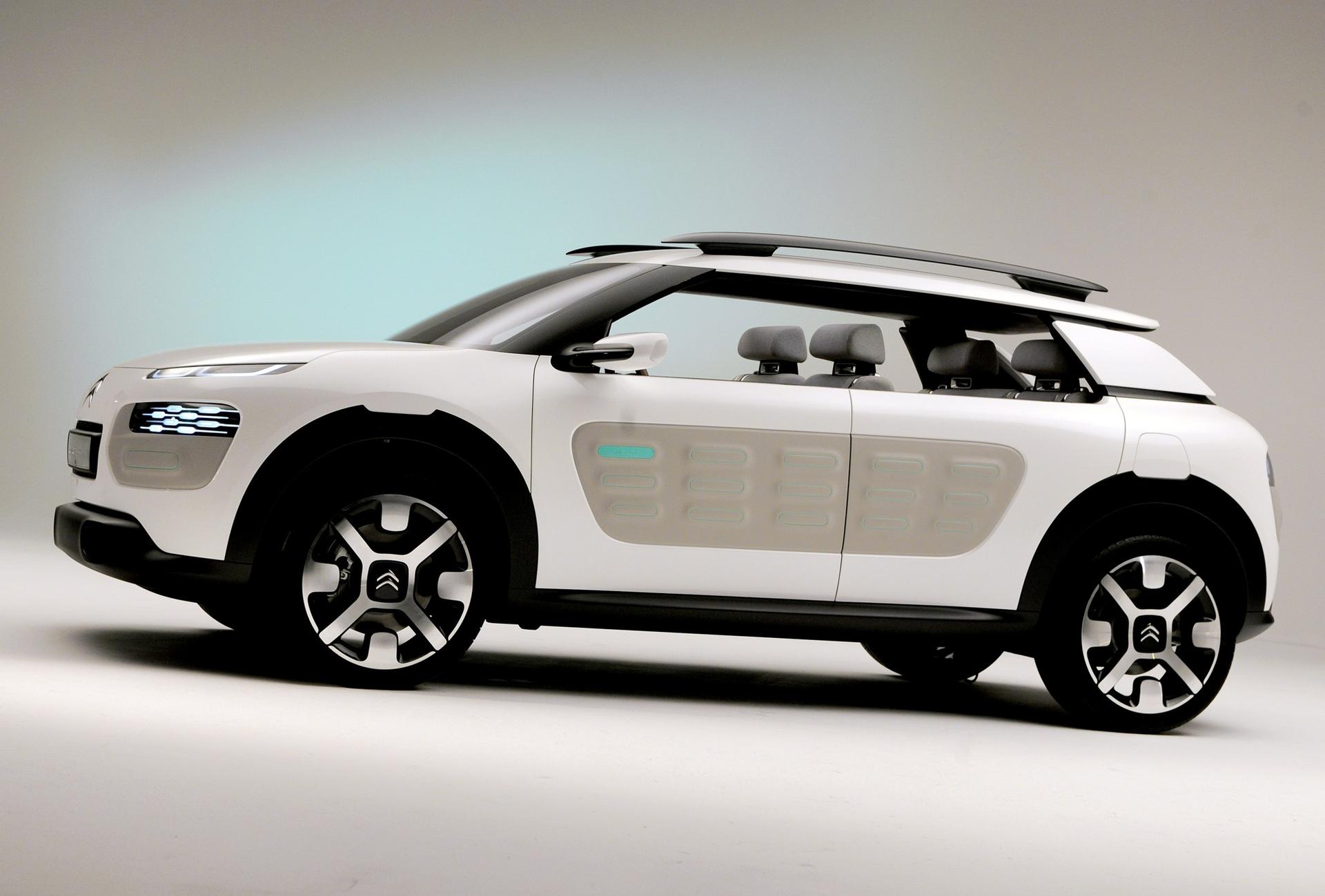



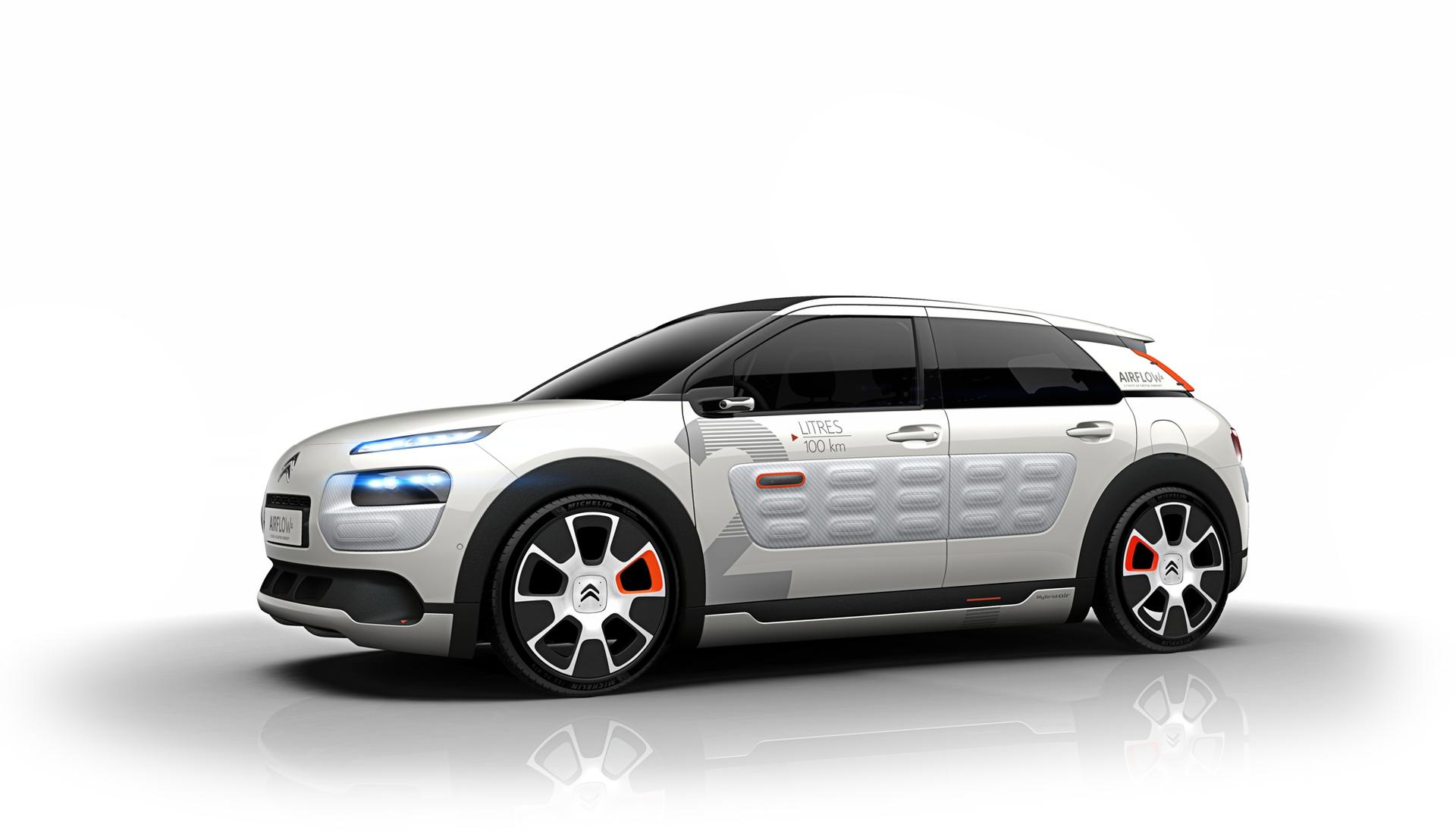
 C4 CACTUS AIRFLOW 2LCONCEPT: JUST 2L/100 KM
Faced with urban concentration, environmental requirements and economic pressure, customers today see fuel consumption as a key concern. True to its DNA, CITROËN is applying its creativity and technology to a new challenge with the C4 Cactus AIRFLOW
A true laboratory for new ideas, the C4 Cactus AIRFLOW 2L concept is packed with advanced technologies illustrating the ambitions and ability of CITROËN to develop new and innovative responses to the automotive challenges of the present and the future.
With the C4 Cactus AIRFLOW 2L concept, CITROËN delivers consumption of 2l/100 km. A breakthrough fuel consumption obtained with:
- optimised design with a 20% improvement in aerodynamics
- lower rolling resistance (Tall&Narrow tyres)
- efforts to use lighter parts and thus reduce overall vehicle weight by 100 kg
- the implementation of Hybrid Air technology, which cuts fuel consumption by 30%.
The birth of the C4 Cactus AIRFLOW 2L concept
The C4 Cactus AIRFLOW 2L project was conducted as part of the “2l/100 km vehicle” programme set up by the Plateforme de la Filière Automobile, an industry group. The objective: to deliver practical solutions to reduce the impact of vehicle running costs, on household expenditure and to reduce the eco-footprint of car travel.
CITROËN has decided to develop this project on the basis of its new model, C4 Cactus. With this vehicle, CITROËN has made a commitment to bring customers more of what really matters today: more design, more comfort and more useful technology at an affordable cost. More than any other vehicle, the C4 Cactus lends itself to this particularly ambitious exercise: to develop a very-low consumption high-tech concept that is both efficient and attractive.
The CITROËN C4 Cactus AIRFLOW 2L Concept
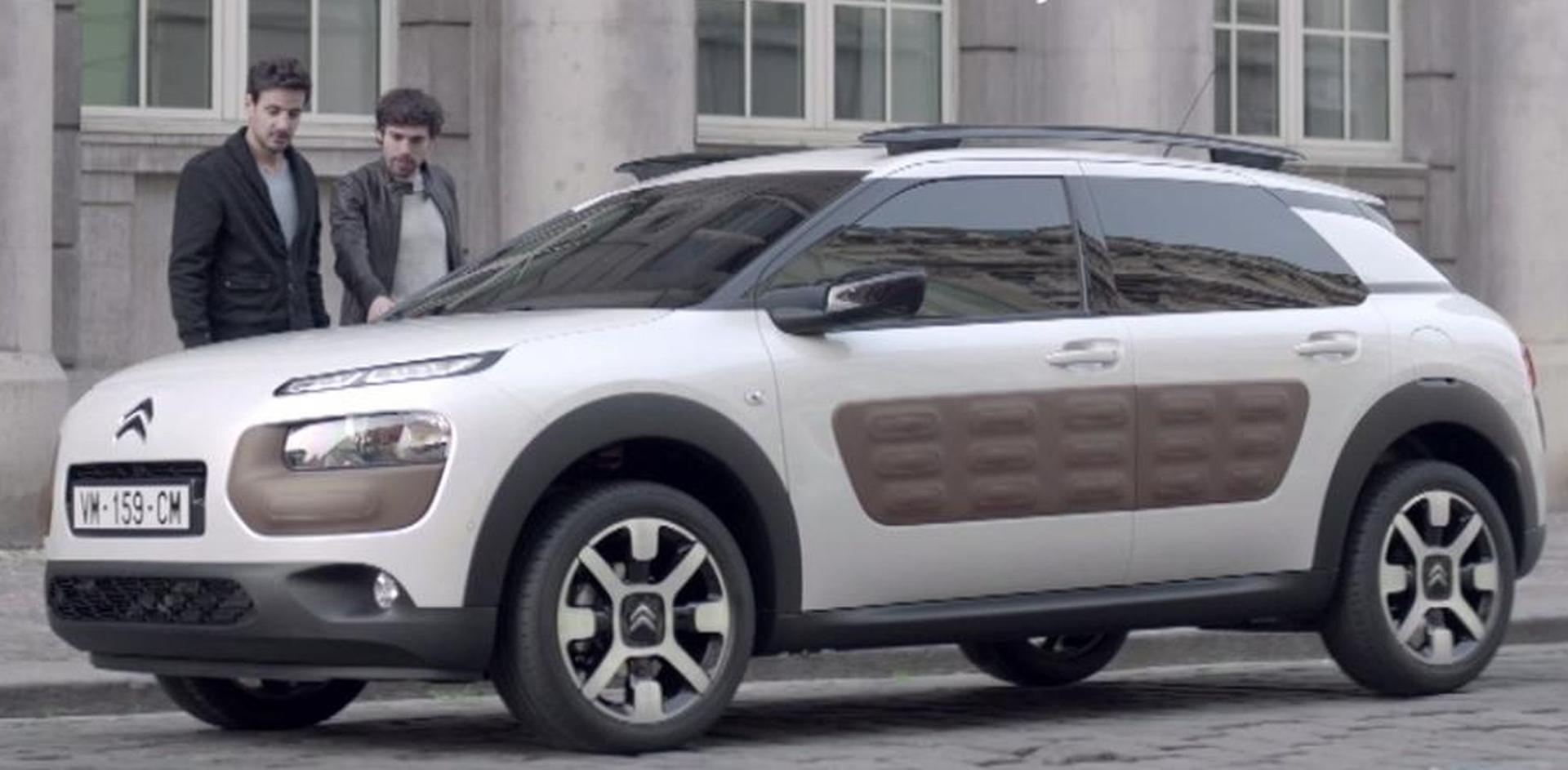
Clan, smooth design lines, efficient engines and technologies selected to reduce vehicle weight: the production CITROËN C4 Cactus already ships with a range of features designed to reduce fuel consumption.
With the C4 Cactus AIRFLOW 2L concept, CITROËN is going still further.
A body style optimised for aerodynamic performance
The unique design of the CITROËN C4 Cactus reconciles style and purpose by associating flowing lines with strong graphic features, each one highlighting a function (protection with the Airbumps and wheel arches; transporting objects with the roof arches; light with the glazed panoramic sunroof).

On the C4 Cactus AIRFLOW 2L, some styling features have been modified and others created in order to optimise vehicle aerodynamics.
- Variable-geometry styling parts:
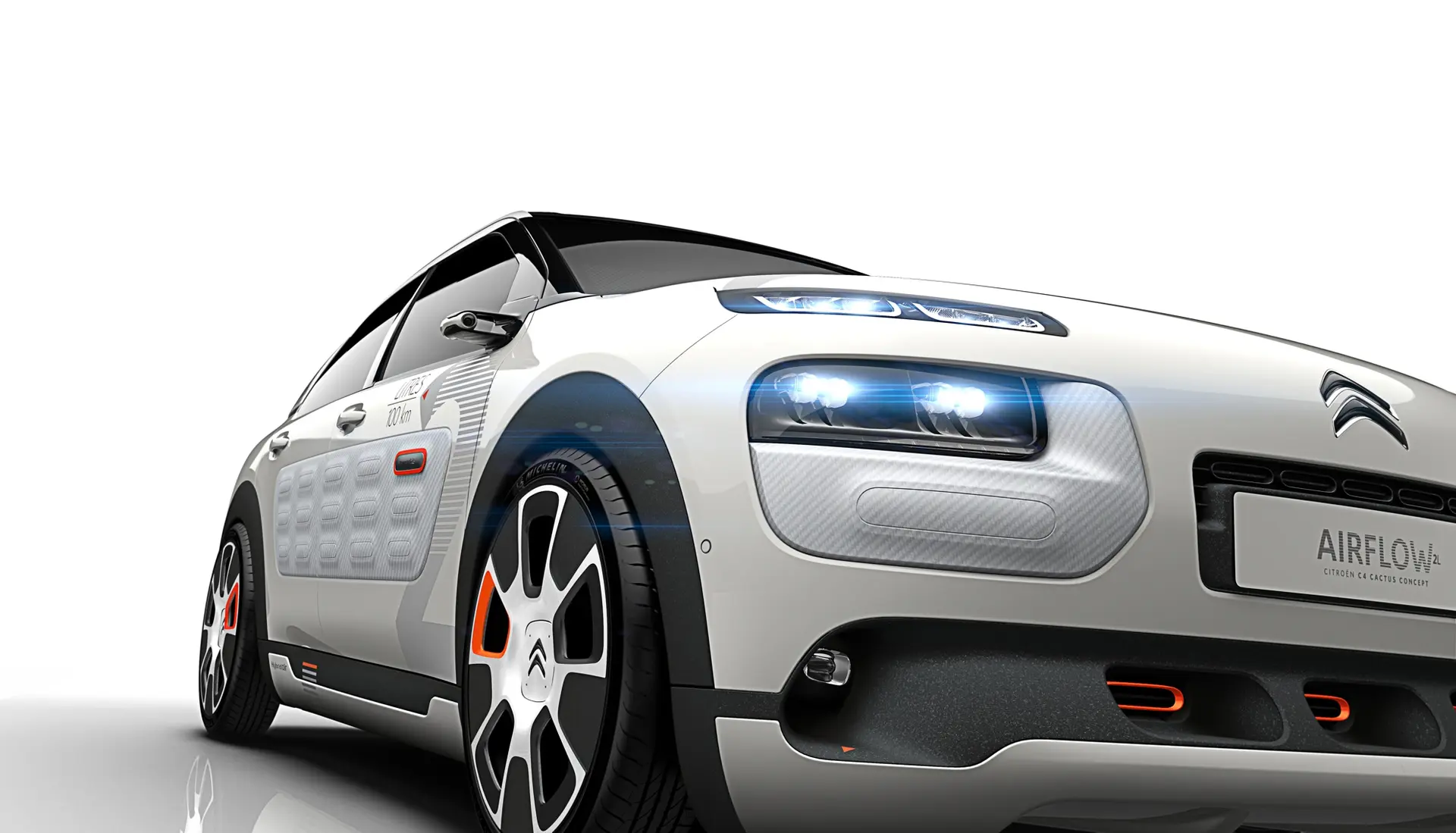
- The new front bumper features three controlled air intakes whose opening is continuously adjusted in accordance with vehicle use, both for engine cooling and for airflow.
- Mobile side deflectors have been added behind the quarter-window to effectively guide the air flow around the vehicle.
- The wheels feature mobile shutters activated and controlled by centrifugal force.
- Fixed-geometry styling parts:
- The tyres selected to equip the vehicle are of the new-generation 19” Tall&Narrow type. Their design and “ultra ultra” low rolling resistance characteristics improve both energy efficiency and aerodynamics. Their large diameter also contributes to comfort since they are better able to soak up bumps and dips in the road surface.
- The wheel arches feature an “Air Curtain”. Small aerodynamic slats on either end of the front bumper channel the airflow and smooth it out along the wheels.
- The spoiler has been lengthened and an air extractor added on the rear bumper in order to effectively channel the airflow around the C4 Cactus AIRFLOW 2L and reduce the turbulence that can increase drag. oThe conventional door mirrors have been replaced by smaller, slimmer rearview cameras to reduce impact on air flow.
- The vehicle substructure has been entirely streamlined. The air flows smoothly, unhampered by the sub-systems positioned under the car.
- LED light modules at front and rear replace the existing lights. Consuming little power, they save energy and thus fuel.These changes reflect a strong design in which styling contributes to vehicle aerodynamics, reducing vehicle drag for an overall improvement of 20% in aerodynamic performance compared with the production model.
- These changes can be recognised by their colour and by the materials used. The colour orange identifies all the aerodynamic features and underlines the high-tech character of the C4 Cactus AIRFLOW 2L concept.
Innovative materials for a lighter weight
The production C4 Cactus is already 200 kg lighter than the CITROËN C4, and the C4 Cactus AIRFLOW 2L concept shaves off a further 100 kg (including the drivetrain). These efforts have therefore reduced the weight of the concept by 11% compared with the production vehicle.
First, efforts to reduce the weight of structural parts: on the C4 Cactus AIRFLOW 2L concept, the body substructure features new materials:
- aluminium, in particular, for the upper cowl panel, inner side members and rear floor pan, high-yield steels for the front side rails and heel board, composite materials for the front floor.This multi-material substructure made it necessary to develop special assembly techniques never used before in the automotive industry. Composite structural parts are a promising field of exploration and will certainly be essential to efforts to make cars lighter in the future. The large-scale production of these parts is one of the high-tech, industrial challenges to be addressed by the automotive sector.Emphasis was placed on lightweight, high- performance materials:
- Looking beyond structural parts, extensive studies were conducted on all vehicle parts to reduce the weight of the C4 Cactus AIRFLOW 2L concept.
- These new materials are structural. They help to soak up energy in the event of impact and meet the highest standards in terms of mechanical strength.
- Carbon-based composite materials were used for the suspension springs, tailgate, rear bench, side panels, roof, roof cross-members, wings and doors. On the lower side sill, wheel arches and lower part of the front bumper, the “textured” look of the carbon brings out the matt appearance of these parts, providing an attractive contrast with the pearlescent appearance of surrounding features.
- Aluminium is used for the engine cradle. The bonnet specifications were the same as for the production C4 Cactus, which already used aluminium.Given that every gram is important, CITROËN also decided to use:
- Owing to their significantly lower bulk density (around 2,700 kg/m3 for aluminiumand around 1,200 kg/m3 for carbon compared with 7,800 kg/m3 for steel), these materials contribute significantly to reducing overall vehicle weight.
- New processes to reduce the thickness of the tubes and cups of the exhaust line and thus reduce weight.
- Translucent polycarbonate for the panoramic sunroof. This material is even lighter than multilayer glass but has the same properties in terms of thermal and acoustic insulation and ultraviolet filtering capability.
- Carbon fibres on the Airbumps® to make the material lighter while maintaining its technical properties.With its latest-generation small engines meeting the future Euro 6 standard, the production CITROËN C4 Cactus already ranks among the best in its segment with CO2 emissions from 82g/km and fuel consumption starting at just 3.1l/100 km.Three operating modes are available:
- The C4 Cactus AIRFLOW 2L concept goes even further by adopting the Hybrid Air drivetrain. Presented by the PSA PEUGEOT CITROËN Group in January 2013 and at the 2013 Geneva Motor Show on the CITROËN C3, this technology combines a range of proven sub-systems and technologies: a 3-cylinder PureTech petrol engine, a compressed air energy storage unit, a hydraulic pump/motor unit and an automatic transmission with an epicyclic gear train. An intelligent electronic management system manages input from the driver to optimise energy efficiency.
- Hybrid Air technology, breakthrough fuel consumption
- Air power (zero emissions) where the compressed air motor replaces the petrol combustion engine
- Petrol power, using only the combustion engine
- Combined power, drawing upon both the combustion engine and the compressed air.The PureTech 82 engine, already available on the production model, has been optimised for this new hybrid drivetrain. Friction losses, which account for 20% of the power consumed by the engine, have been reduced in several ways: using a Diamond-Like Carbon coating, making moving parts lighter, and using bearings to guide rotating parts. Further improvements were made by adopting new polymer pads and using very low viscosity oil. Combined with efforts to optimise combustion, overall engine efficiency has been improved by 5%.
- Combining the PureTech 82 engine with Hybrid Air technology on the C4 Cactus AIRFLOW 2L concept reduces fuel consumption by 30% and contributes significantly to achieving a vehicle of 2l/100 km while approaching the PureTech 110 in terms of dynamic performance.
- On the C4 Cactus AIRFLOW 2L concept, the two compressed air storage tanks are made of composite materials and positioned at the rear of the vehicle.
C4 Cactus AIRFLOW 2L concept, just 2l/100 km
All these advanced technologies together deliver consumption of 2l/100 km. It could therefore be possible, in the medium term, for a vehicle such as C4 Cactus to reach this target.
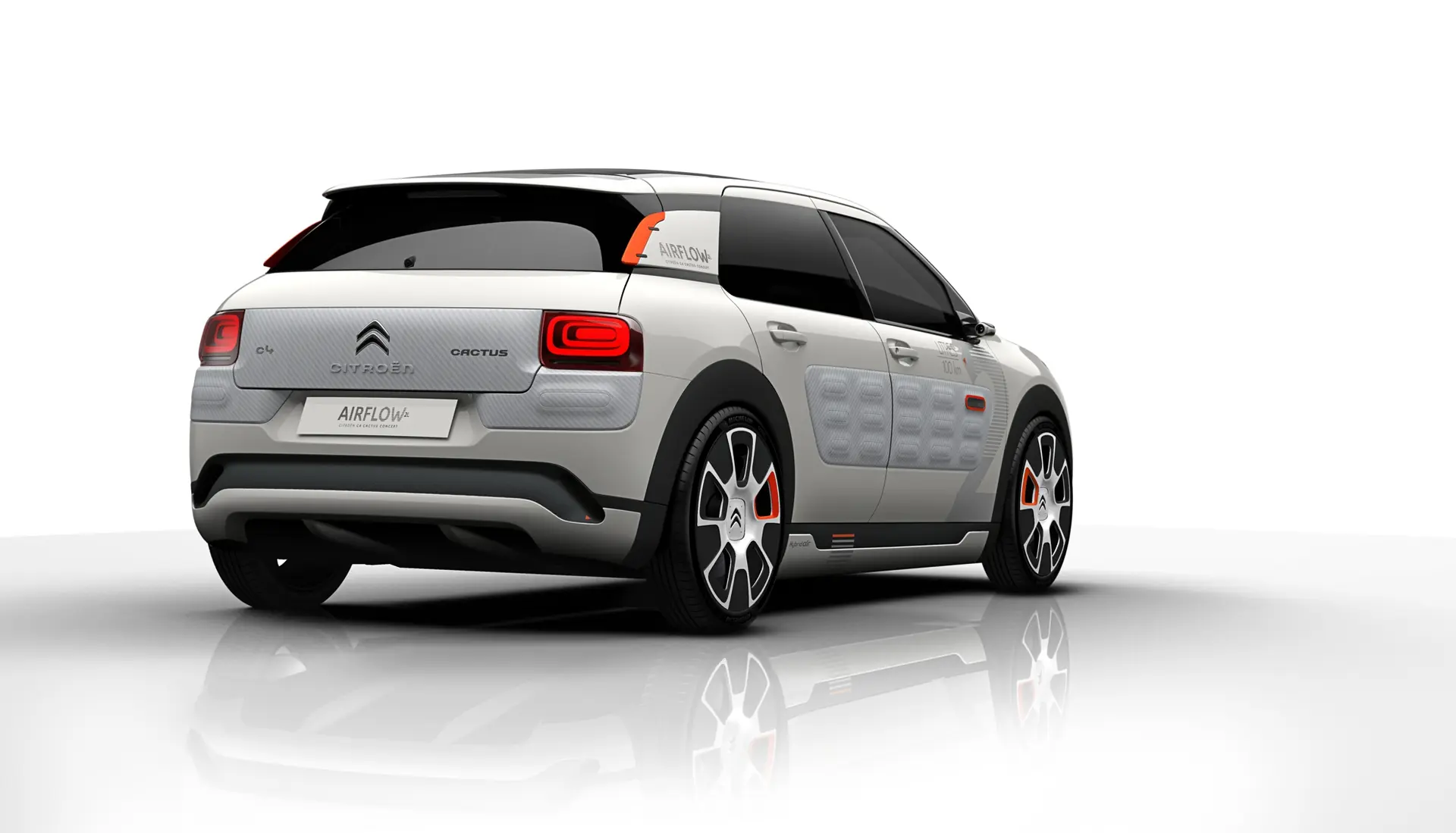
This very low level of consumption is the result of:
- optimised design with a 20% improvement in aerodynamics
- lower rolling resistance (Tall&Narrow tyres)
- efforts to use lighter parts and thus reduce overall vehicle weight by 100 kg
- the implementation of Hybrid Air technology, which cuts fuel consumption by 30%.TECHNICAL CHARACTERISTICS:Length: 4,156 mmHeight: 1,487 mm (to be confirmed)Hybrid Airdrivetrain mated to thePureTech engine 82 S&S, Tyres: Michelin 155/70/R19
- CdA: improvement around 20%
- Width: 1,729 mm
- Unladen weight: 865 kg
- The C4 Cactus AIRFLOW 2L concept is packed with advanced technologies illustrating the ambitions and ability of CITROËN to develop new and innovative responses to the automotive challenges of the present and the future.