


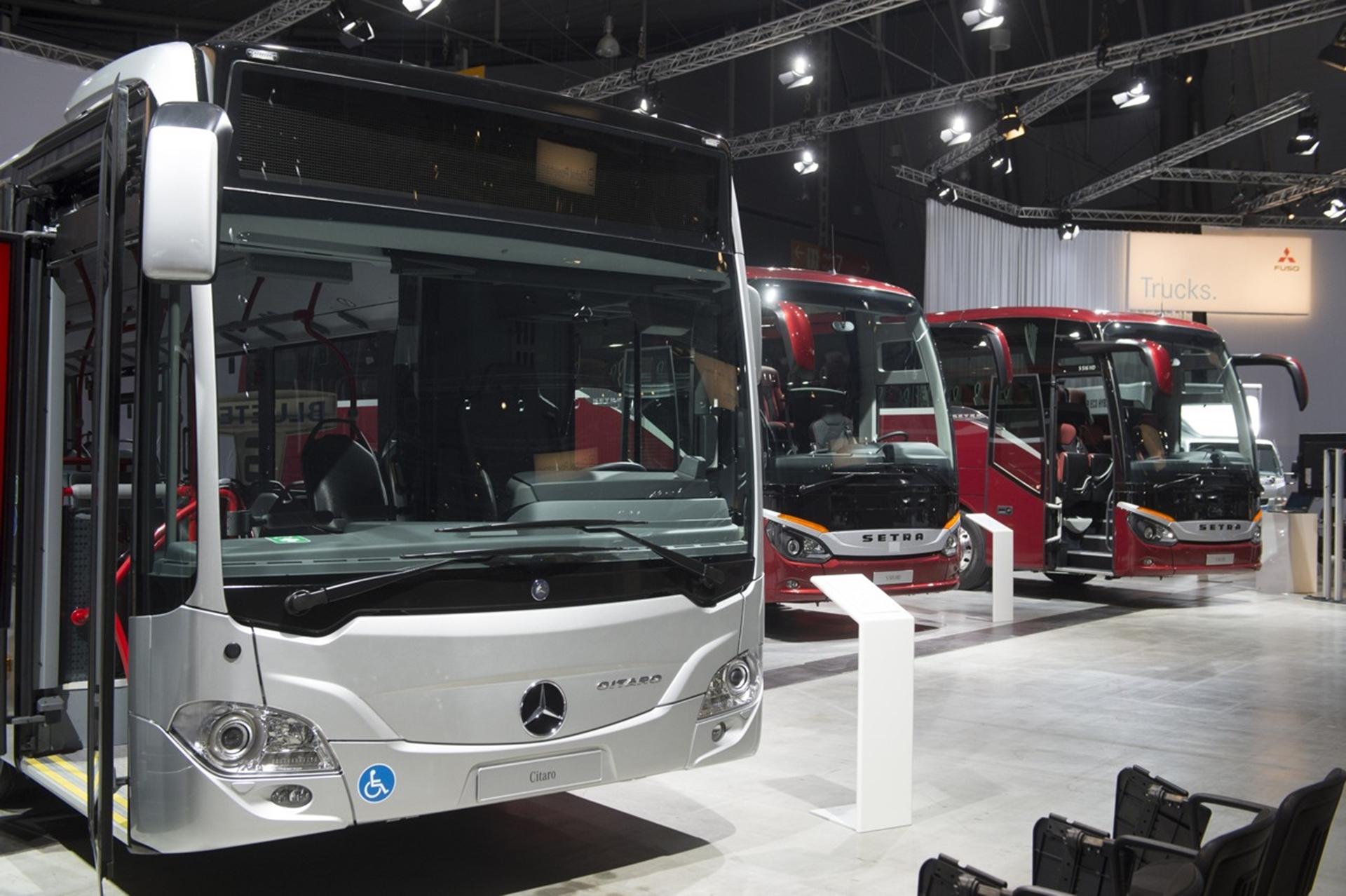
Drive system: two completely newly developed engine families
- Fuel consumption up to 5 percent lower with Euro VI
- Excellent economy thanks to technical finery
- Design: the restyled Citaro rear end
- The exhibition vehicle in detail
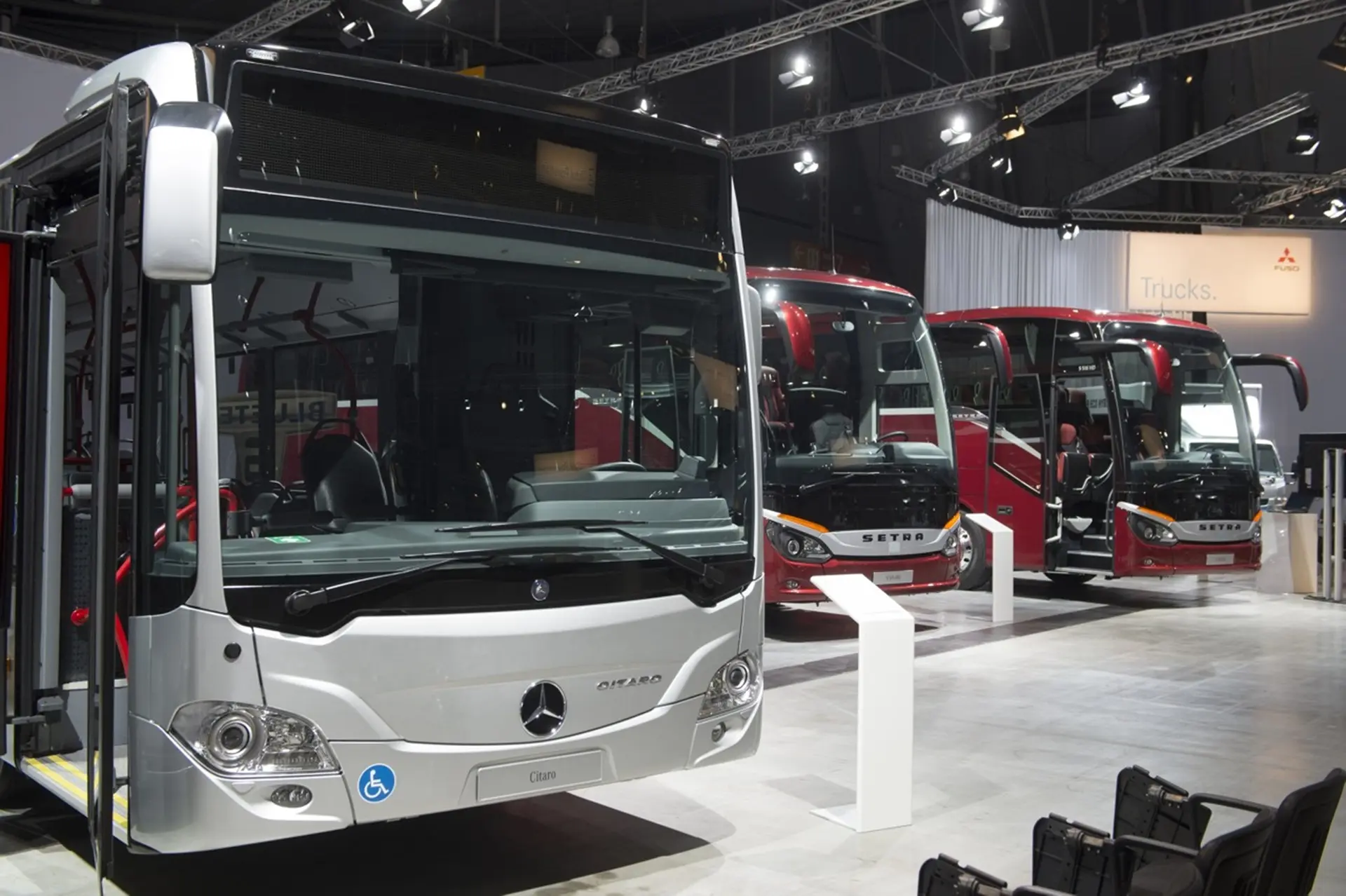
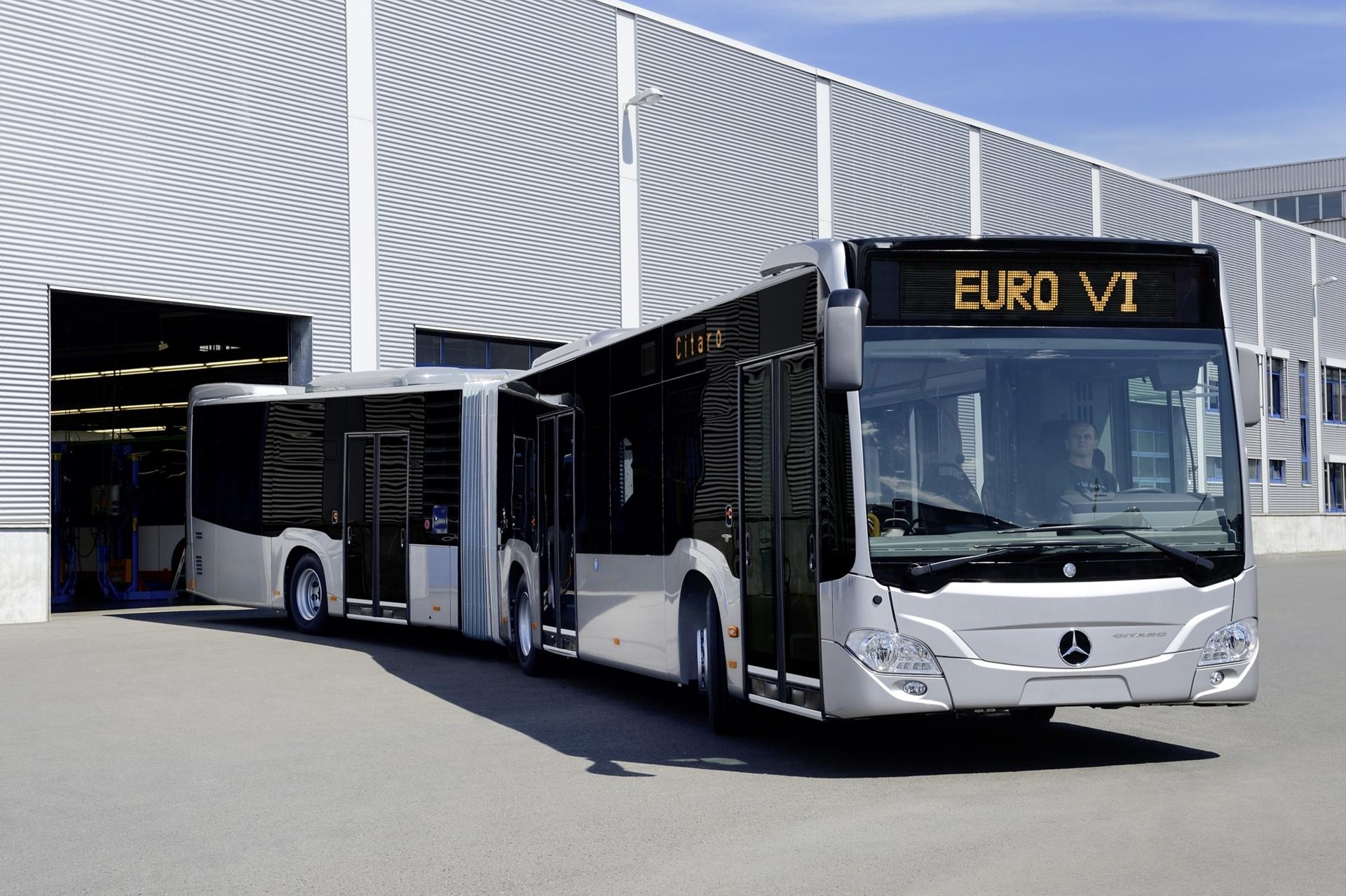
The Mercedes-Benz Citaro is extending its lead over the competition with a brand new generation of engines. It is the first regular-service bus to be supplied with power units that already meet the Euro VI emissions standard. It furthermore includes a raft of innovative measures for cutting fuel consumption and CO2 emissions. At the same time, this compensates for the Euro VI technology’s extra weight.
Drive system: two completely newly developed engine families
The engine series for the Citaro have been developed completely from scratch, and comprise the OM 936 and OM 470 in-line 6-cylinder units with displacements of 7.7 litres and 10.7 litres respectively. Both have a Euro VI emissions rating. Another common characteristic is excellent economy resulting from their durability, efficient consumption of fuel, AdBlue and engine oil, as well as the long service intervals for the particulate filter in the Citaro of 120,000 km or two years.
In practice, the engines stand out for their spontaneous response from standstill and impressive power output combined with smooth running. The high torque that comes online from very low rev speeds ensureseffortless and economical power delivery from just above idling speed.
Thanks to the beefy performance on tap, it was possible to lengthen the final drive ratios compared to the previous engines in almost all cases. The result is a considerable reduction in both engine speed and noise levels. The optimum shift points furthermore occur at low engine speeds, enabling a smooth, fuel-efficient driving style with a smaller number of gear changes for even greater comfort.
Technical features of the new engines
A highly efficient combustion process using common-rail injection forms the foundation for clean emissions and low fuel consumption. The high ignition and injection pressures both set new benchmarks, while the system of cooled exhaust gas recirculation brings further benefits, too. Both engines employ the BlueTec 6 exhaust gas aftertreatment technology from Mercedes-Benz: here, a closed particulate filter is combined with the successful SCR system from Mercedes-Benz to optimum effect.
The new OM 936 in detail: compact and powerful
The refined features of the OM 936 include VCP (Variable Camshaft Phaser), as the first adjustable exhaust camshaft to be fitted in a diesel engine is known. This aids particulate filter regeneration by modifying the valve timing on the exhaust side. The six-cylinder unit comes in two power ratings.
| Output | Torque |
| 220 kW (299 hp) at 2,200 rpm | 1,200 Nm at 1,200 rpm |
| 260 kW (354 hp) at 2,200 rpm | 1,400 Nm at 1,200 rpm |
The in-line six-cylinder engine is available for the Citaro in a horizontal variant (OM 936h), which comes in both power ratings and is tailored to regular-service bus operation. Although the basic engine remains the same, there is still a great deal of engineering work involved as the entire engine periphery has been purpose developed for such applications.
The 220 kW engine can also be ordered in a vertical variant. The second power rating delivering 260 kW is initially only available for the vertical engine on the Citaro LowEntry model, and cannot be specified for the regular rigid version as yet.
The OM 470 in detail: light but powerful
The new OM 470 is based on the heavy-duty engine series. Weighing just 990 kg (DIN 70020-A), it is perfectly suited to use in articulated vehicles. The standout feature of the vertically installed OM 470 engine is the unique and highly flexible X-PULSE common-rail system from Mercedes-Benz with fully electronic control and hydraulic pressure boosting.
The new OM 470 is designed to power articulated buses that operate in challenging topographical conditions. It comes in a choice of two output and torque ratings:
| Output | Torque |
| 265 kW (360 hp) at 1,800 rpm | 1,700 Nm at 1,100 rpm |
| 290 kW (394 hp) at 1,800 rpm | 1,900 Nm at 1,100 rpm |
Power is transferred to the wheels via an automatic transmission with torque converter. There is a choice of units manufactured by Voith and ZF, which come in the very latest version for the Euro VI emissions rating. With their torque converter design, they are ideally geared towards the low rev speeds of the new engines.
Fuel consumption up to 5 percent lower with Euro VI
Despite the Euro VI rating and the extensive exhaust gas aftertreatment technology that accompanies it, the new Citaro actually succeeds in once again undercutting the fuel consumption figures of its economical Euro V predecessor. Measurements taken in practice indicate an average fuel saving of up to 5 percent.
Excellent economy thanks to technical finery
The development team for the new Citaro really pulled out all the stops to assure it of outstanding economy. Take, for instance, the regular-service bus’s fuel-saving recuperation module: the electrical power generated without using fuel during overrun phases is stored and then used to supply power to auxiliary consumers such as fans, lighting, etc. when the bus is accelerating forward again. The air compressor with two-stage control also features a recuperative operating mode when the engine is overrunning, as it fills the compressed air tanks above the normal level of 10 bar to 12 bar. This excess compressed air can then be utilised by the auxiliary consumers when the vehicle is next accelerating, thereby reducing air compressor operating time and, in turn, fuel consumption.
The battery and alternator management systems are networked by CAN bus, allowing them to communicate with one another and distribute the load more evenly. This serves to extend the operating life of these two units. A tyre pressure monitoring system is optionally available for the first time, which indicates the current pressure in the individual tyres as well as providing a warning when fluctuations are detected.
Lowering the entrances at doors 2 and 3 (or 4 on the articulated bus) by 20 millimetres to 320 millimetres increases passenger comfort, shortens the kneeling time and also reduces air consumption – meaning a substantial reduction in fuel consumption, too.
Despite the inclusion of the new generation of Euro VI engines with their exhaust gas aftertreatment technology, the weight of the new Citaro is largely unchanged, meaning no loss of passenger capacity. As a result, the rigid bus offers space for up to 100 passengers, depending on the chosen configuration.
Design: the restyled Citaro rear end
On the outside, it is the slightly raised rear end and tower-style engine arrangement that distinguish the new Citaro with Euro VI emissions rating. Masked by a styling element on the sides, the rear turret is particularly eye-catching, as it gives the Citaro a slightly rounded and dynamic silhouette. The dark-tinted glass service flap on the left of the rear window is yet another distinctive feature.
The lighter engine compartment flap has been redesigned too, with a sandwich construction formed by joining two pressed parts together. The tail light clusters have an unmistakable design and are made up almost exclusively of energy-saving, long-life LED bulbs.
Engine and radiator in tower arrangement
The engine tower at the rear varies in size depending on whether a horizontal (OM 936h) or vertical (OM 936/OM 470) engine is fitted. The radiator above the power unit is positioned far out of the range of any dirt or spray water that is thrown up, as is the engine’s air intake.
The engine tower features a new insulation concept, comprising two layers of sheet metal with the insulation sandwiched in-between. This insulation jacket has a decorative plastic coating on the side facing the passenger compartment.
The new Mercedes-Benz Citaro: characteristic features
The front end of the Citaro has a particularly striking “expression”, greeting its passengers with a friendly smile. The large almond-shaped headlamps and the front end’s rounded forms help to rid the Citaro of the austere appearance that is so typical of regular-service buses. The deep-set side window line gives the bus a transparent appearance. The three-dimensional styling of the glass-fibre-reinforced-plastic wheel arches lends the body added dynamism.
One of the outstanding safety features at the front is the collision protection for the driver in the front end. This, together with the strengthened A-zero pillars and the frame design, means that future European pendulum impact regulations have already been factored into the Citaro. This collision protection has been tested in accordance with the ECE R 29 standard, while the Citaro bodyshell also already meets the ECE R 66.01 standard governing rollover strength, which only comes into effect in 2017.
Lower, well-illuminated entrances
The passenger compartment of the new Citaro has a particularly inviting feel to it. The pleasant experience for passengers begins at the bus stop thanks to the bright illumination of the entrance and exit areas. The passenger compartment itself stands out for its bright and cheerful design.
Light fittings can be supplied for the ceiling’s border section in the new model generation. These LED lamps can be used to create quiet zones and reading corners within the seating area. The good lighting levels reduce the risk of vandalism and increase passenger safety.
Driver’s workstation with perfected ergonomics
The driver’s workstation on the new Citaro takes ease of operation, ergonomics, instrumentation and comfort to new heights. The door to the driver’s cab is hinged at the rear and opens from the front. At the same time, the developers have improved the door’s stowage facilities. The partition screen for the driver’s cab is larger than before and curves further forward, too. Drivers also benefit from a higher seating position that puts them at eye level with passengers who are boarding.
The instrument panel mirrors all the recommendations for the new European driver’s workstation. The new, elegant shape creates extra kneeroom, while its soft-touch surface further adds to the Citaro’s high-class feel. The cockpit comprises large, clearly arranged dials for road speed and engine speed. Between the two dials there is a colour display showing a multitude of supplementary information, which can be operated using the buttons on the steering wheel. The cockpit’s buttons and switches have been positioned based on the latest ergonomic findings.
The comfort and safety-enhancing Citaro chassis
The chassis excels with exceptional comfort and handling safety thanks to the independent front suspension. The Electronic Stability Program (ESP) is being made available in a low-floor urban regular-service bus for the very first time in the new Citaro, thereby taking safety technology for this type of vehicle into a brand new era.
The exhibition vehicle in detail
The three-door rigid bus with vertically mounted engine encompasses a wealth of outstanding features, ranging from the Euro VI emissions rating to the Electronic Stability Program (ESP). Power is provided from the rear by the new OM 936 in-line 6-cylinder engine with a 7.7-litre displacement, an output of 220 kW (299 hp) and maximum torque of 1200 Nm. Power is transferred by the ZF Ecolife six-speed automatic transmission.
Its safety specification, including the Electronic Stability Program (ESP), is exemplary. The chassis is equipped with anti-roll bars, electronically operated level control and roll-and-pitch control. The lighting system is in a class of its own, comprising bi-xenon headlamps, fog lamps with integrated cornering light function and LED daytime running lamps. Cameras monitor the area around the cash register and the door 1 entrance as well as the passenger compartment. There is a 6.5-inch (16.5 cm) screen integrated into the driver’s workstation to monitor what’s happening. LED entrance lights (known as ambient lighting) are placed under the hem section at all three doors to help passengers boarding the vehicle in the dark.
Functionality: the Citaro is driver and maintenance-friendly
The segmented side panelling with easily replaceable components simplifies repairs. The electrically powered pivot-and-slide doors operate rapidly, and remain securely shut when closed. The electrically operated cassette ramp under the vehicle floor at door 2 makes life easier for the driver. The electric pivot-and-slide door at the front is unique, as it allows fast door opening and a generously sized entrance area for passengers.