



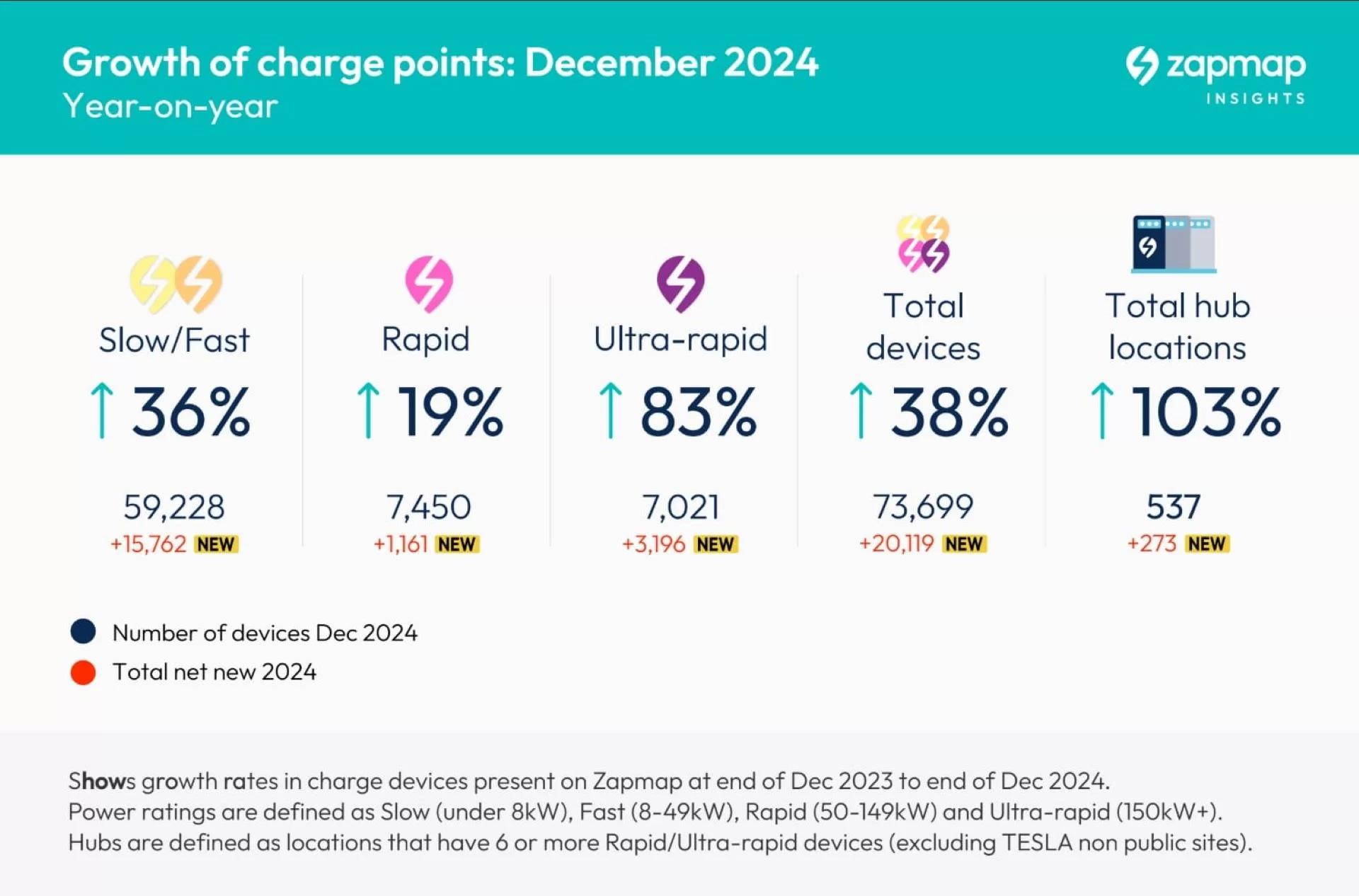
Zapmap, the UK’s leading charge point mapping service, has unveiled its 2024 year-end statistics, showcasing an extraordinary year of growth in the country’s electric vehicle (EV) charging infrastructure. Over the last 12 months, the number of public charge points has surged by 38%, reflecting the accelerating pace of the EV transition and the UK’s continued push toward a sustainable future.
An Unprecedented Surge in Charge Points
In 2024, more than 20,000 new charge points were installed across the UK, bringing the total to a remarkable 73,699. This surge marks a notable shift from a monthly average of 1,400 installations to 1,650, highlighting the urgency to meet the rising demand from the UK’s expanding EV fleet. The momentum, particularly in ultra-rapid charging technology, signals a pivotal moment for the country’s electric mobility landscape.
The Rise of Ultra-Rapid Charging Hubs
The most significant growth was seen in the ultra-rapid segment, with installations of 150kW+ chargers increasing by a staggering 84% since the end of 2023. These high-speed charging hubs, designed to enable quick recharges for long-distance drivers, are now spread across varied locations beyond motorway service areas. Retail parks, car parks, and even farm shops are now home to ultra-rapid chargers, underscoring the growing accessibility for EV drivers in need of swift top-ups.
The UK now boasts over 7,000 ultra-rapid chargers, with the overall count of chargers over 50kW surpassing 14,000. Additionally, the number of charging hubs—clusters of six or more 50kW chargers—has risen sharply from 264 in 2023 to 537 by the end of 2024, highlighting the increasing demand for robust, multi-charger locations.
Progress Across Various Charging Use Cases
Zapmap’s figures show substantial progress in all charging categories, from en-route chargers to destination and on-street chargers, as well as significant headway in addressing regional inequalities. The UK’s charging network now supports various driver needs, whether they’re seeking a quick recharge on a long journey or a more leisurely charge while enjoying a stopover.
Destination chargers, located at sites such as restaurants, hotels, and leisure areas, saw a particularly notable increase, with 12,000 new chargers added in 2024. These additions ensure that EV owners can easily charge while stopping, making longer journeys more convenient and hassle-free.
On-street chargers, essential for those without off-street parking, have also grown, though their distribution remains concentrated, with 72% of these chargers located in Greater London. Other cities such as Coventry and Liverpool have experienced good local availability, but a more balanced distribution of charging infrastructure across the UK is expected with the ongoing LEVI (Local Electric Vehicle Infrastructure) projects. These initiatives will help address the disparity, particularly in less-served areas, by the close of 2025.
Regional Charging Progress and Growth
Zapmap’s data also highlights a strong regional distribution of en-route chargers outside London. As of 2024, nine out of 12 geographical regions in the UK now have more than 1,000 50kW+ chargers. While regions such as Wales and the North West have made considerable strides, Northern Ireland’s pace of installation remains slower, although efforts are ongoing to close this gap.
Electric Vehicle Sales Soar in 2024
Alongside the surge in charging infrastructure, 2024 also witnessed record sales of pure-electric vehicles. According to the Society of Motor Manufacturers & Traders, more than 380,000 pure-electric cars were sold last year, comprising over 19% of all new car sales. This brings the total number of electric vehicles on UK roads to over 1.36 million—an impressive 39% increase from 2023.
A Bright Outlook for Public Charging Infrastructure
Zapmap’s annual driver survey reflects growing satisfaction among EV drivers, with an average rating of 87%. Interestingly, fewer than 3% of respondents indicated they would return to petrol or diesel vehicles. Despite the increase in public charging points, concerns about reliability and availability remain, though a majority—61%—believe the public charging network has improved in the past year.
Zapmap’s data further reveals that over 2.5 million successful charging sessions were completed in a single month by the end of 2024, underscoring the reliability and growth of the infrastructure. As more charge points come online, the UK is inching closer to achieving the Government’s targets for 2030, a view supported by the National Audit Office’s recent assessment.
Looking Ahead to 2025 and Beyond
Melanie Shufflebotham, Co-founder & COO at Zapmap, reflected on the record year: “2024 has been another landmark year for charging infrastructure growth, particularly with en-route charging points being installed ahead of the growth in electric vehicle sales.”
As the UK continues to build momentum, 2025 promises even greater advances. The upcoming introduction of the PCPR consumer regulations and the impact of LEVI-funded projects will further enhance access to public charging stations. With government consultations on a Zero Emission Vehicle (ZEV) mandate likely to provide additional clarity, the future of EV infrastructure looks increasingly promising.
Zapmap’s statistics paint a clear picture: the UK’s commitment to an electrified future is taking shape, with charging infrastructure at the heart of this transition.


