



As expected, the Volkswagen Group opened the 2025 fiscal year on mixed footing. Robust demand for its vehicles—particularly its battery-electric models—has driven significant top-line growth, yet the group’s profitability continues to face headwinds.
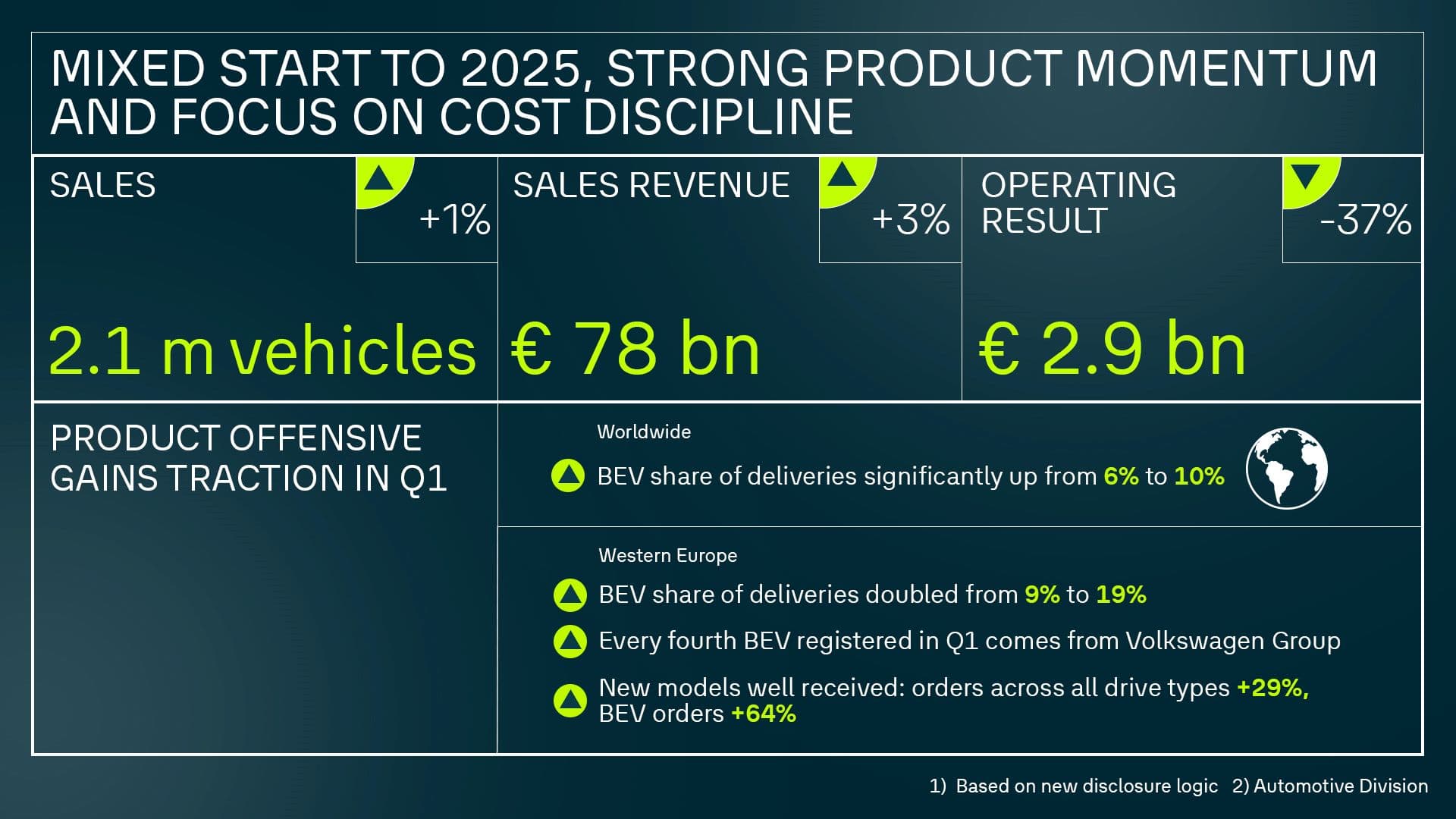
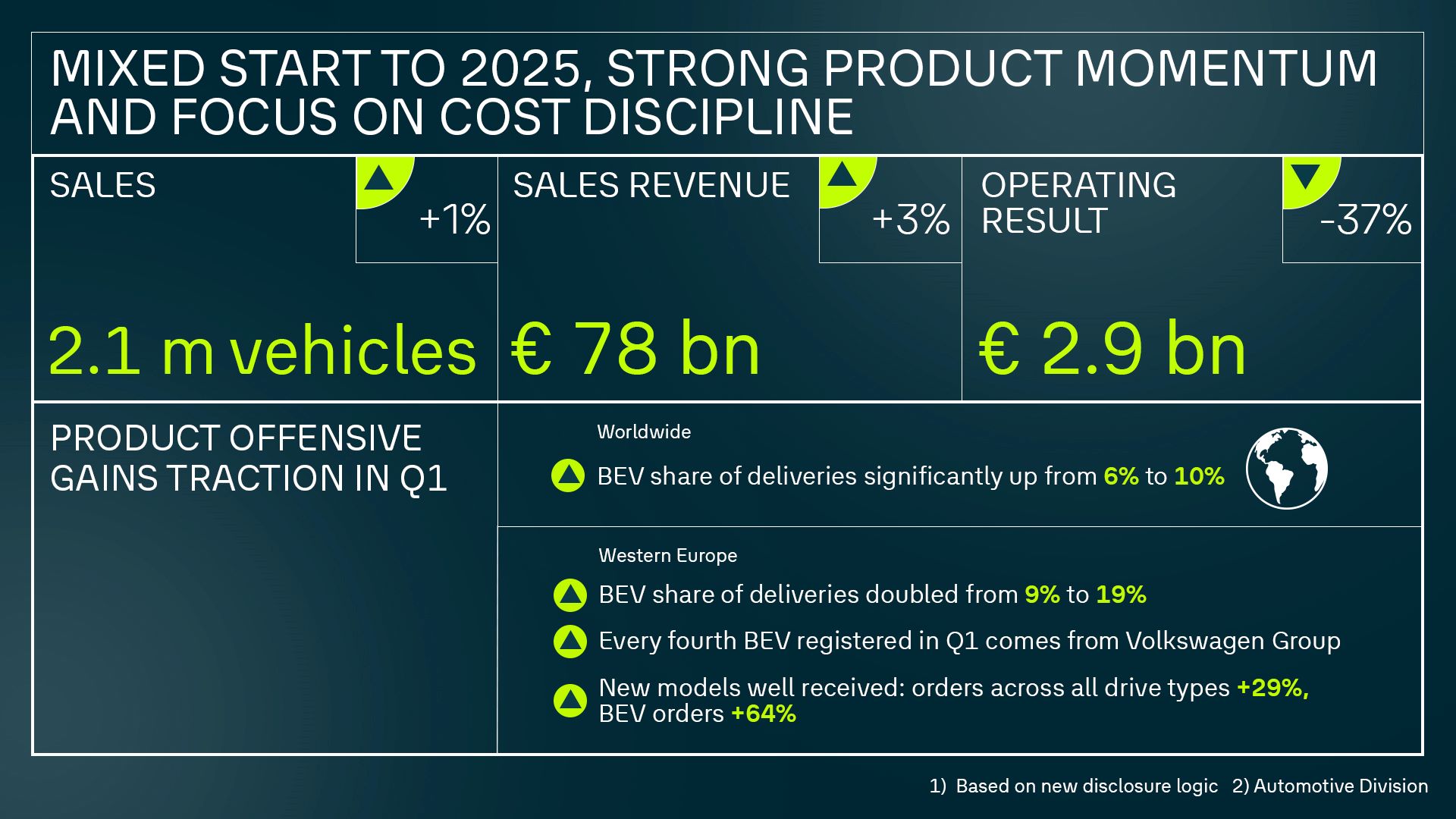
From January through March 2025, Group sales revenue climbed to €77.6 billion, a 2.8 per cent increase over the €75.5 billion reported in Q1 2024. Volume growth was broad-based, with vehicle sales rising by 0.9 per cent to 2.1 million units. Europe and South America led the advance, up 4 per cent and 17 per cent respectively, while sales in North America dipped 2 per cent and China fell in line with expectations by 6 per cent. Encouragingly, order intake in Western Europe surged 29 per cent, filling order banks to nearly one million vehicles—more than one-fifth of which are fully electric, following a 64 per cent year-on-year jump in EV orders.
Yet despite the clear market momentum, profitability has lagged. Q1 2025 operating result stood at €2.9 billion, down from €4.6 billion a year earlier, translating to a margin of just 3.7 per cent versus 6.0 per cent in Q1 2024. A combination of slightly adverse price/mix effects, elevated fixed costs and special items totaling roughly €1.1 billion weighed on the result. Adjusted for these special effects, however, operating profit reached approximately €4.0 billion, lifting the margin to 5.1 per cent.
“Our cars are very well received,” noted Arno Antlitz, CFO & COO of Volkswagen Group. “Order intake in Western Europe increased significantly and our order books are filling up fast. In addition, every fifth car sold in Western Europe is now fully electric with unit sales in Q1 more than doubling. At the same time, this market success of our electric cars puts pressure on our result. An operating margin of around four per cent clearly shows that there is still a considerable amount of work ahead of us.”
Financial discipline remains a priority amid a volatile global backdrop. The Automotive Division’s net cash flow improved to –€0.8 billion, compared with –€2.5 billion in Q1 2024, though it was still impacted by €0.7 billion in M&A and €0.5 billion in restructuring cash-outs. Net liquidity ended the quarter at €33.2 billion, down from €34.4 billion at the close of 2024, reflecting the group’s continued investment in future-proofing its portfolio.
Brand-group performance was uneven. Core (Volkswagen Passenger Cars, SEAT, Škoda) saw revenues rise 8 per cent yet margins halved to 3.2 per cent, as higher BEV volumes and special effects outpaced cost reductions. The Progressive brands (VW Commercial Vehicles, Audi, Porsche) marginally improved operating profit to €0.5 billion, with an adjusted margin of 5.9 per cent. Sport Luxury (Porsche, Lamborghini, Bentley) faced a 4 per cent revenue decline, primarily on lower volumes in China, bringing its margin to 8.7 per cent. Meanwhile, TRATON’s operating margin eased to 6.2 per cent amid softer truck sales.
Looking ahead, Volkswagen Group reaffirms its full-year targets. Sales revenue is expected to exceed 2024’s figure by up to 5 per cent, with an operating return on sales of 5.5–6.5 per cent, excluding the late-April tariff announcements. The Automotive Division aims for an investment ratio of 12–13 per cent, net cash flow of €2–5 billion and net liquidity of €34–37 billion by year-end—though current trends suggest the lower ends of these ranges are more likely.
Navigating a landscape marked by geopolitical tensions, trade barriers, commodity volatility and stricter emissions regulations, the group emphasises cost competitiveness alongside product strength. As Antlitz concluded, “Given the current volatile global economic situation, it is even more important to focus on the levers within our control. This means complementing our great product range with a competitive cost base—so we can ensure we succeed also in rapidly changing global markets.”
In sum, Volkswagen’s first-quarter results highlight both the promise of its electrification strategy and the challenges of sustaining margin improvement. With order books brimming and an ambitious outlook in place, the coming quarters will test the group’s ability to turn volume momentum into durable profitability.
Comments
Newest firstLoading comments…