



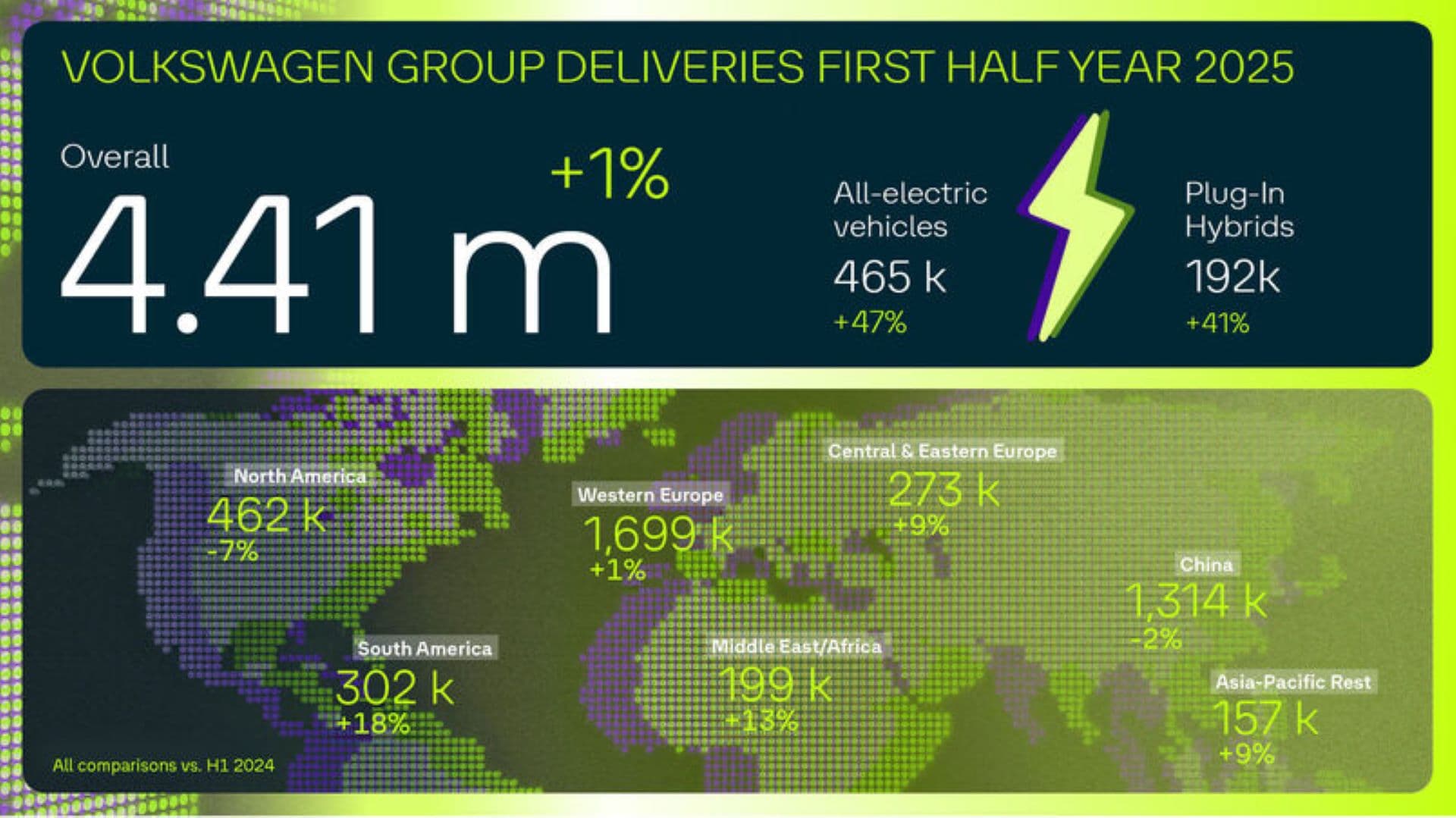
The Volkswagen Group is entering the second half of 2025 with notable momentum, underpinned by a dynamic product portfolio and surging demand for all-electric vehicles (BEVs). Despite regional fluctuations and a globally competitive landscape, the Group has managed to grow deliveries across multiple drive types—especially electric—cementing its leadership position in key markets like Europe.
According to Marco Schubert, Member of the Group’s Extended Executive Committee for Sales, “A wind of transformation continues to blow through the Volkswagen Group. Thanks to a successful model offensive, we’ve strengthened our position in electric mobility while continuing to grow deliveries across all powertrains, despite complex market conditions.”
Steady Global Growth Amid Regional Divergence
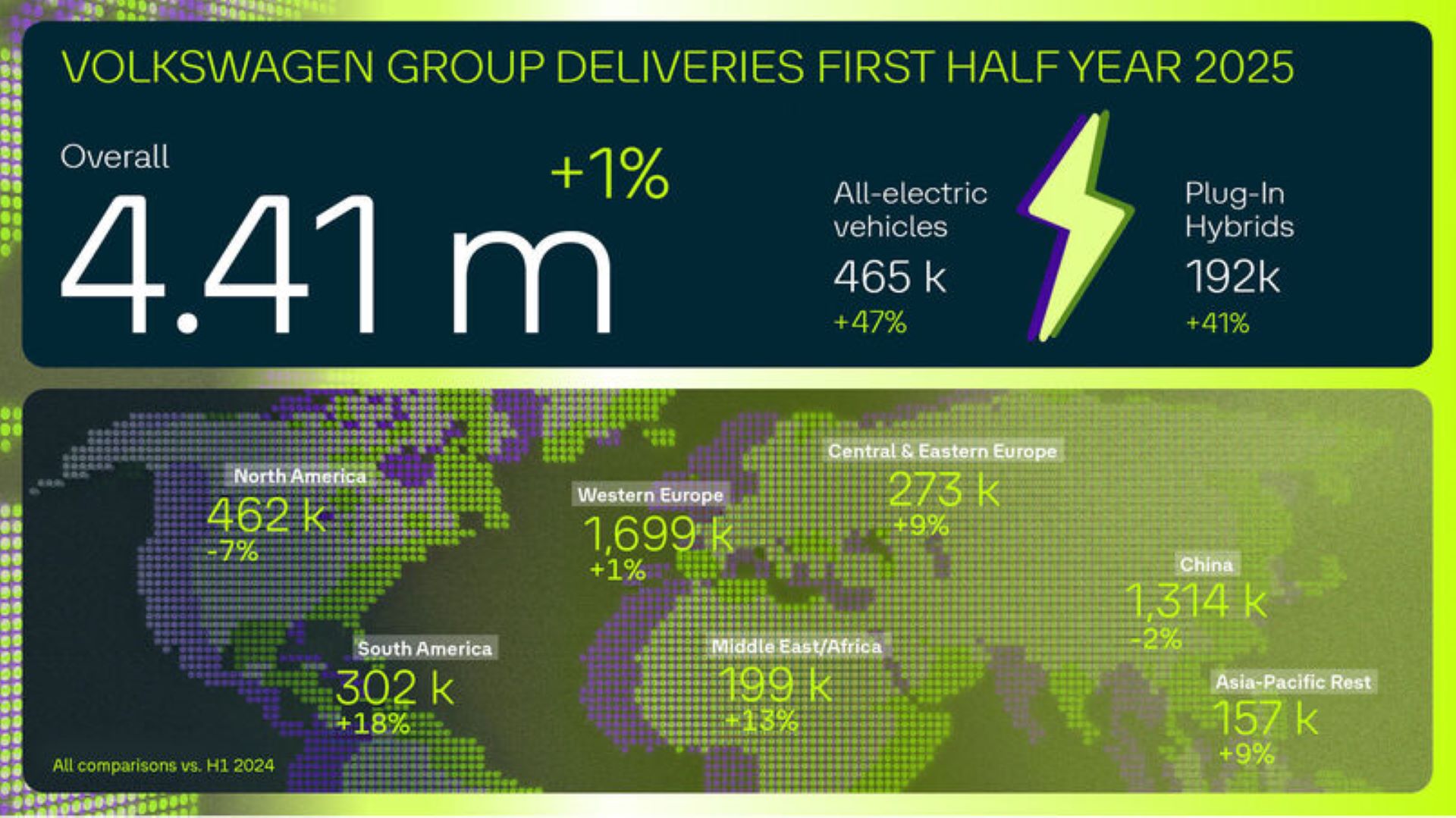
Volkswagen Group delivered 4.41 million vehicles globally in the first half of 2025, a 1.3% year-on-year increase. Strong gains in South America (+18.3%), Central and Eastern Europe (+8.5%), and Middle East/Africa (+13.4%) more than offset expected declines in North America (-6.7%) and China (-2.3%), where competitive pressures remain elevated.
In Western Europe, deliveries climbed modestly by 1%, driven largely by growing appetite for BEVs. In Germany, the Group’s home market, deliveries increased by 1.9%, showing resilience in a mature and discerning automotive environment.
Electric Surge: BEV Deliveries Climb 47%
The most striking development in the first half of 2025 has been the rapid acceleration of BEV sales. The Group delivered 465,500 all-electric vehicles, a substantial 47% increase over the same period last year. This lifted the Group’s global BEV share to 11%, up from 7% in 2024.
Europe was the growth engine, with BEV deliveries skyrocketing 89%, underlining the region’s status as both a regulatory and consumer hotspot for zero-emissions mobility. The USA followed with a 24% increase, despite broader challenges in the North American market.
In contrast, China—a traditionally vital region for BEV growth—saw a 34% decline, highlighting intensifying competition and shifting market dynamics. Nonetheless, Volkswagen remains the clear BEV market leader in Europe, commanding approximately 28% market share.
Plug-in Hybrid Revival and Order Momentum
Plug-in hybrids (PHEVs) are also experiencing a resurgence. Volkswagen Group delivered 192,300 PHEVs, a 41% year-on-year increase, buoyed by consumer demand for second-generation models offering up to 143 km of pure electric range.
Incoming orders in Western Europe reflect this shift: overall orders rose 19%, with BEV-specific orders increasing by 62%. Key drivers include newly launched models such as the Volkswagen ID.7 Tourer, CUPRA Terramar, Škoda Elroq, Audi Q6 e-tron, and the iconic Porsche 911.
Best-Selling Electric Vehicles
Volkswagen Group’s BEV portfolio continues to evolve with impressive breadth and depth. The most popular models by delivery volume include:
- Volkswagen ID.4/ID.5 – 84,900 units
- Volkswagen ID.3 – 60,700 units
- Audi Q4 e-tron (incl. Sportback) – 44,600 units
- Volkswagen ID.7 (incl. Tourer) – 38,700 units
- Škoda Enyaq (incl. Coupé) – 38,700 units
- Audi Q6 e-tron (incl. Sportback) – 36,500 units
- Škoda Elroq – 34,300 units
- Volkswagen ID. Buzz (incl. Cargo) – 27,600 units
- Porsche Macan – 25,900 units
- CUPRA Born – 22,100 units
These numbers reflect Volkswagen Group’s ability to cater to both volume segments and premium customers with a diversified electric offering.
Brand and Regional Highlights
- Volkswagen Passenger Cars led with 2.32 million units delivered, up 4.5%
- Škoda saw a notable 13.6% rise, bolstered by BEV momentum
- Audi, Bentley, and Porsche experienced marginal declines overall, but Audi’s BEV sales still climbed 34%
- Lamborghini was one of the few premium brands to post growth (+2.2%)
- South America emerged as the fastest-growing region (+18.3%), particularly in Brazil (+7.4%)
Looking Ahead: Staying the Course on Electrification
Volkswagen Group’s continued success hinges on maintaining the pace of its product offensive and reinforcing its electrification strategy. The Group’s ability to navigate headwinds in China and North America while thriving in Europe and South America demonstrates the strength of its multi-brand, multi-powertrain approach.
Schubert underscores the path forward: “We need to further strengthen this positive development by continuing our successful model offensive.” With sustained investment in innovation, and rising consumer appetite for electric mobility, the Group is well-positioned to shape the next phase of global automotive transformation.
Comments
Newest firstLoading comments…