





Hanover, 8 March 2025 – Volkswagen Commercial Vehicles is commemorating 75 years of the VW Bus, the longest-running commercial vehicle in European automotive history. On this day in 1950, the first Transporter—internally dubbed the T1—rolled off the production line in Wolfsburg, marking the beginning of an extraordinary legacy. Since then, more than 12.5 million VW Buses have been produced, with manufacturing shifting to Hanover in 1956. This milestone solidifies the VW Bus as the most successful European commercial vehicle of all time.
Over the decades, the VW Bus has evolved into a cultural icon, embodying both functionality and freedom. From the T1 to the latest T6.1, Volkswagen maintained a single-platform philosophy to support an array of derivatives—ranging from work vans to beloved camper van legends. However, the dawn of electric mobility has ushered in a new era, transforming the VW Bus from a one-size-fits-all vehicle into a tailored offering for various needs. The 2021 Multivan introduced a plug-in hybrid drive, followed by the ID. Buzz in 2022, Volkswagen’s first mass-produced all-electric van. In 2025, the latest Transporter product line will complete the modern three-pillar range, which now consists of six base models: the Multivan, California, ID. Buzz, ID. Buzz Cargo, Transporter, and Caravelle shuttle version. Each model continues to carry the DNA of the original T1, ensuring the VW Bus remains as versatile and timeless as ever.
The Birth of a Legend: T1 (1950–1967)
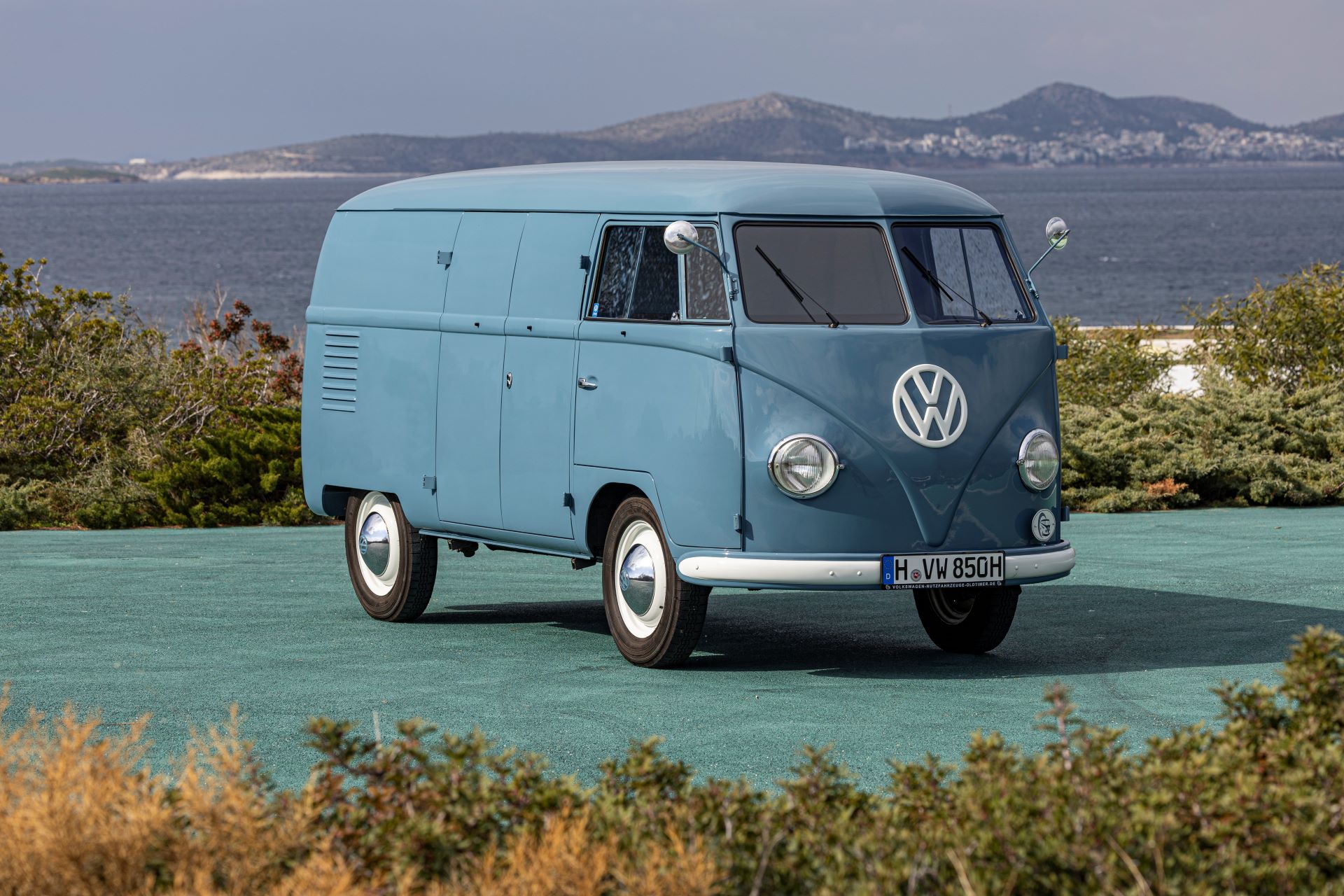
In the post-war reconstruction era of 1950, Germany was reinventing itself, and its businesses needed an affordable, reliable van. Enter the Volkswagen Transporter, or Type 2, following in the footsteps of the successful Beetle (Type 1). Initially named ‘Bulli’—though the patent office rejected the trademark—the T1 quickly gained popularity, particularly in German-speaking regions.
The first T1 was a utilitarian panel van with a 4.5 cubic meter load capacity, a distinctive split windscreen (earning it the British nickname “Splittie”), and a modest 25 PS flat-four engine capable of reaching 80 km/h. Soon after, Volkswagen introduced variations including the Kombi, minibus, and the legendary ‘Samba bus’ in 1951, featuring two-tone paint, up to 23 windows, and a panoramic folding roof. The demand was so immense that production moved to the Hanover plant in 1956, and by 1962, Volkswagen had already produced one million T1s. When the T1 was replaced by the T2 in 1967, over 1.8 million units had been sold, cementing its place in history.
The Flower Power Generation: T2 (1967–1979)
The late 1960s and 1970s were defined by cultural revolutions, and the VW Bus was at the heart of it all. The T2, introduced in 1967, became the quintessential symbol of the counterculture movement, seen at music festivals like Woodstock and Monterey Pop. With a larger, more modern design, a curved windscreen, and a standard sliding door, the T2 was a step forward in comfort and usability.
Technological advancements included improved chassis dynamics, better braking systems, and increased engine output, ranging from 50 PS to 70 PS. Production flourished, and by 1978, 4.5 million Transporters had been built. While German production ceased in 1979, the T2’s journey was far from over—factories in Mexico and Brazil continued manufacturing the model until 2013, with special edition farewells like the “56 Anos Kombi – Last Edition.”
Precision and Innovation: T3 (1979–1992)
As the automotive industry advanced in the late 1970s, Volkswagen introduced the T3, a more angular and modern interpretation of the VW Bus. It offered superior safety, increased space, and the first in-house camper van, the California, in 1988. The T3 also marked the debut of water-cooled engines, turbo-diesel variants, and all-wheel drive models with the innovative ‘syncro’ system. The blend of durability and innovation made the T3 one of the most beloved Transporter generations.
A Timeless Legacy
From its humble beginnings as a practical work van to its status as a symbol of adventure and freedom, the VW Bus has continuously evolved while staying true to its multifunctional DNA. Today’s ID. Buzz and Transporter lineup embrace the same spirit of versatility that defined the original T1, ensuring that the VW Bus remains relevant for future generations.
As Volkswagen marks 75 years of this automotive icon, one thing remains certain: the VW Bus is more than just a vehicle—it’s a cultural phenomenon that has stood the test of time.
Comments
Newest firstLoading comments…