


New assistance systems: The helpers in the background
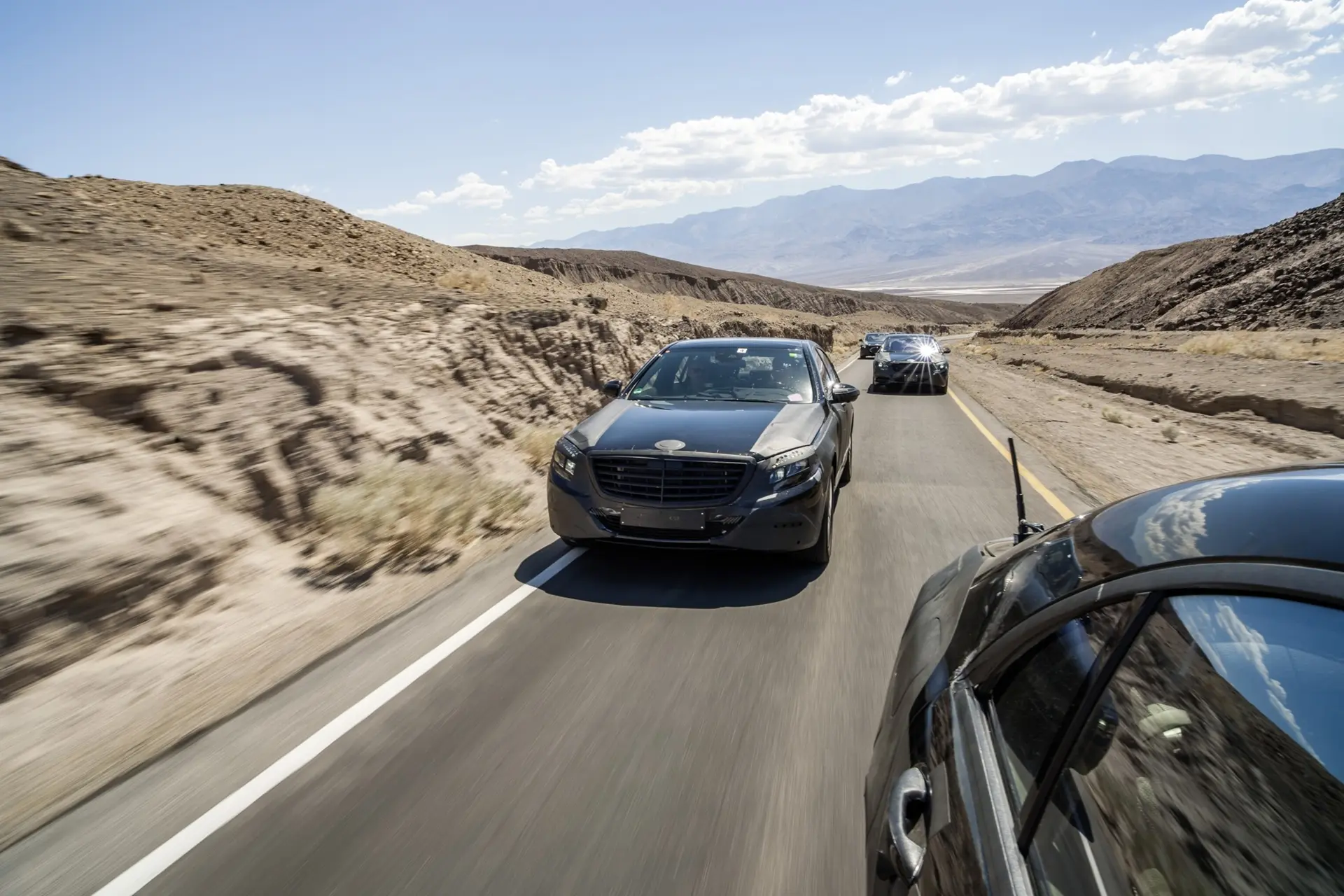
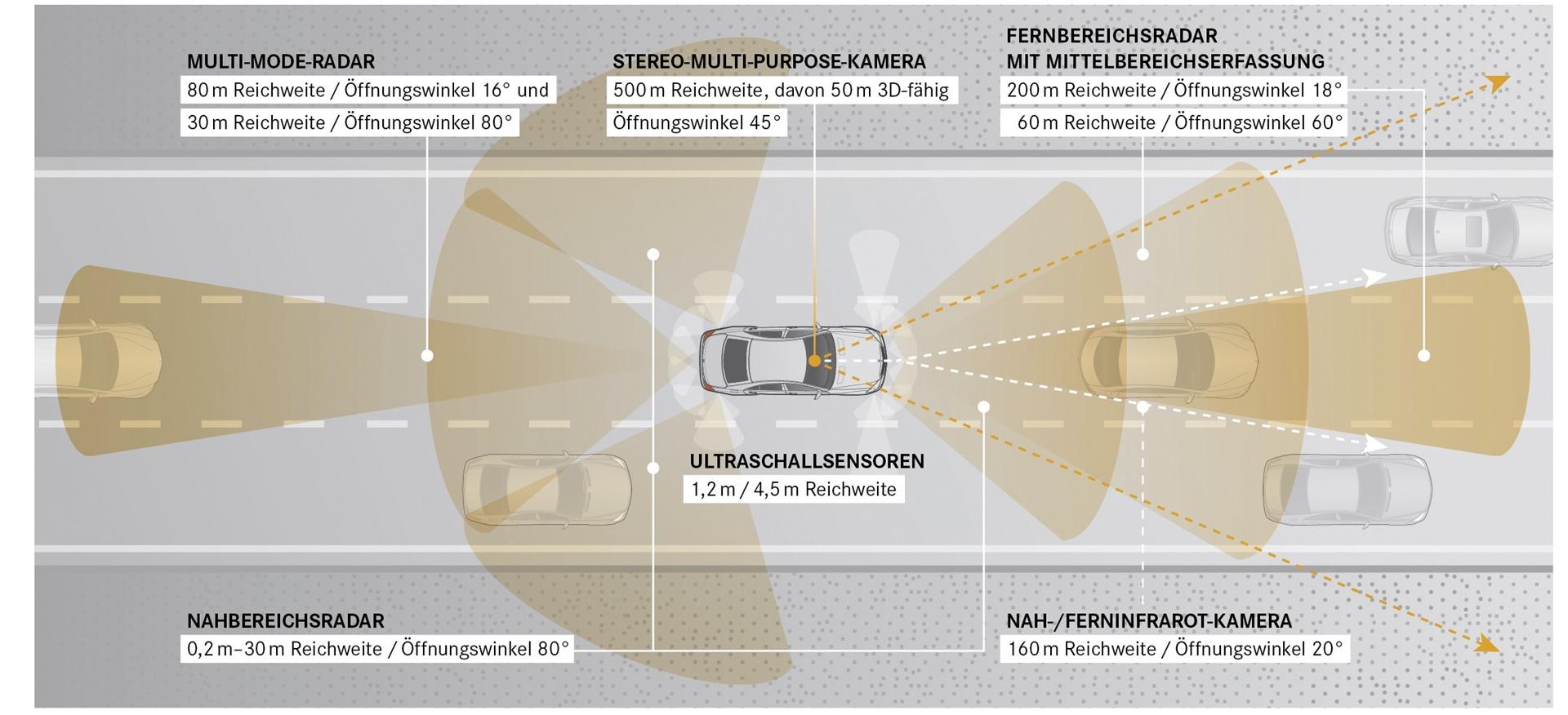
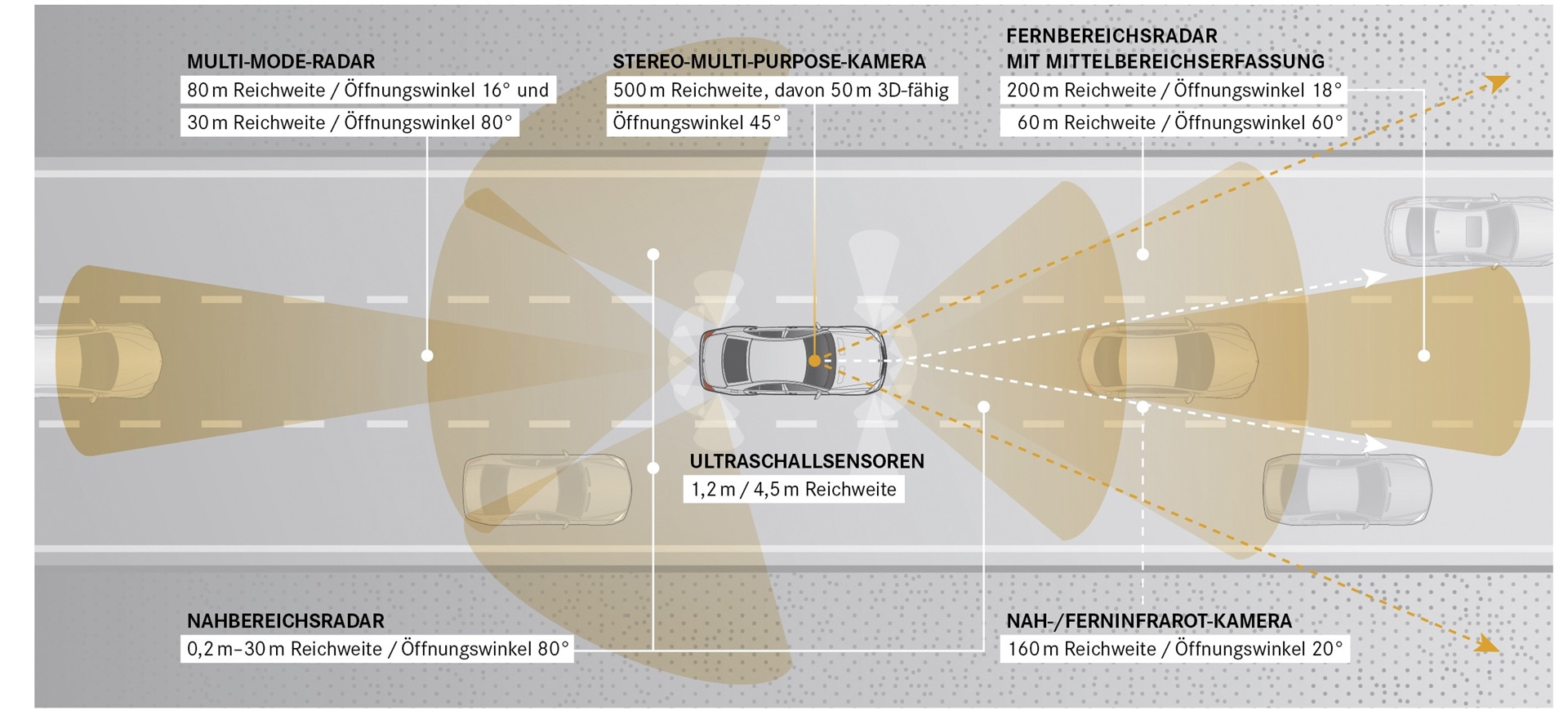
Avoid accidents and mitigate their consequences – this is the integrated approach adopted by Mercedes-Benz Accident Research under the heading “Real Life Safety”. Mercedes-Benz is systematically pursuing this strategy with numerous new assistance systems and greatly enhanced functions. The new functions all rely on the same sensor system, comprising a new stereo camera together with multistage radar sensors.
The support functions range from relieving the burden on the driver and therefore increasing comfort, to issuing visual, acoustic and/or haptic warning signals, to enhancing the driver’s reactions. Some systems are even able to take corrective action in an emergency, such as autonomous applications of the brakes to prevent an accident or reduce its severity.
Comfort-enhancing assistance with lateral lane guidance: DISTRONIC PLUS with Steering Assist
The DISTRONIC PLUS adaptive control system is a driver aid designed to keep the vehicle at the desired distance from another vehicle in front that is travelling slower than the selected cruising speed. This radar-based function has now been enhanced by the addition of Steering Assist, which helps drivers to stay centred in their lane by generating the appropriate steering torque when travelling on a straight road and even in gentle bends.
The stereo camera recognises lane markings as well as vehicles driving ahead together with their three-dimensional positioning, and relays this information to the electric steering assistance system. When driving at slow speeds, e.g. in congested traffic, Steering Assist can use the vehicle ahead as a means of orientation, enabling semi-autonomous following even when there are no clear lane markings visible. As a result, the system is able to further enhance driving comfort and substantially ease the driver’s workload in many traffic situations.
The new Steering Assist function integrated into the DISTRONIC PLUS system is predominantly based on the new stereo camera (see previous section). At the same time, the area in front of the vehicle continues to be monitored by two short-range radar sensors and a long-range radar sensor with medium-range detection. The system fuses the data gleaned from both technologies, calculates any reactions required, and then regulates the vehicle’s speed as requirements dictate by controlling engine power, transmission and brakes, as well as actuating the electric steering for lateral vehicle guidance.
DISTRONIC PLUS with Steering Assist can be activated as before with a lever on the steering column in a speed range from 0 – 200 km/h. Any speed between 30 km/h and 200 km/h can be selected as the desired cruising speed. A green steering wheel symbol appears in the instrument cluster to indicate when Steering Assist is operating while DISTRONIC PLUS is activated. Meanwhile, longitudinal information (cruise control function) is still visualised in the speed display by means of circular segments and the speedometer needle.
Drivers must keep their hands on the steering wheel at all times even when Steering Assist is activated, as the function only works in bends above a certain, speed-dependent radius. Legal considerations also mean there are no plans to introduce hands-free driving. The system’s design is so refined that the sensors can detect whether the driver’s hands are actually on the steering wheel. If they are not, a visual warning is issued first. Should the driver fail to react to this prompt, a warning signal sounds and lateral lane guidance is deactivated. This does not affect the cruise control function, however, which continues to be operative. Needless to say, the driver is able to override the Steering Assist at any time. If the driver signals to change lane, for instance, the lateral guidance function will switch into passive mode for the duration of the lane change.
The longitudinal performance capabilities of DISTRONIC PLUS have been further refined. Now, the system is able to brake at a rate of up to 5 m/s² without any intervention from the driver. If the “S” drive mode button is pressed, the rate of acceleration increases, too. Vehicle acceleration is also more dynamic if the driver signals a wish to overtake by switching on the indicators, assuming the road is clear.
By combining radar and camera data, DISTRONIC PLUS is also able to detect both vehicles cutting in and vehicles ahead in adjacent lanes and take necessary action promptly. This can prevent illegal undertaking on motorways and multi-lane highways, for example, by adapting the speed to that of vehicles in the outside lanes.
Braking assistance for crossing traffic: BAS PLUS with Cross-Traffic Assist
City junctions are a major accident blackspot. The collisions here can mostly be put down to driver distraction or misjudgement. Whereas humans often react too slowly, assistance systems are immune to that brief moment of shock.
Apart from material damage, accidents at junctions often result in serious personal injuries, too. The new Brake Assist BAS PLUS from Mercedes-Benz is therefore capable of more than just helping the driver to avoid collisions with vehicles ahead or lessen their consequences in a purely longitudinal direction: the new Cross-Traffic Assist function can also come to the driver’s aid when there is a risk of a collision with cross traffic at junctions.
If this anticipatory system detects a hazardous situation of this type, it prompts the driver to start emergency braking by activating visual and acoustic warnings. If the driver presses the brake pedal too tentatively, BAS PLUS will step in by automatically boosting brake pressure for effective emergency braking, even applying the brakes at full power if necessary. Applying just the right amount of braking power for the situation at hand maximises the available braking distance for traffic behind.
The Cross-Traffic Assist function is operative at speeds up to approx. 72 km/h, while BAS PLUS is able to aid the driver in longitudinal situations at any speed.
BAS PLUS with Cross-Traffic Assist is potentially able to either prevent or lessen the severity of approx. 27 percent of all accidents at road junctions resulting in personal injury. This equates to some 20,000 accidents a year in Germany alone (source: investigations carried out by the GIDAS German In‑Depth Accident Study and Mercedes-Benz Accident Research).
Detects broken lines too: Active Lane Keeping Assist
The new improved version of Active Lane Keeping Assist is now also able to intervene should the driver inadvertently cross a broken line when the neighbouring lane is not clear and changing lane could cause a collision as a result. The system can determine if this is the case using the information from the stereo camera and the radar system. The latter has been supplemented by a sensor at the rear, which works in unison with the other sensors in the front and rear bumpers.
Active Lane Keeping Assist is not only capable of recognising critical situations such as overtaking vehicles, vehicles to be overtaken and parallel traffic, it can also respond effectively to oncoming traffic. If the system detects the vehicle crossing the lane markings when the adjacent lane is not clear, not only does it cause the steering wheel to vibrate in pulses as a haptic warning for the driver, it guides the vehicle back into lane by single-sided braking via the ESP®. It thereby forms the ideal complement to the Active Blind Spot Assist, and also makes it possible for the first time to prevent collisions with oncoming traffic together with their often serious consequences.
Active Lane Keeping Assist is active at speeds between 60 and 200 km/h. If driver activity in the form of e.g. active steering, braking or acceleration is detected or when the indicators are switched on, both the warning and the corrective brake actuation are suppressed.
Now also recognises no-overtaking zones and access restrictions: Traffic Sign Assist
A new Traffic Sign Assist system which builds on the capabilities of the previous Speed Limit Assist represents yet another contribution to accident prevention from Mercedes-Benz. The system is now also able to recognise no-overtaking zones and alert drivers to access restrictions.
The camera on the inside of the windscreen continues to pick up speed limit signs, including those on overhead gantries and in roadworks, for example. The camera’s data is cross-referenced against the information in the navigation system and can be displayed in both the instrument cluster and the map view. If the camera fails to spot any road signs showing a speed limit or a speed limit is lifted, the legal speed limits based on the navigation data are shown instead, such as a maximum speed of 100 km/hon country roads in Germany or 50 km/h in built-up areas.
No-overtaking zones and the signs signalling their end are also registered and displayed, while in the case of signs imposing access restrictions, an acoustic warning is additionally emitted together with a visual warning in the instrument cluster – an effective way of helping to prevent serious accidents caused by wrong-way drivers.
Visualising drowsiness: ATTENTION ASSIST
A quarter of all motorway accidents in Germany are put down to drowsiness, making it one of the most frequent causes of accidents, most of which are of a serious nature. In 2009, Mercedes-Benz presented ATTENTION ASSIST, which is able to detect tell-tale signs of inattentiveness and increasing drowsiness based on changes in steering behaviour and a host of other factors.
The system has been subject to ongoing development, and the latest version has the ability to detect drowsiness and inattentiveness across a far greater speed range from 60 – 200 km/h. The system’s sensitivity can furthermore be adjusted, e.g. for drivers who already feel tired when they get behind the wheel.
A new menu in the instrument cluster display also makes the system more tangible and transparent for the driver by visualising the current ATTENTION ASSIST level and the driving time since the last break. What’s more, it is also possible to see whether the system is active in the current driving situation. If the ATTENTION ASSIST warning recommending the driver to take a break is emitted, nearby service areas can be indicated in the navigation system.
The system can be deactivated by making the appropriate selection in the instrument cluster menu. However, it will always be automatically reactivated with the sensitivity setting last selected the next time the vehicle is started.
Automatic manoeuvring into and out of parallel and perpendicular parking spaces: Active Parking Assist
The Active Parking Assist is designed for automated parking with active steering and brake control in both parallel and perpendicular spaces. It is an advanced version of the PARKTRONIC system with Parking Guidance offered previously. What’s more, the system is now also able to manoeuvre out of parallel parking spaces again all by itself with automatic steering and brake control, assuming the vehicle was parked there automatically previously.
When travelling at speeds below 30 km/h, ultrasonic sensors with an extended range in the bumpers’ side sections survey the nearside of the road for suitable parallel and perpendicular parking spaces. The same procedure is carried out for the far side of the road if the driver indicates accordingly. A symbol in the instrument cluster shows that the system is in the process of measuring. If a suitable parking spot is identified, an arrow appears alongside the symbol indicating that the system is ready for automatic parking. All the driver now has to do to activate the system is engage reverse gear and confirm by pressing the OK button on the steering wheel.
Active Parking Assist steers and brakes the vehicle automatically as well as indicating the various driver actions required in the display, such as the transmission position to be selected. The driver moves the vehicle by lightly pressing the accelerator or releasing the brake.