


4MATIC for the compact model range from Mercedes-Benz: Greater driving dynamics, greater traction, greater safety
- Fully variable permanent all-wheel drive for the front-wheel vehicles
- Dual clutch transmission with integrated power take-off
- Torque on demand-rear axle
- Intelligent control systems for safer and more enjoyable driving
- Different modes to suit personal driving styles
The most innovative components of the new 4MATIC include the power take-off to the rear axle which is integrated in the 7G-DCT automated dual clutch transmission and the rear-axle gear with integrated, electrohydraulically controlled multi-disc clutch. This set-up enables fully variable distribution of the drive torque between front and rear axle. Additional benefits of this design are a lower system weight than is available from the competition and high efficiency.
The 4MATIC all-wheel drive is a completely new development tailored to the requirements of the new front-wheel drive architecture. The engineers at Mercedes-Benz have ventured into uncharted territory here, as the design of the previous model series ruled out the introduction of an all-wheel drive system based on a front-wheel drive architecture with transversely mounted front engines. On these previous models the differential was located in front of the engine in the direction of travel, thus thwarting any options of diverting drive power to the rear axle. In addition, the body design with sandwich floor prevented the integration of a cardan shaft to the rear axle.
For the new front-wheel drive vehicles, adequate installation space for an all-wheel drive powertrain was provided right from the initial stages of the planning process. In addition, the development engineers designed the powertrain such that the differential axle is situated behind the engine, thus enabling power to be branched off to the rear axle. The future all-wheel drive line-up from Mercedes-Benz will be heralded in the coming year by the new CLA and the particularly agile and powerful CLA 45 AMG. While the basic mechanical configuration is identical on all versions, the AMG models feature a modified power output to the rear axle.
Integrated power take-off unit (PTU) channels power to the rear axle
The new 4MATIC is being combined with the 7G-DCT seven-speed automated dual clutch transmission which was premiered in the B-Class. The power flux to the rear powertrain is provided by a compact power take-off unit (PTU) which is fully integrated in the main transmission and is supplied with lubricant from the latter’s oil circuit. This configuration gives rise to substantial weight advantages in comparison to rival systems which branch off power by means of an add-on component with its own oil circuit. Together with the friction-minimised tapered roller bearings, the PTU achieves an excellent level of efficiency.
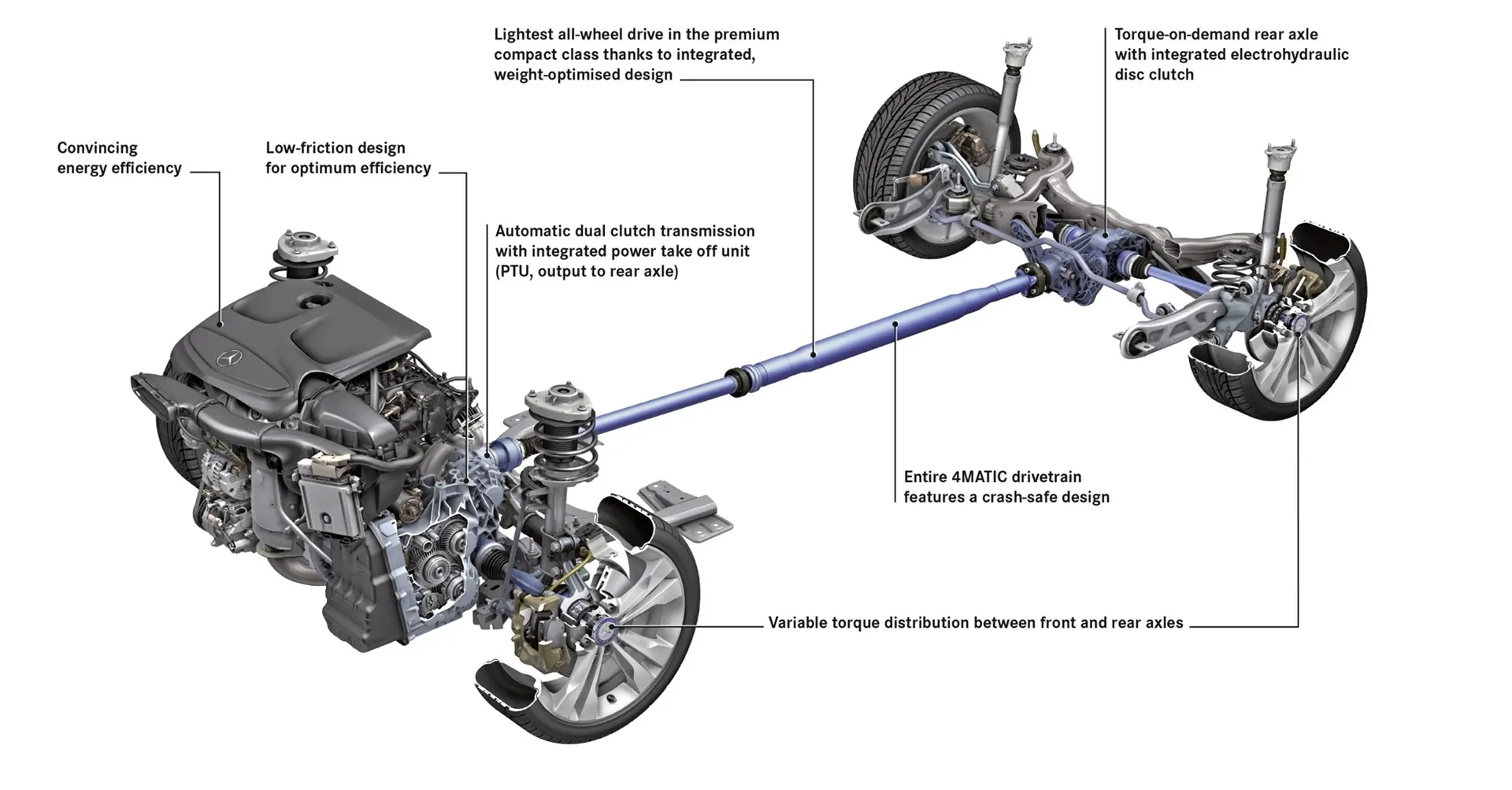
The low system weight of the new 4MATIC is not attributable solely to the PTU. Other weight-stripping measures include a compact rear-axle gear unit, inductively hardened rear-axle side shafts in hollow design and weight-optimised propeller shafts. The system weight of the new 4MATIC is up to 25 percent lighter than the all-wheel-drive versions offered by the competition. These lightweight design measures and the high functional efficiency result in a good level of energy efficiency.
As is always the case with all-wheel drive systems incorporating a transversely mounted drive unit at the front, the power flux requires to be diverted by 90 degrees. On the 4MATIC, this is achieved by quite simple means: the differential gearwheel of the main transmission drives the spur gear of the PTU and a compact bevel gear stage diverts the power flux. The rear axle is driven via an output flange and a cardan shaft.
A vibrationally decoupled intermediate bearing is fitted between the two-part cardan shaft and underbody and a flexible coupling is installed between the shaft and the rear-axle gear unit. An axially moving joint at the front compensates the typical movements of the engine-transmission unit under load and prevents the transfer of such movements to the rear powertrain. By virtue of these measures, all the 4MATIC versions attain a level of NVH comfort on a par with that of the comparable models with front-wheel drive. In order to minimise crash-induced stress for passengers in a head-on or rear-end collision, the cardan shaft is provided with a crash joint. Here again, the 4MATIC models attain a standard of safety on a par with that of the front-wheel drive models.
Completely new development with torque-on-demand rear axle
The electrohydraulically actuated multi-disc clutch integrated in the rear-axle gear unit is responsible for fully variable torque distribution. Operating principle: when the multi-disc clutch is open, the CLA is driven almost exclusively by the front axle. When the clutch is closed, the rear axle comes into play. This means that the drive torque can be shifted in fully variable mode between front and rear axle according to the given situation (torque on demand).
The system pressure to activate the rear axle is supplied in milliseconds by the rotor pump which is integrated in the rear-axle gear unit. The pump is activated automatically as soon as only minimal speed differences apply between front and rear axle. Pressure control is performed by a proportioning valve under the steering of the ESP®.
The most diverse parameters are taken into consideration here, such as lateral acceleration, steering angle, yaw rate, accelerator position, ABS control settings or the selected shift programme of the 7G-DCT dual clutch transmission. An additional pressure regulating valve limits the drive torque at the rear axle to 750 Newton metres. Up to 1000 Newton metres are possible on the AMG version.
Intelligent control systems for more enjoyable driving
The 4MATIC is activated according to the basic principle of “as often as necessary as rarely as possible”. This means that when the underlying conditions allow the all-wheel drive CLA models run almost exclusively in front-wheel drive mode. As soon as the driving situation requires, additional drive torque is channelled to the rear axle as appropriate. The reverse process takes place just as quickly: as soon as additional drive torque is no longer expedient at the rear axle – e.g. in case of heavy braking manoeuvres with ABS intervention – the rear powertrain is deactivated and torque is reduced to zero. With this strategy, the developers have managed to combine two key requirements defined in the performance specifications: optimum energy efficiency coupled with maximum driving dynamics and driving safety.
In normal circumstances, the drive torque distribution between front and rear axle can be set from 100:0 to 50:50. In certain driving situations, such as when exceeding the µ-jump limit, higher levels of torque may be allocated to the rear axle to avoid unstable operating conditions. Here are some examples of torque distribution (front:rear in percent, approximate values):
- Full-load acceleration at approx. 50 km/h → 60:40
- Dynamic cornering under load → 50:50
- Exceeding the µ-jump limit → 10:90
- Heavy braking with ABS intervention → 100:00
Another basic principle of the 4MATIC system results in a further increase in driving dynamics, guaranteeing greater driving enjoyment without compromising driving safety. In case of understeering or oversteering under load, the drive torque is first of all distributed such as to stabilise the vehicle. This ensures that traction and driving enjoyment are fully maintained in speedy driving on winding stretches of road. Only if these measures fail to have a stabilising effect do the control systems adapted to 4MATIC conditions, such as ESP® or 4ETS, intervene to keep the CLA stable.
The 4ETS electronic traction system forms part of the ESP® electronic stability programme and brakes the driven wheels individually when they go into spin. This provides for a high level of traction on slippery surfaces, on roads which are icy on one side or in continually changing conditions. In a nutshell: while 4ETS is responsible for maintaining the highest possible traction in all conditions, ESP® serves as the higher-level control instance to ensure optimum driving stability.
Individual: driving modes to suit personal driving styles
As already mentioned, the torque distribution ratio is also dependent on the activated shift programme of the 7G-DCT dual clutch transmission. The ECO programme results in torque distribution of a conservative nature. Less torque is channelled to the rear axle, resulting in gentler handling and supporting an economical driving style at lower revs. In SPORT or MANUAL mode the activation times are shortened and more torque is distributed to the rear axle in the interests of a dynamic, sporty driving style.
On the AMG versions such as feature on the CLA 45 AMG, 4MATIC adaptation takes place in accordance with the 3-stage ESP® system, employing the user-selectable settings ESP ON, ESP SPORT Handling Mode and ESP OFF. This 3-stage stability programme is also applied to adapt the control strategies of the variable 4MATIC system. The new AMG 4MATIC applies more rear-biased torque distribution as a general principle, in order to increase lateral dynamics around the vehicle’s vertical axis.
Detailed investigations in the testing phase
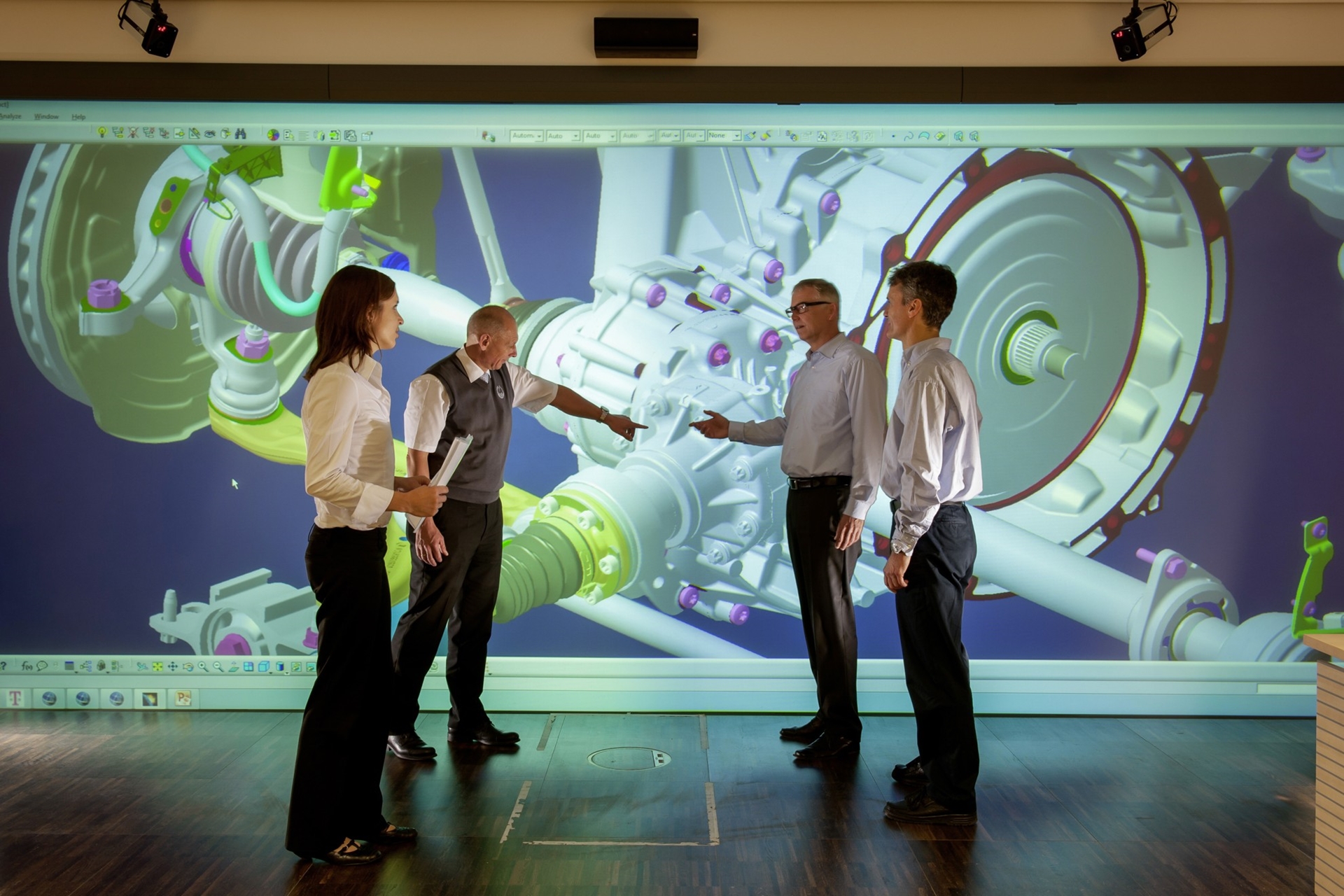
Alongside exact and realistic simulation using a digital prototype, extensive practical testing remains integral to the development phase of new models and drives. For the new 4MATIC, endurance testing and detailed tuning trials were carried out in all climatic zones and on all possible types of roads and surfaces. The test engineers carried out their work at test sites beyond the Arctic Circle and in desert regions, as well as trials closer to home at the Daimler test sites in Papenburg and Boxberg. Fine tuning of the control systems took place on race tracks such as the legendary Nürburgring Nordschleife and demanding alpine passes.
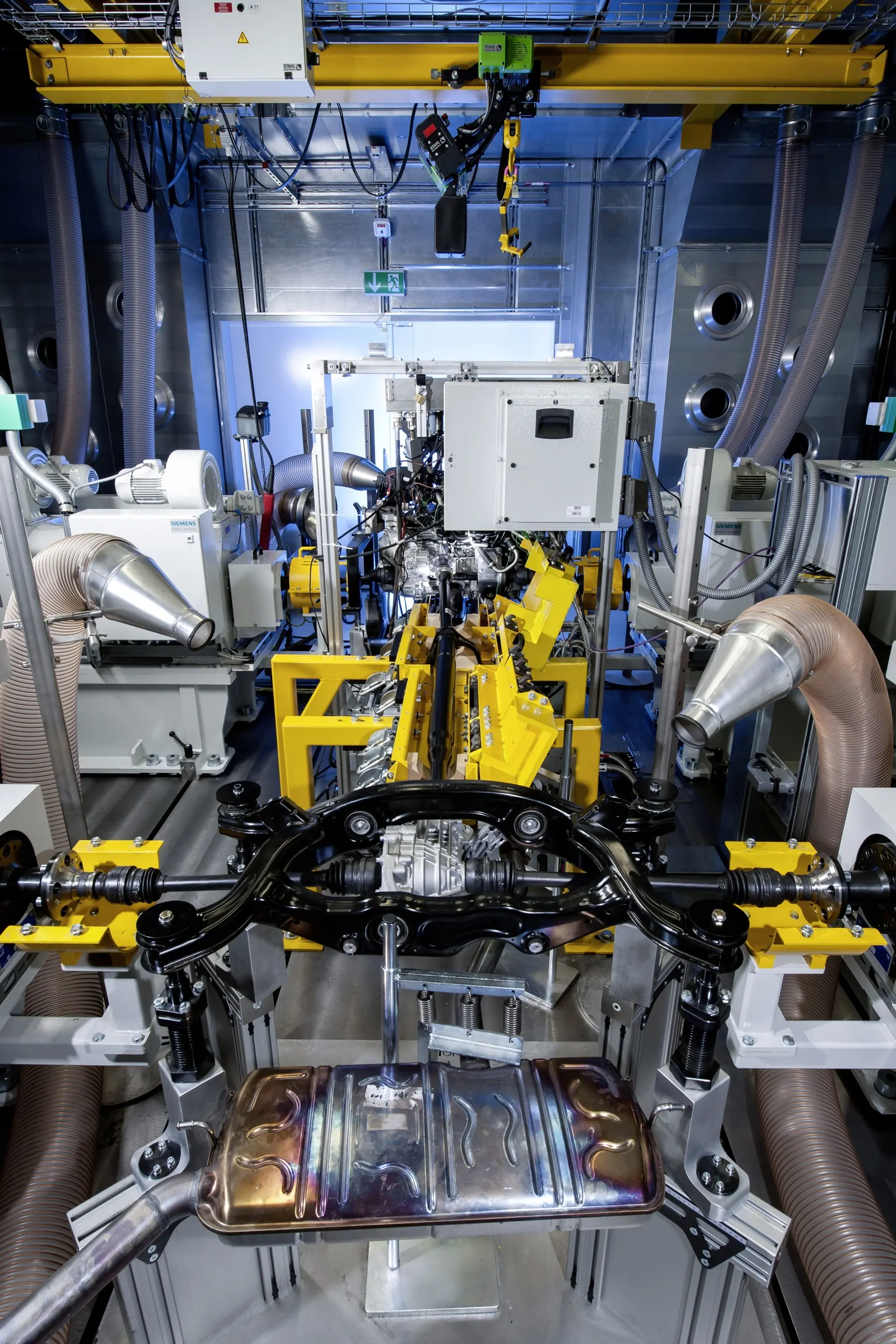
The test programme was backed up with extensive trials under standardised conditions on the all-wheel drive test rigs in Stuttgart-Untertürkheim. The entire powertrain with engine is set up on these large-scale test rigs and subjected to punishing treatment around the clock, following previously recorded and digitised test routes. Driving resistance is simulated here by four electric motors connected to the hubs of the respective wheels. This enables exact comparison of different design variants under standardised conditions without weather influences or changing road conditions, to reveal the best solution.
The test rig runs are also important for the purpose of tuning individual parameters. An example here is provided by the power take-off unit (PTU), which shares a common oil circuit with the main transmission in the interests of minimising component weight and maximising efficiency. As the lubricant supply process cannot be simulated exactly using a computer model, the engineers have come up with an “x-ray trick”. They produce the housing in a robust, transparent material and install this “glass PTU” in the powertrain. HD cameras can then be used to provide a perfect view of the oil circuit during the subsequent runs on the test rig and optimisation measures can duly be carried out as necessary.
The above-described large-scale test rig demonstrates Daimler AG’s commitment to maximum environment-friendliness and resource conservation with regard to the design and operation of test facilities. The four electric motors function as generators during braking, feeding the recuperated energy back into the power grid – at Mercedes-Benz, recuperation is not limited to the vehicles themselves.
Perfect duo: new 4MATIC and 7G-DCT dual clutch transmission
Drawing on over 50 years of experience in the development and production of automatic transmissions, Mercedes-Benz has ventured into new technical territory with the 7G-DCT dual clutch transmission: the new system is an automated three-shaft manual transmission consisting of two subtransmissions, each with its own clutch. Both actuation of the clutches and gear shifting take place fully automatically and without any interruption in tractive power. This enables a comfortable but nevertheless dynamic mode of driving. Thanks to its seven gears it offers a large gear ratio spread of up to 7.99. This means that a very short transmission ratio is available when moving off on an uphill slope with a high payload, for example, while during cruising the engine speed can be lowered considerably. The transmission’s efficiency improves fuel economy by up to 9 percent in comparison to the CVT which has been employed in the A-Class to date, bringing fuel consumption down to a level below that obtained with a manual transmission.
At a length of 367 millimetres and a weight of 86 kilograms, the 7G-DCT is more compact and lighter than the transmissions in this torque class which have been available on the market to date. The clutches take the form of oil-cooled multi-disc clutches. The specially developed hydraulic fluid is actively cooled, thus ensuring correct functioning of the transmission even under extreme conditions, despite the comparatively low filling level of six litres. Excess engine heat can also be transferred to the transmission, which improves its efficiency.
For the first time on this type of unit, the transmission is supplied with oil by two oil pumps – one mechanical and one electric. The electric pump maintains the oil pressure when the engine is switched off via the start/stop function. This means that the transmission is immediately operational when the engine is restarted and the vehicle can move off again without any delay. In addition, the electric pump is able to support the mechanical pump when peak loads apply, enabling a more compact and efficient design for the mechanical pump.
Another new feature is electrical activation of the hydraulics for the parking lock, which is locked by mechanical means. This “park by wire” function enables the transmission selector lever to be positioned as desired: it is located in the form of a steering column lever on the right behind the steering wheel. In combination with the electric parking brake, additional space has thus been created in the centre console for additional stowage facilities.
Three gearshift programmes are available to the driver:
- ECONOMY: in this mode, the transmission performs gearshifts fully automatically and particularly comfortably. The gears are selected with due regard to a particularly economical style of driving at low revs
- SPORT: the transmission performs gearshifts fully automatically. The shift and response times are shorter, with gearshifts at higher engine speeds
- MANUAL: in this mode, the driver operates the transmission manually via shift paddles behind the steering wheel. The engine speeds at which the gears are shifted can therefore be freely chosen
In ECO or SPORT mode, the driver is still able to intervene manually in the gear-shifting process via the shift paddles. The transmission reverts to the selected automatic mode after the paddles have remained inactive for ten seconds, or after a longer delay when driving downhill or on winding roads.