



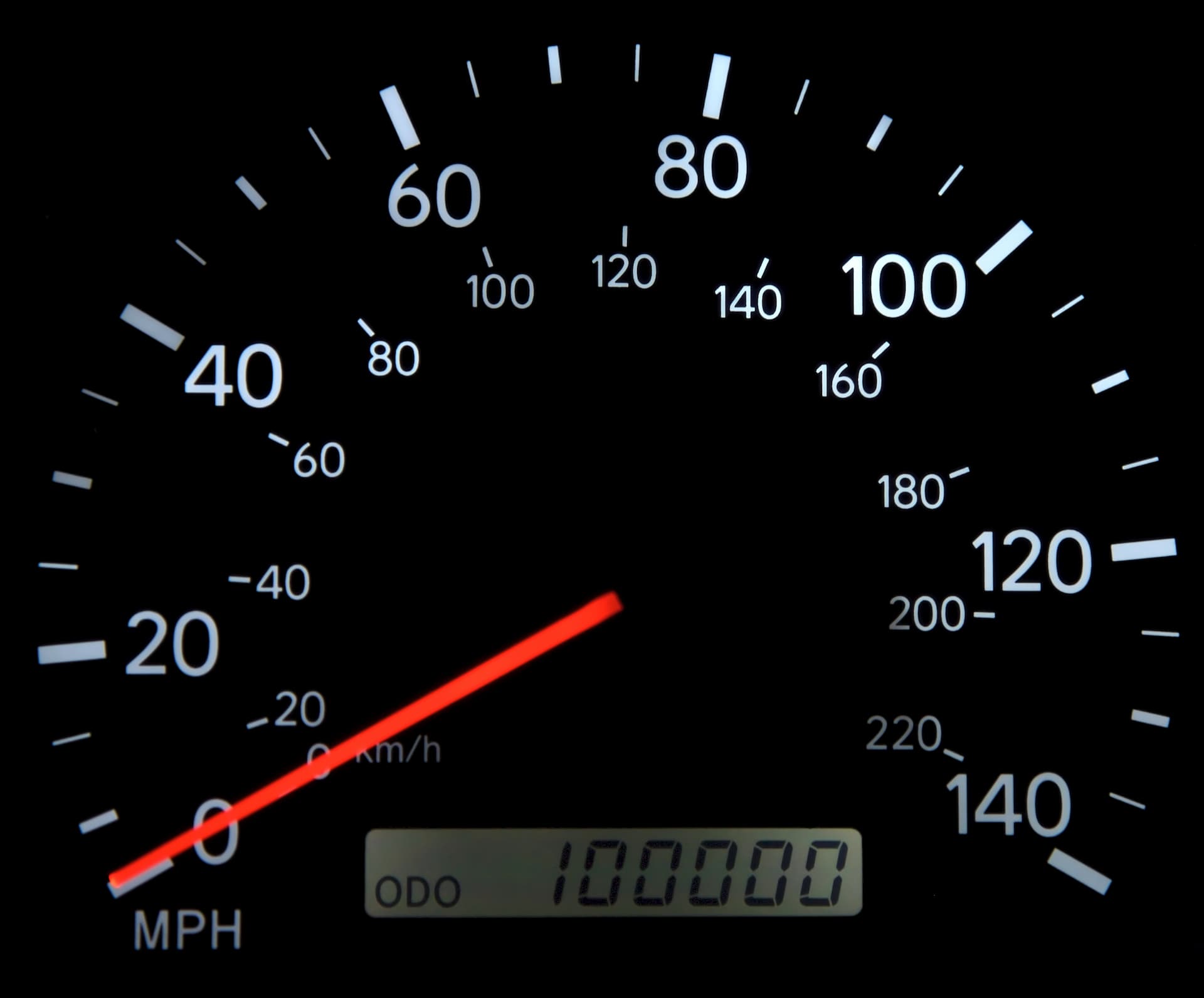
Just one in 10 Brits would purchase a used car that had more than 100,000 miles on the clock, a survey has revealed.
Despite a shortage of used cars entering the market according to the SMMT, CarGurus, an online automotive marketplace to shop, buy, and sell used vehicles, found that just 13.3% of drivers would be willing to buy a petrol car with over 100,000 miles on the odometer, while 15.5% would buy a diesel.
Notably, when asked the same question regarding electric vehicles (EVs), an even lower proportion of the 1,000 drivers surveyed (8.9%) would purchase an EV with 100,000 miles or more.
The research also indicated that consumers were less likely to purchase a higher-mileage EV compared to petrol or diesel vehicles. The mean mileage at which drivers would be put off buying an EV was 49,900, in contrast to 60,500 for petrol and 64,000 for diesel cars.
The CarGurus survey also looked at the most important factors drivers consider when buying a car. While drivers remained most concerned by vehicle price (55%), mileage was the next most important (36%) ahead of MPG (34%), the car’s age (27%) and safety (23%).
CarGurus has gathered data based on its extensive online inventory to illustrate how higher mileage impacts prices across identical models:
| Make | Model | Age | Mileage | Approximate price/saving |
|---|---|---|---|---|
| Nissan | Leaf N-Connecta | 3 years old | 10,000 | ≈ £19,500 |
| 25,000 | -10% | |||
| 45,000 | -20% | |||
| Ford | Fiesta 1.25 Zetec 5-door | 5 years old | 50,000 | ≈ £8,000 |
| 75,000 | -12.5% | |||
| 100,000 | -37.5% | |||
| Range Rover | Evoque SE Tech (manual) | 5 years old | 20,000 | ≈ £20,000 |
| 50,000 | -7.5% | |||
| 90,000 | -25% | |||
| Volkswagen | Golf 1.4 TSI SE Nav | 5 years old | 50,000 | ≈ £13,500 |
| 75,000 | -18.5% | |||
| 100,000 | -30% |
The study went on to explore what was putting drivers off from buying high-mileage cars. Topping the list was the cost of maintenance (70%), fear of it breaking down (55%) and finding it harder to secure car finance (18%).
When looking specifically at EVs, the biggest concern was battery life (52%), followed by how expensive the battery is to maintain (39%) and overall reliability (29%).
However, as explained in an in-depth guide from CarGurus on expected EV battery life and replacement costs, buyers need not be so concerned when considering a high-mileage EV purchase.
Lastly, CarGurus looked at which car brands consumers would be most willing to consider if a car had 100,000 miles or more on the clock.
The car brands that consumers are most likely to purchase when considering a petrol or diesel vehicle with over 100,000 miles:
| Car brand | Ranking |
|---|---|
| Ford | 1 |
| Audi | 2 |
| BMW | 3 |
| Mercedes | 4 |
| VW | 5 |
| Volvo | 6 |
| Toyota | 7 |
| Land Rover | 8 |
| Vauxhall | 9 |
| Honda | 10 |
The car brands that consumers are most likely to purchase when considering an EV with over 100,000 miles:
| Car brand | Ranking |
|---|---|
| Tesla | 1 |
| Toyota | 2 |
| Mercedes | 3 |
| Audi | 4 |
| BMW | 5 |
Ivan Aistrop, Deputy Editor at CarGurus U.K, said: “In spite of a shrinking used car market and the ongoing cost of living crisis, our research details that a very small proportion of drivers (around one in ten) are willing to purchase a high-mileage vehicle. For high-mileage EVs, this is an even smaller portion (8.9%).
“There is no typical mileage that determines a good used car as every buyer’s needs are unique. High-mileage vehicles need not necessarily put off buyers and can even offer good cost-saving opportunities if the vehicle has a full-service history, for example.
“Generally, concerns over the cost of maintenance and breakdowns dominate for high mileage vehicles, but for EVs, worries about battery life are a significant factor on consumers’ minds. However, manufacturers go to lengths to ensure EV batteries will endure well over 100,000 miles of use, as well as provide longer warranties, typically of around eight years.
“German brands make up four of the top five most likely purchases if buyers were to consider a used vehicle with over 100,000 miles. Interestingly, Ford takes the top spot with Japanese brands Toyota and Honda further down the list.”
CarGurus’ top five tips for buying a high-mileage car:
- Don’t be put off!
Mileage and age are both useful indicators as to what condition a used car may be in, but they are by no means the most useful. It’s more important to ascertain how well the car has been maintained throughout its life, and how it’s been used/driven. Remember, cars are designed and built to be driven, and it’s entirely possible that a car with above-average mileage can be in better condition than an identical vehicle with fewer miles on the clock. - Insist on a full-service history
The best way to determine how well a car has been maintained is to check its service history. All cars have an established service and maintenance schedule detailing what work should be done at what point (whether that is a point in time or a point in the mileage covered – both can apply). By cross-referencing that schedule with a car’s service history, you can ascertain whether all the necessary work has been carried out, and at what point. - Try to find out how the car has been used
Different types of driving put different types of stress on a car, and in different amounts. A car with a low mileage might predominantly have been used in built-up urban areas for stop-start commuting, and that means more strain will have been put on its clutch, brakes, and gearbox than a car that has spent the majority of its time cruising along motorways and clocking up a higher mileage. Short-hop use can also mean that a car’s engine and associated components aren’t given a chance to get up to optimum operating temperature often enough. - Make sure the higher mileage is reflected in the price
A lower mileage car won’t always be in worse condition than a higher mileage equivalent, but it should always – in theory at least – be cheaper to buy. That’s because it’s one of the many factors used in ascertaining the value of a used car. - Definitely consider a high-mileage car if you’re a low-mileage driver
If you’re a low-mileage driver, buying a high-mileage car could be the gift that keeps on giving. Not only will your car be cheaper to buy in the first place, but if you then keep the car for a few years, your lower mileage during your period will help to bring the overall mileage closer to the industry average of roughly 7,500 miles per year. Or put another way, your high-mileage car won’t be a high-mileage car any longer.
Comments
Newest firstLoading comments…