



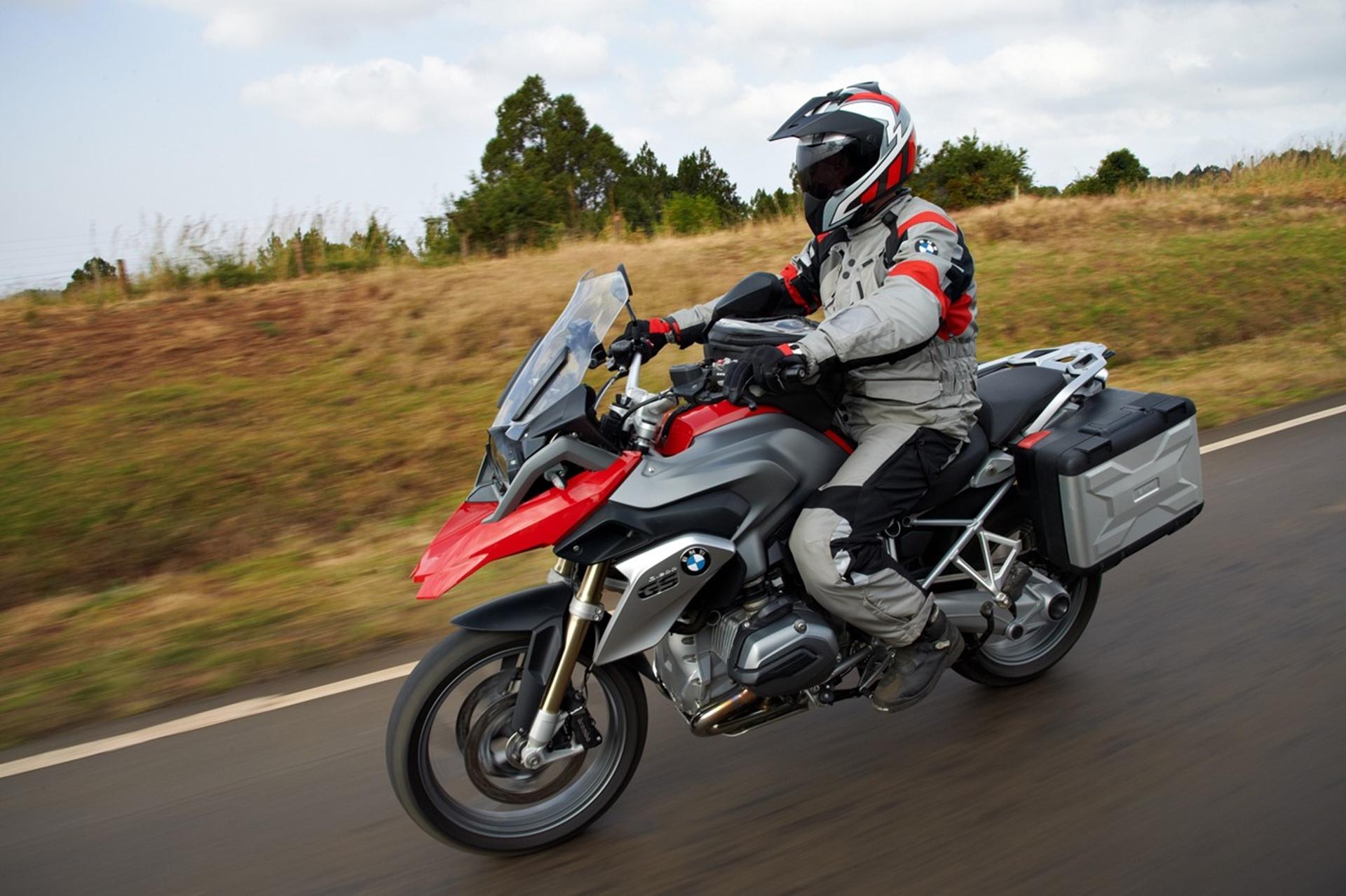
New chassis with torsionally stiff tubular steel bridge frame and bolt-on rear frame.
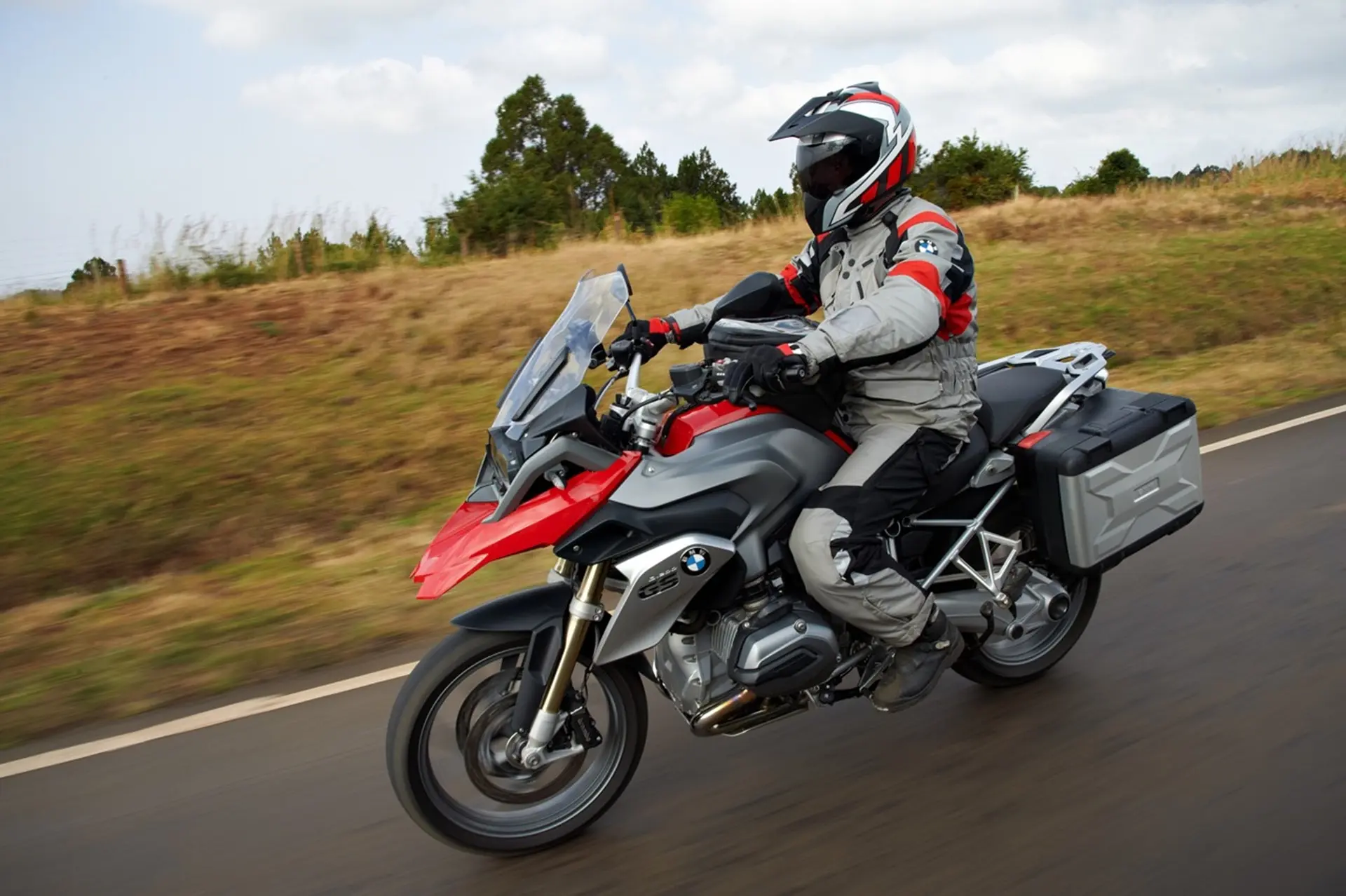
One of the primary goals in developing the new BMW R 1200 GS was to further increase the bike’s high level of riding dynamics while also creating a suspension which would extend the possible range of uses of the “big GS” both on and off the road. The new, more rigid main frame including the steering-head bearing for the Telelever and the swingarm axle of the EVO Paralever has made it possible to significantly improve ride stability, handling and precision.
The bike also benefits from the improved suspension/damping set-up in terms of touring suitability, since lengthy trips are now more comfortable and less tiring for this reason.
The optimised connection with the road surface, especially due to the new suspension/damping set-up and the new wheel/tyre dimensions, means that the new R 1200 GS is also considerably more dynamic. Its precise handling allows the motorcyclist to adopt a very sporty style while retaining full controllability and without requiring excessive physical effort.
Off-road the rider of the new R 1200 GS benefits from a tighter connection with the ground, too, as well as appropriately adapted control strategies which generate a much greater sense of trust in the vehicle.
While the frame of the R 1200 GS previously consisted of an upper frame to support and position the Telelever and the rear frame with integrated swingarm mount and welded on rear section, the chassis of the new R 1200 GS is now made of a continuous steel bridge frame with a bolt-on rear frame. The latter offers particular benefits in terms of maintenance. However, the integration of the engine as a load-bearing element has been retained as this is beneficial to the bike’s weight and rigidity.
Optimised Telelever at front and EVO Paralever at rear for an even more precise ride feel.
As before, the triangular swingarm in forged aluminium is supported by the engine housing. The outstanding underlying principle of this type of front wheel control is the fact that it relieves the telescopic control of longitudinal and transverse forces as well as separating wheel control from suspension and damping, resulting in an unsurpassed degree of sensitivity of response in the front section. A high level of ride precision and directional accuracy combined with excellent ride comfort and anti-dive control are the fundamental advantages of this design.
The Telelever has been geometrically refined for use in the new R 1200 GS, and its excellent properties have been further optimised. While retaining the same degree of rigidity, the fork tube diameter of the telescopic control was reduced from 41 to just 37 millimetres. This means that in spite of integrating radiators in this area, it was still possible to retain the existing steering angle of +/- 42 degrees, ensuring excellent manoeuvrability and slow riding. In combination with a more rigidly designed trailing arm, the overall result was even higher steering precision and transparent feedback in the front section. As before, the entire Telelever is designed to be maintenance-free with its encapsulated ball joints and permanent lubrication as well as a lifetime filling of the telescope tubes with oil.
In the patented rear wheel control system EVO Paralever it was possible to provide improved protection for the lower spring strut area against potential damage during off-road riding by means of the wrap-around swingarm. Due to its more rigid housing in the main frame, the progressive damping spring struts at front and rear now respond much more sensitively as well as having considerably increased damping reserves. With progressive damping, the progression of the damping force depends on spring travel. On the one hand, it enables a very finely tuned response even to the smallest road bumps, yet it still offers plenty of potential for off-road use with harsher impacts and ground waves. In spite of the much enlarged swinging arm length, the torsional stiffness of the Paralever is the same as in the predecessor model.
At 190 and 200 millimetres, the spring travel at front and rear remains identical to the predecessor model. The share of positive and negative spring travel also remains the same. It is 122 to 68 millimetres at the front and 135 to 65 millimetres at the rear.
The rear spring strut has 12 rebound-stage damping adjustment settings and also a handwheel for adjusting the spring mount (“spring preload”) so as to enable continuously variable hydraulic adaptation to the personal needs of the rider.
The new R 1200 GS also meets the need for greater off-road suitability by offering increased ground clearance. This is now 195 millimetres – 8 millimetres more than before. The increased ground clearance was not achieved by extended rebound travel in the wheel control, but by adapting the conception of the vehicle as a whole.
Semiactive suspension: BMW Motorrad Dynamic ESA for optimum riding dynamics in every situation as an ex works option and BMW Motorrad Integral ABS as standard.
With the optional Dynamic ESA, BMW Motorrad offers an electronic suspension which taps into a whole new range of possibilities as well as providing maximum riding safety and performance. This semiactive suspension monitors the vertical movement of front and rear wheel control in travel and speed as well as other parameters by means of a spring travel sensor in each position and adapts the damping automatically to the situation depending on riding conditions and the manoeuvres being carried out by the rider. Dynamic ESA also responds to an ABS control brake manoeuvre, for example. Damping adjustment of the spring struts at front and rear is effected by means of electrically controlled regulation valves.
The drastically improved contact between road and tyres means that the new R 1200 GS is able to provide a previously unequalled sense of security on very uneven roads and when riding off-road.
Dynamic ESA does not work as a self-contained system, but is able to communicate with the other control systems of the R 1200 GS – BMW Motorrad ABS as well as Automatic Stability Control ASC – via CAN bus.
What is more, the basic settings of Dynamic ESA are linked to the riding modes “Rain”, “Road”, “Dynamic”, “Enduro” and “Enduro Pro”, which can be conveniently selected by the rider at the press of a button. Each of the riding modes gives the rider a damper setting as recommended by BMW Motorrad experts. The mode switch can be used to adapt the overall characteristics of Dynamic ESA, engine control (characteristics), ABS and ASC to the given situation by selecting the various modes with their respective settings. What is more, the damper setting can be tailored to personal preferences in all modes, ranging from “soft” to “normal” and “hard” by means of the “ESA” switch on the end of the left handlebar. The load settings for one person, one personal with luggage or two persons are also set using this switch, just as the rider prefers.
In “Rain” mode, the dampers have a soft basic set-up. In order to ensure maximum safety when accelerating, ASC is set for early control intervention in “Rain” mode. ABS is adjusted for use on the road.
If the rider selects the “Road” mode, Dynamic ESA shifts to a tighter setup. ASC ensures optimum traction on dry roads and the ABS is also configured for road use.
In “Dynamic” mode, Dynamic ESA provides an even tighter damper setting which is entirely geared towards a sporty style of riding on the road. In this profile, ASC characteristics are further tightened, even enabling experienced riders to perform light drifts. Here again the ABS setting is geared towards road use, while also providing a more dynamic throttle response.
The “Enduro” mode provides a high-traction damper setting for off-road riding. Here ASC provides for more slip on the rear wheel, allowing light off-road drifts. The ABS setting is designed for running over loose surfaces such as gravel with road tyres, which have a higher approved level of slip. As on the road, the ABS operates with a part integral function: in other words when the front wheel brake is activated, part of the brake force is directed to the rear wheel. This is a feature which offers a high level of safety over rough terrain, too. Here the control strategy is designed so that wheel lock is prevented while still allowing effective deceleration. Increased ride stability and a greater sense of trust are the pleasing result.
An additional coded plug enables the rider to access the “Enduro Pro” mode for more ambitious off-road riding. This setting provides significantly increased bottom-out reserves. In this mode – reserved solely for off-road use with studded tyres – experienced motorcyclists can deliberately make the rear wheel of the R 1200 GS break out due to ASC intervention adjusted to professional enduro use. The ABS characteristics are specially adapted to this type of sporty use since control is specifically geared towards riding on loose surfaces with studded tyres. What is more, ABS does not act on the rear wheel when the rear brake is applied. Deactivation of the part integral function means that the front and wheel brake operate entirely separately from one another, in keeping with the preferences of an experienced enduro rider, also allowing so-called initial brake drift before hairpin bends.
And when the coded plug is used, the individual Dynamic ESA setting is preserved over a change of riding mode. Without the coded plug all settings are set to default, e.g. when turning off the ignition. ABS and ASC can be manually disengaged by the rider in all modes. With the coded plug inserted, the systems remain deactivated when restarting the bike after having turned off the ignition before.
Refined master chassis geometry data and long swingarm for excellent traction.
Even the previous R 1200 GS offered top-level response, leaving virtually nothing to be desired in terms of handling, directional accuracy, steering precision and high speed stability. For this reason, the master chassis geometry has not been radically changed but merely slightly optimised. The steering head angle has increased slightly to 64.5 degrees. Wheel castor is virtually identical, having previously been 101 millimetres and is now
99.6 millimetres. The wheelbase of 1507 millimetres has remained unchanged.
The length of the swingarm has been considerably increased. Previously 535.6 millimetres in length (measured from the swingarm centre of rotation to the middle of the rear axle), the new figure is 588 millimetres. In practice, this extension translates mainly into improved traction and thus more effective transmission of drive forces for further improved performance.
This is a benefit which particularly comes into play in off-road riding and therefore over loose surfaces.
New tyre/wheel dimensions of 120/70 R19 at front and 170/60 R17 at rear as a world first, tailored specially to the R 1200 GS.
In order to provide a fuller ride feel and more harmonious response, in conjunction with increased directional accuracy and performance when braking and accelerating, the wheel and tyre dimensions of the R 1200 GS were recalculated and defined over a number of highly involved development phases in collaboration with well-known tyre manufacturers.
The tyre dimension 120/70 R19 is used for the first time ever in a large enduro bike. As compared to the previous tyre size of 110/80-19, the tyres for the weight-optimised 10-spoke light alloy cast wheel enlarged to 3.0 inches (previously 2.5 inches) offer a larger contact area, which has the effect of producing higher levels of transferrable cornering and deceleration forces.
But in practice, the rider benefits from more than just improved banking response and increased power transmission during braking. A special tyre contour tailored to the new R 1200 GS also guarantees maximum neutrality when cornering as well as the very highest level of riding precision.
A newly defined tyre is also used on the rear wheel of the R 1200 GS to enhance traction, cornering and ultimately riding dynamics, too. While the R 1200 GS previously had a 150/70 R17 tyre at the rear, a size 170/60 R17 tyre now ensures a significantly larger contact surface for better cornering and traction. In keeping with the new tyre size, the rim width of the likewise weight-optimised 10-spoke light alloy rear wheel has also been increased from 4.0 to 4.5 inches.
And in the R 1200 GS, too, the extensive BMW Motorrad options program allows these to be fitted with cross-spoke wheels, especially for increased off-road use. These have also been completely newly developed and are identical in size to the standard light alloy cast wheels. In the course of redevelopment, the light alloy rim was given a matt, robust and easily cleanable surface coating. The weight-optimised hubs boast a finely wrought technical design and are connected to the rim by stainless steel spokes.
Revised brake system with radially mounted Brembo Monobloc brake calipers and BMW Motorrad Integral ABS as standard.
The BMW Motorrad brake system of the R 1200 GS – which like all BMW motorcycles is fitted with ABS as standard – has undergone extensive revision. Radially bolted Brembo Monobloc brake calipers with a piston diameter of 32 millimetres (previously: 34 and 36 millimetres) are now fitted. The diameter of the master cylinder of the handbrake pump has been reduced from 16 to 15 millimetres. The diameter of the two floating brake discs is 305 millimetres as before.
The rear single disc brake still has a 2-piston floating caliper with a piston diameter of 28 millimetres. Meanwhile, the diameter of the brake disc has increased in size from 265 to 276 millimetres.


