




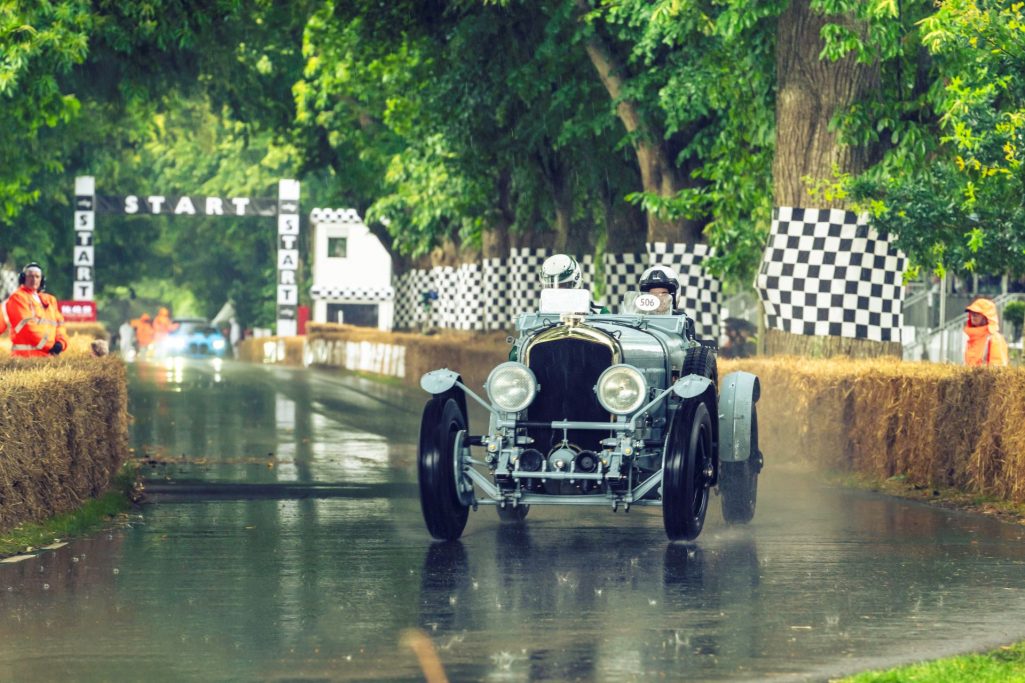
This year’s Goodwood Festival of Speed witnessed the grand global debut of Mulliner’s Speed Six Continuation Series. The meticulously crafted Bedford Grey 205 bhp ‘Factory Works’ car, the second of two development prototypes, successfully completed eight runs up the iconic Goodwood hill climb without a hitch. This accomplishment marked the final significant shakedown for Mulliner’s latest masterpiece, sealing its readiness for the racing world.
Rigorous Testing and Durability Proven
Car Zero, the principal engineering test prototype of the Speed Six Continuation Series, has undergone an exhaustive series of tests both on the dyno and racetrack, emerging victorious. With these trials completed, work has now commenced on the twelve customer cars, each tailored to its owner’s specifications with a choice of period-correct finishes and materials.
Conquering Diverse Road Conditions
Following an initial 1,000-kilometre shakedown near Mulliner’s Crewe base, Car Zero embarked on an 8,000 km journey of intensive mileage accumulation at Millbrook Proving Ground. The rigorous test schedule included Belgian pavé, the challenging Alpine course, multiple Vmax (top speed) test runs, and unmetalled surfaces reminiscent of the roads Bentley drivers tackled in the 1920s. By the end of this demanding programme, Car Zero had covered 11,700 km of intensive test mileage, equivalent to ten return journeys from Crewe to Le Mans, or 30,000 km under normal driving conditions.
Unmatched Racing Performance
With mileage accumulation complete, Car Zero was handed over to a team of professional drivers. During a six-hour continuous racing simulation at Goodwood Motor Circuit, Car Zero covered 500 km and 130 laps in a single session, mirroring the performance of six consecutive Vintage races at the Goodwood Revival. Throughout this rigorous session, Car Zero maintained impeccable performance, consistently matching recent Goodwood lap times of original pre-war Bentleys. All customer Speed Sixes will be scrutineered by Motorsport UK to FIA Appendix K regulations, ensuring their authenticity and eligibility for competition.
Ultimate Engine Endurance
The 6,597cc straight-six engine of the Speed Six, originally designed by W.O. Bentley, powered the most successful Bentley race car of the Cricklewood era. Adhering strictly to the original specifications and drawings, Mulliner’s team crafted the first brand new Speed Six engine in nearly a century from over 600 new components, including the engine block. Utilizing Crewe’s state-of-the-art engine dynamometers, the engineering team devised a continuous 20-hour dyno test programme, covering a range of engine speeds and loads. After two such test cycles and 40 hours of running, the new Speed Six engine consistently delivered the set power and torque targets with total reliability.
Crafting the Future
Work on the first customer cars of the Speed Six Continuation Series is now underway at Mulliner Classic, with the first delivery scheduled for autumn. Though faithful to the original design, the Speed Six Continuation Series benefits from modern advancements. As Mulliner Special Project Leader Ben Linde explains, “Today’s machine tools offer more precision than those of the Cricklewood works, and modern lubricants further enhance performance. All Speed Six Continuation cars will operate smoothly on standard unleaded fuel and come equipped with new tyres that feature period-correct tread patterns.”
A Nod to a Glorious Past
On 22 June 1930, Bentley Chairman Woolf Barnato and co-driver Glen Kidston clinched victory at Le Mans, driving a Team Bentley Speed Six to cover a record 2,930 km at 122.111 km/h. According to Ben Linde, the twelve Speed Six Continuation Series cars currently being crafted at Mulliner Classic will be more than capable of replicating that historic feat. “The Speed Six epitomized Bentley race engineering in the 1920s,” he notes. “You could drive it to Le Mans, race for 24 hours, and then drive home with the winner’s trophy on the back seat. The Speed Six Continuation Series captures that spirit faithfully, utilizing the tools, techniques, and engineering drawings of the time.”


