



In a significant stride toward the future of near-space tourism, Frank Stephenson Design has unveiled the interior of HALO Spaceflight’s innovative space capsule, named “The Aurora,” in London on April 11, 2024. This landmark reveal showcases a harmonious blend of luxury, safety, and cutting-edge design, setting a new standard for passenger experience in space travel.
“The Aurora” stands out as a masterpiece of design ingenuity, integrating advanced materials, technology, and design principles. Frank Stephenson Design’s partnership with HALO Space has resulted in a capsule that emphasizes comfort, luxury, lightness, and safety, ensuring an unparalleled journey through the cosmos.
Frank Stephenson, the visionary behind the design, expressed the complexity and excitement of creating an interior that meets rigorous safety standards and weight considerations while providing a visually stunning and functional space for passengers. “The challenge was immense, but the outcome is something we are profoundly proud of,” he remarked.
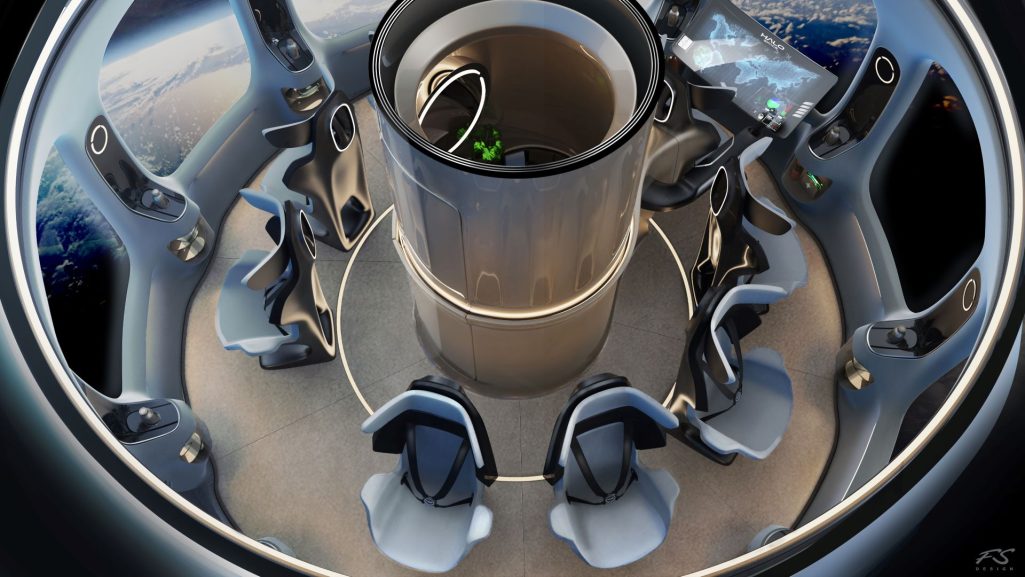
The capsule is engineered with lightweight aluminium alloy and composites, allowing for a total launch weight of 3,500 kilograms. It comfortably accommodates eight passengers and a pilot within a spacious interior, complemented by large windows totaling 2.82 square meters for unparalleled views of Earth from space.
Carlos Mira, CEO of HALO Space, emphasized the capsule’s fusion of luxury, elegance, safety, and functionality. “Frank and his team have transcended traditional design boundaries to deliver an unforgettable spaceflight experience,” Mira said.
Drawing aesthetic cues from Space Age architecture, “The Aurora” features curved lines, reflective materials, and a seating arrangement designed to enhance viewing angles, mirroring the majestic sweep of the Milky Way.
HALO Space’s commercial flights promise a unique ascent experience, utilizing a helium balloon for a smooth, low-G journey to heights of up to 35 km, with flight durations of 4–6 hours. This venture not only opens the doors to space tourism for a broader audience but also aims to democratize space travel by 2030, targeting 10,000 passengers and introducing initiatives to overcome financial hurdles for aspiring space explorers.
Comments
Newest firstLoading comments…